
Toys“R”Us Opens 120 New Stores in 2026: What Its Retail Comeback Means for Legacy Brands

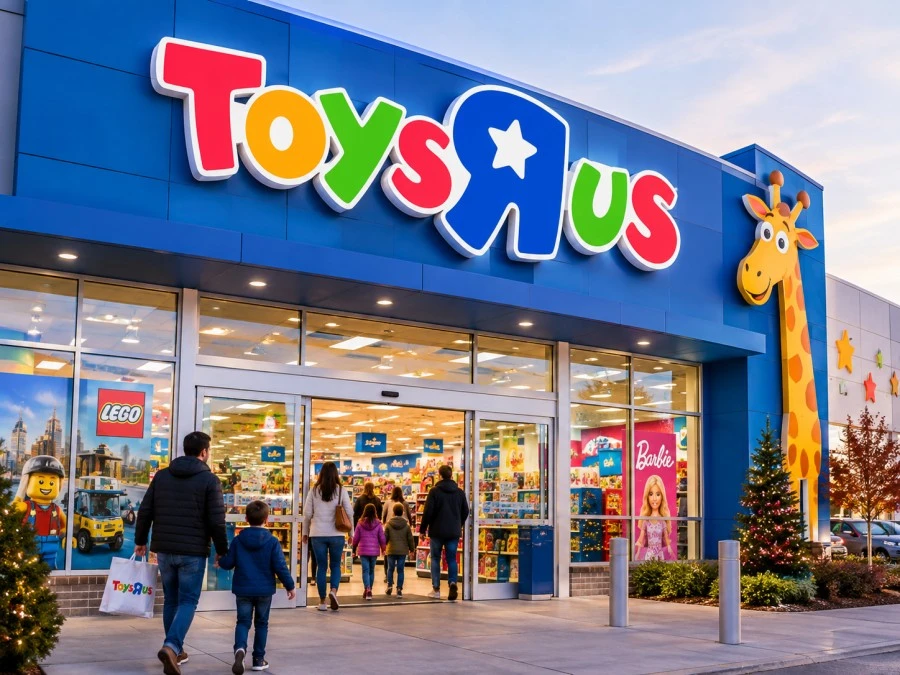
Toys“R”Us is adding 120 standalone U.S. stores for the 2026 holiday season, taking its standalone footprint to 160 locations through a partnership with Go! Retail Group. The larger business question is whether partnerships, multiple retail formats and experiential stores can produce durable economics without recreating the operating model that preceded the company’s 2017 bankruptcy.
For executives managing legacy brands, the Toys“R”Us expansion offers a useful test case: brand recognition can create an opening, but repeat customer demand and store-level economics determine whether a comeback can scale.
Boardroom Briefing: What Executives Should Know
- Toys“R”Us plans to increase its standalone U.S. store count from 40 to 160 for the 2026 holiday season, with Go! Retail Group handling the new-store rollout.
- Partnerships are central to the strategy, spanning standalone stores, Macy’s shop-in-shops, airport locations and Navy Exchange locations.
- Experiential retail is becoming part of the format, with select locations adding Creator Studios, cafés and candy shops.
- Market timing is favorable but not risk-free: Forbes reports Circana data showing U.S. toy sales rose 17% in the first half of 2026, while average selling prices increased 4%.
- Scale remains different from sustainability. The company has announced the store expansion, but public reporting does not establish the long-term profitability of every new location. Fox Business noted that the company had not provided a complete list of locations, opening dates or store sizes in its announcement.
- The historical lesson remains relevant: the U.S. business filed for bankruptcy in 2017 and liquidated its U.S. stores in 2018 before the brand was acquired by WHP Global in 2021.
Toys“R”Us Is Not Rebuilding the Old Retailer; It Is Testing a Distributed Model
Toys“R”Us is rebuilding its U.S. presence through multiple retail formats rather than relying on a single traditional store network. The company announced 120 new standalone stores for the 2026 holiday season, bringing its planned standalone U.S. total to 160, with Go! Retail Group handling the rollout.
The distinction matters because the current strategy extends beyond standalone stores. Toys“R”Us is combining those locations with shops inside Macy’s, airport shop-in-shops and Navy Exchange locations. The company also continues to operate e-commerce and a broader international retail business.
From Bankruptcy to Brand Reconstruction
The current U.S. expansion follows a multiyear effort to rebuild Toys“R”Us after its 2017 bankruptcy and 2018 U.S. store liquidation. WHP Global acquired a controlling interest in the brand in 2021 and subsequently expanded its U.S. presence through locations including Macy’s and standalone stores.
The financial history is important because the current strategy should not be evaluated simply as a return to the company’s former footprint. The business is being rebuilt under a different ownership and distribution structure.
That distinction also matters for executives studying legacy-brand turnaround strategy. A company recovering from a failed operating model does not necessarily need to recreate every part of the model that came before it.
The relevant question is narrower: which parts of the brand still generate measurable customer demand, and which operating structures can deliver that demand profitably?
Why the 160-Store Number Matters Less Than the Format Mix
A 160-store footprint is a scale metric, not a profitability metric. Executives evaluating the expansion should focus on store productivity, inventory turnover, occupancy costs, repeat customer behavior and the relationship between physical and digital sales.
A diversified format strategy can provide more ways to reach customers, but it also creates more variables to measure. A standalone store has different economics from a shop-in-shop inside Macy’s. An airport location has different customer behavior from a suburban destination store.
That makes omnichannel retail strategy relevant to the case. The objective is not simply to maximize physical locations. It is to determine which combination of channels produces sustainable customer acquisition, conversion and retention.
The Economics Behind the Comeback: Can Physical Retail Become an Asset Again?
Physical retail becomes strategically valuable when stores generate profitable transactions while also supporting customer acquisition, brand engagement and omnichannel demand.
The category backdrop gives Toys“R”Us a meaningful test environment. According to Circana data cited by Forbes, U.S. toy sales increased 17% during the first half of 2026, while the average selling price increased 4%.
Broader U.S. retail demand also showed strength in August. Reuters reported that retail sales increased 1.2% month over month, while core retail sales increased 1.4%. Reuters also reported that inflation and pressure on household purchasing power remained concerns.
That combination creates an important distinction for executives. Strong category sales can support a store expansion, but management still needs to establish whether customer demand remains strong after seasonal traffic and promotional activity normalize.
Partnership-Led Expansion vs. Traditional Retail Buildout
Toys“R”Us is using a retail operating partner to accelerate its 2026 standalone-store rollout rather than rebuilding the entire physical network internally. Go! Retail Group says it has operated pop-up stores across six countries since 1993 alongside year-round retail, e-commerce and wholesale operations.
That structure can give a legacy brand access to operating capabilities without requiring every function to be rebuilt from scratch.
It also creates a potential testing mechanism. Different markets can reveal which store formats, assortments and customer experiences generate repeat demand before the company commits to broader infrastructure.
For executives considering an asset-light growth strategy, the useful principle is not that partnerships automatically reduce risk. The useful principle is that partners can provide specialized operating capabilities while management retains a framework for measuring performance.
The financial scorecard should include:
- Four-wall operating profit
- Sales per square foot
- Inventory turnover
- Occupancy cost as a percentage of sales
- Repeat customer rate
- Digital-to-store and store-to-digital conversion
- Customer acquisition cost
- Customer lifetime value
A larger footprint should follow evidence of repeatable unit economics rather than substitute for it.
Experiential Retail Is Becoming Part Store, Part Media Platform
Toys“R”Us is adding experiential elements because select stores are being designed to support content creation, events and customer engagement alongside traditional retail transactions. The company says some locations will include Creator Studios, cafés and candy shops.
The Creator Studios are particularly relevant to consumer-brand executives. Toys“R”Us describes them as spaces where influencers, creators and toy brands can create content, introduce products and host launches and events.
The concept changes the potential role of a store.
A conventional retail location primarily converts foot traffic into purchases. A content-enabled location can also generate product demonstrations, creator collaborations, events and social distribution.
That is the business case behind experiential commerce. Physical space can serve multiple functions when customer engagement itself becomes part of the commercial proposition.
Why Creator Studios Matter Beyond Toys
Creator Studios connect physical retail with digital customer acquisition by turning selected stores into spaces for product launches, content production and events. The model gives brands and creators a physical setting that can generate both in-store engagement and digital content.
The approach is being tested rather than presented as a universal store format. Forbes reported that Toys“R”Us is launching Creator Studios at five existing locations.
That test is strategically important.
A CMO should not measure the concept only through impressions or social engagement. The more useful metrics are incremental customer acquisition, conversion, repeat visits and sales attributable to the activity.
For a COO, the question is different: does the additional space generate enough economic value to justify its footprint?
For a CFO, the question is whether the format creates measurable incremental contribution after staffing, buildout and operating costs.
The strongest retail experiments answer all three questions.
The Contrarian Case: Nostalgia Can Open the Door, but It Cannot Carry the P&L
Nostalgia can generate awareness and initial traffic, but it cannot by itself produce sustainable retail economics.
Toys“R”Us has retained significant consumer recognition despite the closure of its former U.S. store network. The brand’s current expansion is explicitly built around that existing recognition, while the new stores add products, experiences and multiple channels.
The commercial challenge is converting awareness into recurring behavior.
A former customer may visit because of childhood memories. A sustainable retailer needs customers to return because the assortment, pricing, convenience and experience remain relevant.
The Nostalgia Trap
Brand equity is valuable, but brand awareness is not the same as current product-market fit.
That distinction applies well beyond retail. A restaurant can retain a famous name while losing traffic. A software company can retain brand recognition while its product becomes less competitive.
The executive question is always behavioral: What does the brand cause customers to do today?
Toys“R”Us is attempting to answer that question through a combination of recognizable toy brands, physical discovery and new experiences. The company says its new stores will feature brands including LEGO, Barbie, Hot Wheels and Pokémon.
The relevant test is not whether customers remember Toys“R”Us. The relevant test is whether customers repeatedly choose it.
What Could Still Go Wrong
The principal execution risk is that holiday traffic could make a large store rollout appear stronger before recurring demand and store-level economics have been established.
Fox Business reported that Toys“R”Us had not disclosed a complete list of the 120 locations, their opening dates or store sizes in its announcement. It also reported that the company had not specified whether all 120 stores would remain open after the holiday season.
That makes post-holiday performance particularly important.
Executives should monitor sales after the seasonal peak, inventory productivity, lease commitments, repeat customer behavior and the contribution of each format.
The 2026 holiday period can establish whether the stores attract customers. The months afterward will provide a better indication of whether the underlying economics are repeatable.
The Legacy-Brand Playbook: What Toys“R”Us Can Teach Other Turnaround Leaders
Legacy brands can rebuild relevance by restoring distribution selectively, testing formats through partners and measuring customer behavior before committing to permanent scale.
Rebuild Distribution Before Rebuilding Scale
Legacy brands can use flexible distribution to test where existing brand equity still converts into current customer demand.
The objective is not to reproduce the historical footprint automatically. It is to identify the channels and markets where customer demand can support profitable operations.
That can include shop-in-shops, pop-ups, airport locations, partnerships or digital channels before a company makes larger fixed commitments.
Use Partners to Test Demand Before Committing to Permanent Infrastructure
Operating partners can provide specialized retail capabilities while giving a legacy brand another mechanism for testing demand across locations and formats.
The partnership with Go! Retail Group illustrates this approach. Go! Retail Group brings experience across pop-up and year-round retail formats, while Toys“R”Us retains the consumer brand and merchandise proposition.
The critical requirement is measurement.
A partnership should provide management with enough operational and financial visibility to determine which locations work and why.
Turn Physical Locations Into Customer-Experience and Content Assets
Physical locations can generate value beyond transactions when they support discovery, events, creator activity and customer acquisition.
The Toys“R”Us Creator Studio concept provides one example. A store can become a location for product launches and content production while remaining a conventional retail environment.
That does not make experiential investment automatically profitable.
It makes measurement more important.
The Strategic Playbook for CEOs Rebuilding a Legacy Consumer Brand
A legacy-brand turnaround should move through diagnosis, controlled testing, measurement and selective scaling rather than immediate footprint expansion.
Leadership teams evaluating a similar strategy should use five steps:
- Diagnose the original failure. Separate brand problems from financing, operating, merchandising and distribution problems.
- Preserve the highest-value brand assets. Identify the names, products, communities and experiences that still create measurable demand.
- Test flexible distribution. Use pop-ups, partnerships, shop-in-shops or digital channels before making large fixed commitments.
- Measure unit economics before accelerating. Track store productivity, customer retention, inventory turns and contribution margins by format.
- Scale only repeatable formats. A successful pilot should produce a model that can be reproduced without exceptional circumstances.
This is the operating logic behind a consumer brand turnaround strategy.
For CFOs, the framework separates brand investment from infrastructure investment.
For CMOs, it connects awareness to measurable customer action.
For COOs, it establishes whether a format can operate profitably at scale.
For CEOs, it creates a decision framework for moving from experimentation to expansion.
The Executive Outlook: Toys“R”Us Is Testing Whether Brand Equity Can Be Converted Into Modern Retail Economics
The Toys“R”Us comeback will be measured less by the 120-store announcement than by what those stores prove after the holiday season.
Toys“R”Us says its global business generates more than $2 billion in annual retail sales through more than 1,680 stores and e-commerce businesses across 37 countries. That is a company-provided figure and covers the global business rather than the new U.S. stores alone.
The U.S. strategy is also diversified. Standalone stores are being combined with Macy’s shops, airport retail and Navy Exchange locations, giving the brand multiple physical distribution channels.
That creates a useful case for the wider retail industry.
The central question is no longer whether a famous legacy brand can come back. It is whether brand equity can be converted into repeatable unit economics under modern retail conditions.
For executives managing another legacy brand, the practical lesson is to measure the comeback through store productivity, customer retention, inventory discipline and format-level profitability, not store count alone.