Why Europe’s Oldest Industrial Giant Is Splitting Its Empire to Create a High-Yield Real-Asset Pure Play

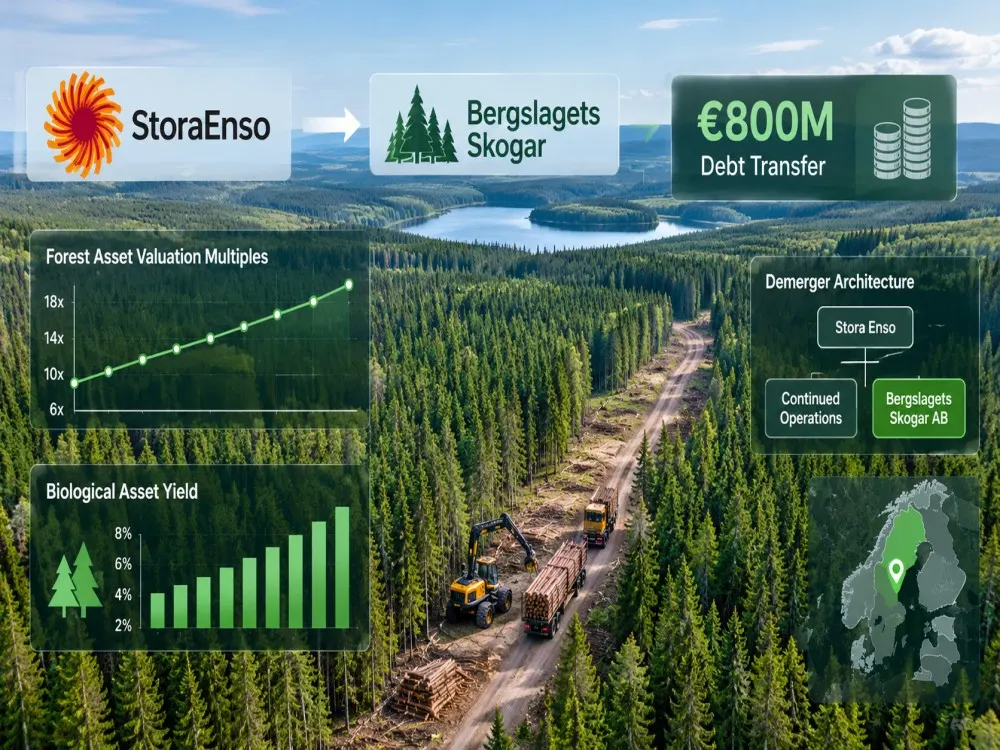
Heavy industrial conglomerates across Europe and North America face steep valuation discounts as public equity markets penalize balance-sheet complexity and cyclical manufacturing margins tied to capital-intensive fixed assets. Bundling inflation-hedging biological land holdings with commodity-exposed manufacturing operations depresses overall enterprise multiples and traps balance-sheet equity inside low-multiple manufacturing valuations. Stora Enso’s approved demerger of its Swedish forest assets into Bergslagets Skogar provides an executive masterclass in how legacy conglomerates can decouple cyclical operations, reallocate roughly €800 million in net debt, and carve out pure-play, high-yield natural assets with 80% to 100% dividend payout mandates.
Boardroom Briefing
- Conglomerate discount unbundling takes center stage as Stora Enso’s board formally approved the separation of €8.4 billion in biological forestry assets from core industrial packaging and biomaterials.
- Balance sheet deleveraging transfers approximately SEK 9.1 billion (roughly €800 million) in net debt to the new entity, accelerating Stora Enso’s path toward an investment-grade leverage profile.
- Capital return mandates commit Bergslagets Skogar to distribute 80% to 100% of adjusted net income, creating a specialized yield vehicle targeted at institutional real-asset allocators.
- Supply agreement commercialization replaces captive feedstock with arms-length, market-indexed bilateral contracts representing 9% of Stora Enso’s regional wood requirements.
- Governance momentum enters its final phase with an Extraordinary General Meeting scheduled for December 15, 2026, backed by core anchor shareholders controlling 69.9% of total voting rights.
The Sum-of-the-Parts Arbitrage: Why Legacy Industrial Conglomerates Are Breaking Up
Industrial conglomerates execute pure-play spin-offs to eliminate conglomerate valuation discounts by separating capital-intensive, cyclical manufacturing operations from stable, cash-generative real assets that trade at premium valuation multiples. For decades, integrated paper, packaging, and forestry producers held commercial timberlands as internal strategic reserves to feed pulp mills. Modern public markets evaluate those two business models through entirely divergent valuation lenses. High-margin packaging and biomaterials lines trade on operational EBITDA multiples, where market fluctuations in consumer demand generate direct earnings volatility.
Forestland functions as an asset-backed inflation hedge characterized by predictable biological growth, low operational volatility, and steady land value appreciation. When held together within an operational corporate structure, institutional investors apply an aggregate holding-company discount that undervalues the underlying timber assets. Corporate boards are adopting corporate portfolio restructuring models
to split integrated operations into focused entities. Dividing the business allows the market to re-rate each entity according to its own risk profile, cost of capital, and investor base.
The transaction formally approved by Stora Enso’s Board of Directors on October 30, 2026, proves this capital strategy. By separating its Swedish forest holdings into Bergslagets Skogar AB, Stora Enso establishes Europe’s largest listed pure-play forest owner with an asset fair value of €8.4 billion, representing roughly €10.66 per share. As Hans Sohlström, President and CEO of Stora Enso, stated: “We have now formally decided to proceed with the planned separation of Bergslagets Skogar, creating two independent companies with distinct operational profiles and building a stronger Stora Enso.”
The Economics of Unbundling: Transferring Debt and Optimizing Capital Structures
Transferring debt to a newly capitalized carve-out lowers the parent company’s net debt-to-EBITDA ratio, directly expanding its borrowing headroom and freeing up operational cash flow for core business reinvestment. In capital-intensive industrial sectors, carrying heavy leverage across cyclical downswings exposes corporations to credit downgrades and elevated debt service burdens. The demerger structure rebalances the group’s capital structure by shifting SEK 9.1 billion (around €800 million) of parent net debt directly onto Bergslagets Skogar.
Bergslagets Skogar will support this balance sheet through dedicated bank term facilities of up to SEK 9.5 billion. Because biological forest assets provide exceptional balance-sheet stability and liquid underlying collateral value, the spin-off can service fixed liabilities with minimal operational disruption. The new entity operates under a conservative financial policy that caps its Net Loan-to-Value (LTV) ratio between 0% and 20%.
For Stora Enso, shedding €800 million in net liabilities immediately improves its leverage metrics and restores financial agility. Rather than servicing legacy balance-sheet obligations, the parent company retains cash flow to defend margins, modernize packaging facilities, and fund research into renewable biomaterials. Boardrooms utilizing balance-sheet deleveraging frameworks
recognize that loading debt onto cash-stable real assets optimizes interest coverage across the entire corporate structure.
Engineering the Pure-Play Yield Engine: Inside Bergslagets Skogar’s Distribution Model
Bergslagets Skogar’s dividend policy targets distributing 80% to 100% of adjusted net income as ordinary dividends, excluding volatile biological fair-value markups to ensure stable, real-cash shareholder distributions. Real-asset portfolio managers require predictable cash conversion rather than accounting-driven non-cash gains. To satisfy this institutional demand, the board built a payout formula that strips out unrealized fair-value adjustments under IAS 41, profits or losses from land divestments, and post-tax reforestation capital expenditures.
The strategic financial targets for Bergslagets Skogar establish clear operating boundaries:
- Net Standing Stock Growth: Target net standing volume expansion of 1% per annum, ensuring that annual timber harvest volumes never exceed natural annual forest regeneration rates.
- Cash Return Benchmarks: Achieve a long-term annual free cash flow return of 2% on total forest assets, generated entirely through commercial wood trade and surface monetization.
- Distribution Discipline: Distribute 80% to 100% of adjusted net income through ordinary dividends to establish a high-yield vehicle for defensive capital allocators.
- Leverage Ceilings: Maintain a conservative Net Loan-to-Value (LTV) ratio between 0% and 20% to safeguard investment-grade debt access through fluctuating macroeconomic cycles.
Biological Asset Accounting vs. Free Cash Flow: Managing Harvest Rates and Valuation Swings
Biological asset accounting under international financial reporting standards introduces major swings to net earnings because standing timber must be marked to market based on discounted cash flow projections. A sudden drop in global pulp prices can force paper write-downs even while biological timber volumes continue to grow physically. Bergslagets Skogar resolves this accounting friction by isolating real operational cash generation from statutory valuation adjustments. This financial discipline guarantees that the targeted 2% free cash flow yield translates into tangible cash payouts rather than volatile paper profits.
Monetizing the Surface: Renewable Energy Leases and Biodiversity Credits as Cash Flow Multipliers
Modern forestland generates cash flow well beyond physical roundwood sales. Surface rights are rapidly converting into renewable infrastructure corridors that command premium yields. Tuomas Hallenberg, Chief Executive Officer of Bergslagets Skogar, emphasized this commercial evolution: “As Europe’s largest listed pure-play forest owner, we expect to combine stable cash flow generation from responsible wood trade with opportunities to create additional value through renewable energy and future climate solutions.”
Long-term leases for utility-scale onshore wind farms, grid-scale battery storage, and institutional carbon credits provide long-duration, high-margin cash flows that carry zero operational harvesting overhead. Integrating commercial land leases with natural-asset yield optimization
allows pure-play landholders to build revenue streams that remain insulated from timber commodity market fluctuations.
The Supply Chain Counter-Risk: What Happens When Captive Feedstock Becomes a Third-Party Expense?
The primary risk of an industrial asset carve-out is the permanent loss of captive raw materials, forcing downstream manufacturing plants to purchase fiber at market-indexed prices and absorb higher input cost volatility. When an industrial prime owns its timberland, it retains an internal supply hedge against regional pulpwood shortages. Once that timberland trades as a separate publicly listed company, fiduciary responsibility compels its management team to maximize selling prices on every cubic meter of wood.
Treating captive natural resources as internal cost centers fails because operational divisions prioritize short-term harvest extraction over long-term biological capital appreciation, depressing total asset valuation. Stora Enso addressed this operational risk by establishing a multi-year Long-Term Supply Agreement (LTSA) prior to the demerger approval. The agreement secures roughly 9% of Stora Enso’s regional Nordic wood supply on commercial, arms-length terms.
Downstream paper and packaging mills retain guaranteed volume access while agreeing to market-priced transactions that eliminate artificial internal subsidies. Industrial operators implementing mitigating supply chain price volatility
strategies understand that replacing captive cost structures with indexed bilateral contracts enforces supply chain discipline and reveals the true economic margins of manufacturing assets.
The Nordic Blueprint: Cross-Border Demerger Mechanics and Tax-Neutral Structuring
Partial cross-border demergers function by transferring specific asset clusters and corresponding debt facilities into a newly incorporated entity while distributing shares to existing equity holders on a tax-neutral, pro-rata basis. Executing an asset unbundling of this scale requires strict alignment across multiple jurisdictions. Stora Enso utilized the partial demerger provisions under the Finnish Companies Act while preparing dual listings for Bergslagets Skogar on both Nasdaq Stockholm and Nasdaq Helsinki.
Cross-border tax execution represents the central pillar of the transaction. Stora Enso secured binding advance tax rulings from Finnish and Swedish tax authorities to confirm that the demerger qualifies for corporate income tax neutrality across both markets. Under this legal framework, Stora Enso shareholders receive one new share in Bergslagets Skogar for each existing share held, without triggering taxable capital gains events at the corporate or shareholder level.
Shareholder governance has moved in lockstep with executive execution. Institutional anchors Solidium Oy and Wallenberg Investments Holdings AB, alongside Nordic pension funds representing 28.6% of equity capital and 69.9% of voting rights, have formally committed to support the transaction at the Extraordinary General Meeting on December 15, 2026. This overwhelming investor backing clears the operational path for full legal separation and public listing by March 31, 2027. Corporate leaders executing strategic cross-border tax engineering
view this transaction as an institutional benchmark for executing complex multi-market carve-outs without equity dilution.
The Corporate Demerger Playbook: A Boardroom Guide to Unlocking Latent Asset Value
Corporate portfolio restructuring dictates that transferring non-core infrastructure or real-asset holdings to a dedicated entity can reduce a parent industrial firm’s net leverage ratio by over 0.5x to 1.0x EBITDA while capturing higher sum-of-the-parts market valuations. Corporate boards evaluating corporate carve-outs must follow a structured four-stage execution methodology:
- Identify Mispriced Balance Sheet Assets: Conduct a rigorous sum-of-the-parts assessment to identify biological, infrastructure, or real estate assets whose capital profiles conflict with cyclical operational units.
- Structure Asset-Backed Debt Transfer: Rebalance group liabilities by moving non-recourse debt packages onto the spin-off entity, sized to maintain conservative LTV ratios that ensure low debt service costs.
- Formalize Commercial Offtake Agreements: Replace internal intercompany transfers with multi-year, market-indexed bilateral contracts that protect supply security while establishing clean operational accounting.
- Establish Transparent Capital Return Mandates: Build investor confidence by implementing strict capital allocation and dividend discipline, tying distributions to cash flow metrics that exclude non-cash mark-to-market fluctuations.
Executing this four-step process eliminates corporate discount penalties, aligns distinct investor bases, and creates transparent performance accountability across every operational division.
The Executive Horizon: Natural Capital as the Boardroom’s Ultimate Inflation Hedge
A real-asset pure-play spin-off is defined as a corporate restructuring mechanism whereby an enterprise separates tangible physical or biological assets from operational manufacturing lines to create an independent, asset-backed company targeted at yield-oriented investors. As institutional pension funds and sovereign wealth allocators seek inflation-protected, cash-generative assets, biological holdings have moved from operational cost centers into core institutional holdings.
The listing of Bergslagets Skogar marks a turning point in global industrial capital allocation. Decoupling €8.4 billion in forestry assets from industrial manufacturing eliminates holding discounts, offloads €800 million in debt, and launches a self-funding yield vehicle. For enterprise executives, this demerger establishes a clear strategic precedent: in capital markets shaped by elevated interest rates and compressed margins, sustained shareholder value comes from operational focus and aggressive capital unbundling.