
Why SoftBank and Japan’s Top Research Lab Are Wiring Quantum Hardware Directly into AI Data Centers

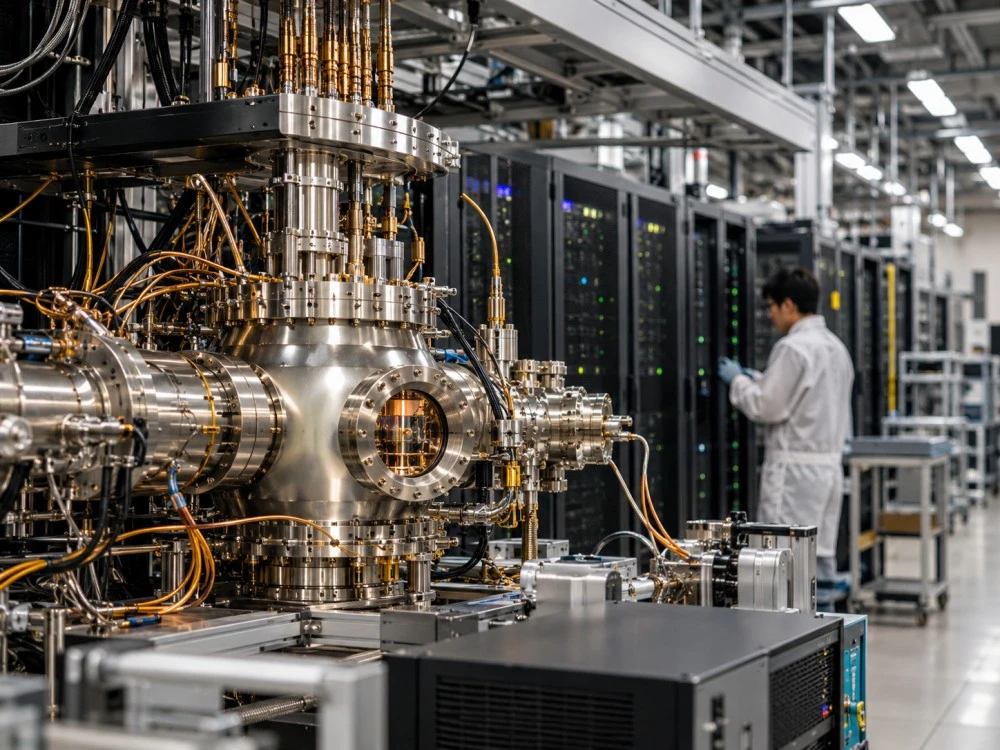
As hyperscale AI training clusters collide with thermal dissipation thresholds and utility-scale power shortages, SoftBank Corp. and Japan’s national research institute RIKEN have completed the integration of Quantinuum’s 56-qubit System Model H2, known as “Reimei,” directly into supercomputing and commercial AI data center environments. While enterprise IT roadmaps remain fixated on procurement cycles for next-generation silicon, conventional GPU architectures face exponential degradation when computing high-dimensional combinatorial problems, chemical dynamics, and topological data structures. This briefing deconstructs the architectural mechanics, power economics, and hybrid orchestration frameworks underpinning the RIKEN-SoftBank deployment, delivering an executive roadmap for integrating quantum coprocessors into enterprise AI infrastructure before 2030.
Boardroom Briefing
- Hybrid Quantum-AI Infrastructure: The RIKEN-Quantinuum-SoftBank deployment transitions quantum hardware from isolated physics laboratories into active, rack-adjacent coprocessors inside production data centers. It proves that quantum hardware can operate as a co-located accelerator alongside classical supercomputing nodes.
- Compute Density Economics: Offloading combinatorial state-space calculations to trapped-ion hardware avoids the severe power penalties incurred when forcing classical GPU clusters to run brute-force mathematical simulations. A hybrid partition reduces total runtime and kilowatt-hour consumption for specific scientific algorithms.
- Sovereign AI Infrastructure: Japan’s Ministry of Economy, Trade and Industry (METI) and NEDO are funding this initiative to anchor sovereign compute independence. The deployment protects domestic enterprise capabilities from global supply chain chokepoints and overseas silicon monopolies.
- Hybrid Orchestration Latency: The decisive technical challenge is no longer raw qubit volume, but bus latency and synchronization between classical memory pools and quantum control electronics. Bridging this gap requires specialized software platforms like Quantinuum Nexus to coordinate distributed job schedules.
- Capital Allocation Timelines: Enterprise technology executives must view 2026 through 2028 as an active operational window for algorithmic hybridization rather than a speculative evaluation phase. Organizations that fail to identify hybrid-compatible workloads risk obsolescence when fault-tolerant coprocessors enter commercial production.
The Convergence of Reimei and Fugaku: Anatomy of an Operational Hybrid Supercomputer
The Reimei-Fugaku hybrid platform is RIKEN’s operational compute architecture linking Japan’s flagship Fugaku classical supercomputer with Quantinuum’s 56-qubit System Model H2 trapped-ion quantum computer to execute concurrent classical-quantum workloads. Rather than treating quantum processors as isolated, cloud-accessible novelties, the deployment physically and logically anchors Quantinuum’s hardware at RIKEN’s Wako campus while bridging high-speed links to the Fugaku supercomputer at the RIKEN Center for Computational Science in Kobe.
Reimei & Fugaku Hybrid Supercomputing Model
• 99.9% Two-Qubit Gate Fidelity for deep, low-error circuit depth
• Dedicated execution of high-dimensional non-polynomial state-space kernels
The upgrade replaces the earlier System Model H1, quadrupling the accessible state space and delivering all-to-all qubit connectivity through a trapped-ion Quantum Charge-Coupled Device (QCCD) architecture. “Since its installation in February 2025, Reimei H1 has been widely used by JHPC-quantum users,” noted Dr. Mitsuhisa Sato, Division Director of the Quantum-HPC Hybrid Platform Division at RIKEN. “The upgrade to H2 is exactly what we have been eagerly anticipating, and with its 56 qubits, we expect it to play a key role in demonstrating quantum advantage through quantum-HPC hybrid computing.”
Treating quantum computers as standalone mainframe replacements fails because quantum processors lack high-bandwidth memory hierarchies and are structurally optimized to operate solely as specialized coprocessors for classical accelerated computing. The operational model deployed by RIKEN does not assign entire programs to quantum hardware. Classical CPU and GPU clusters handle data ingestion, linear algebra, control flow, and error parsing, while offloading narrow, non-polynomial mathematical calculations to the trapped ions of the H2 core.
The Kilowatt Wall: Why Silicon Alone Cannot Power the Next Phase of Enterprise AI
The compute kilowatt wall is the physical power and thermal dissipation ceiling where scaling classical silicon clusters produces diminishing computational returns for exponential energy expenditure. Modern hyperscale facilities housing tens of thousands of accelerated GPUs are running directly into regional grid capacity caps, requiring hundreds of megawatts to sustain model training runs.
According to a 2026 International Energy Agency (IEA) analysis, data center electrical demand is on track to surpass 1,000 terawatt-hours globally, driven by dense AI infrastructure. This consumption trajectory forces enterprise operators to confront escalating data center power consumption limits
across every tier-one metropolitan market. The financial fallout is immediate: escalating energy utility tariffs and cooling requirements are driving up total cost of ownership, transforming enterprise GPU allocation and cloud CapEx into boardroom-level balance-sheet liabilities.
Hyperscale data center economics dictate that once a combinatorial computational problem scales past 50 active variables, hybrid quantum coprocessing reduces per-job energy consumption by orders of magnitude relative to dense GPU clusters. While modern silicon processors excel at highly parallel matrix multiplications, they burn gigawatts of electricity attempting to simulate complex quantum molecular states or non-deterministic polynomial-time (NP-hard) optimizations. Offloading these specific bottlenecks to a 56-qubit QCCD processor collapses the runtime from weeks of multi-node GPU compute to seconds of trapped-ion gate operations, preserving power reserves for mainstream inference workloads.
Deconstructing the Hybrid Architecture: Interconnects, Co-processors, and Runtime Control
A Quantum-AI Hybrid Data Center is defined as a unified compute facility that colocates high-performance classical clusters with quantum processing units (QPUs), orchestrating workloads dynamically via low-latency hybrid compilers. Moving quantum hardware from research laboratories into enterprise facilities requires resolving physical and logical separation challenges.
Architectural Integration: Deconstructing SoftBank’s Quantum-AI Interconnect Architecture
SoftBank connects quantum processors directly to AI data centers by establishing dedicated low-latency optical connections between trapped-ion hardware and classical GPU clusters to offload mathematically intractable simulation tasks. Under its “Activate AI for Society” initiative, the telecommunications group is building out an operational deployment blueprint that links regional enterprise facilities to RIKEN’s quantum core.
Trapped-ion systems require ultra-high vacuum environments and precise laser control systems, preventing their installation directly into standard server racks. SoftBank’s architecture resolves this physical boundary by integrating next-generation data center networking fabrics that connect high-speed optical transceivers to classical host controllers. This architecture reduces transfer latencies to microseconds, enabling real-time data exchange between classical servers and quantum processors without exposing the quantum hardware to electrical or thermal interference.
Runtime Orchestration: Middleware, Latency Management, and Workload Routing
The primary technical bottleneck in quantum data center deployment is orchestration latency and control-plane synchronization, which dictates how rapidly classical high-performance memory buffers can transfer state data to quantum control electronics without idling classical server racks. If a GPU cluster must wait hundreds of milliseconds for a quantum circuit to initialize and measure, the economic benefits of the acceleration evaporate.
The Reimei-Fugaku orchestration layer functions by utilizing classical supercomputing nodes to parameterize quantum circuits, executing the state calculation on Quantinuum’s H2 trapped-ion core, and streaming measurements back to GPU memory for downstream AI model inference. The execution loop relies on the Quantinuum Nexus platform, which serves as a unified control plane. The software dynamically parses code, identifies mathematical operations suited for quantum execution, compiles the instructions into native pulse sequences, and coordinates job queues between Fugaku’s CPU nodes and Reimei’s 56 qubits.
The “Qubit Vanity Metric”: Why Gate Fidelity and Coherence Sinks Outweigh Raw Hardware Scale
The qubit vanity metric refers to the misleading practice of evaluating quantum hardware solely by raw physical qubit counts rather than two-qubit gate fidelity, coherence duration, and quantum error correction overheads. Mainstream coverage frequently champions platforms boasting hundreds or thousands of noisy physical qubits, overlooking the operational reality that without sufficient gate precision, deeper computational circuits degrade into random noise.
The Quantinuum System Model H2 prioritizes quality over raw volume. Achieving a 99.9% two-qubit gate fidelity allows algorithms to run hundreds of sequential operations before circuit errors accumulate. Furthermore, its all-to-all connectivity allows any ion to interact with any other ion in the trap without routing penalties.
Dr. Rajeeb Hazra, President and CEO of Quantinuum, emphasized that validating technology roadmaps within production supercomputing environments proves commercial readiness faster than lab experiments. Industry projections align with this approach: a 2025 Gartner study projects that through 2028, over 70% of enterprise quantum evaluations will focus on two-qubit gate fidelity and error-corrected logical qubit yields rather than raw physical qubit capacity. Understanding commercial quantum error correction timelines allows IT executives to avoid overpaying for noisy systems that cannot execute reliable calculations.
Beyond Science Fiction: Industrial Workloads in Pharma Synthesis, Grid Routing, and Topological Data Analysis
Production hybrid quantum-AI systems address commercial bottlenecks in molecular dynamics for pharmaceutical drug candidate screening, material degradation modeling for batteries, multi-variable logistics routing, and financial graph anomaly detection. These industrial challenges share a common trait: their mathematical complexity scales exponentially on classical hardware.
Consider advanced therapeutics. Classical density functional theory (DFT) relies on mathematical approximations that frequently mischaracterize transition states in metal-centered enzymes. By deploying algorithmic optimization in drug discovery, research teams offload the exact electron correlation calculations of a target molecule’s active binding site to the H2 coprocessor, while the surrounding protein folding structure is modeled by classical neural networks on Fugaku.
SoftBank’s interest directly intersects with complex network orchestration. As automated vehicles, urban air mobility networks, and decentralized power grids scale, dynamic routing requires solving combinatorial optimizations with millions of variables in real time. Hybrid quantum supercomputers provide the mathematical throughput needed to compute these global minimums without saturating the electrical grid.
The Strategic Playbook: The Enterprise Quantum-Readiness Audit: A 36-Month Technical Roadmap for CTOs
The enterprise quantum-readiness audit is a structured operational evaluation that identifies combinatorial bottlenecks in existing data pipelines, establishes hybrid programming competencies, and prepares IT infrastructure for quantum coprocessor integration. Enterprise leaders cannot afford to defer strategy until fault-tolerant hardware reaches consumer availability.
Enterprise Quantum-Readiness Roadmap
Audit & Profiling
- Audit algorithms with factorial or exponential scaling
O(2^N). - Profile high-load GPU clusters running over 48h continuously.
- Select a focused pilot domain (e.g., molecular modeling, route optimization).
Prototyping & SDKs
- Implement hardware-agnostic SDKs (Quantinuum Nexus, Qiskit).
- Build software abstractions to split classical vs. quantum compute tasks.
- Benchmark gate fidelity and circuit noise thresholds for pilot cases.
Hybrid Integration
- Upgrade data center networking fabrics for low-latency optical bus links.
- File defensive algorithmic IP on proprietary hybrid workflows.
- Secure sovereign compute capacity reservations with national hubs.
Phase 1: Months 1–12 (Algorithmic Inventory and Workload Profiling)
- Audit internal computational pipelines: Identify algorithms exhibiting exponential ($O(2^N)$) or factorial ($O(N!)$) time complexity across business units.
- Profile data center power usage: Isolate high-performance computing workloads where GPU clusters operate at peak thermal thresholds for more than 48 continuous hours.
- Select a pilot domain: Restrict initial technical explorations to molecular modeling, logistics route planning, or high-dimensional graph analysis.
Phase 2: Months 13–24 (Hybrid Pipeline Prototyping)
- Deploy hybrid software frameworks: Integrate hardware-agnostic developer toolkits such as Quantinuum Nexus, Qiskit, or Cirq into existing machine learning pipelines.
- Abstract classical-quantum boundaries: Construct software wrappers that allow data scientists to run routines on classical GPUs while routing subroutines to remote QPUs via cloud interfaces.
- Evaluate gate-fidelity requirements: Benchmark pilot problems across different quantum architectures to determine the threshold of two-qubit gate accuracy required for meaningful outputs.
Phase 3: Months 25–36 (Co-located Orchestration Readiness)
- Prepare networking interfaces: Evaluate local data center network fabrics to ensure compatibility with optical low-latency coprocessor interconnects.
- Establish algorithmic IP portfolios: File defensive patents on hybrid quantum-classical workflows specific to proprietary company datasets.
- Secure sovereign compute capacity: Negotiate access agreements with national and commercial hybrid centers to ensure long-term availability of error-corrected hardware.
Sovereign Compute Moats and the Global Reconfiguration of AI Cloud Providers
Sovereign AI compute infrastructure represents a national strategic priority where governments and domestic telecommunications operators co-finance proprietary hardware architectures to secure domestic technological autonomy and shield enterprises from global supply-chain vulnerabilities. The collaboration between Quantinuum, RIKEN, and SoftBank is not merely a commercial agreement; it is a pillar of Japan’s national technology policy.
Sponsored by the New Energy and Industrial Technology Development Organization (NEDO) under Japan’s Ministry of Economy, Trade and Industry (METI) project for uncharted computable capabilities, this initiative aims to create a “Made with Japan” fault-tolerant quantum platform. By anchoring Quantinuum’s hardware within domestic borders and linking it to the nation’s premier supercomputer, the Japanese government is shielding its industrial base from shifting export controls and overseas hardware monopolies.
This marks a turning point in sovereign AI compute strategies. As geopolitical friction concentrates semiconductor supply chains among a handful of players, forward-looking enterprise leaders must construct their architectures with geographic and structural diversity. SoftBank’s blueprint demonstrates that tomorrow’s competitive moats will not be won simply by purchasing more silicon, but by orchestrating classical and quantum processors into a cohesive, sustainable compute engine.