
Raising Cane’s New Restaurants: Expansion Strategy 2026

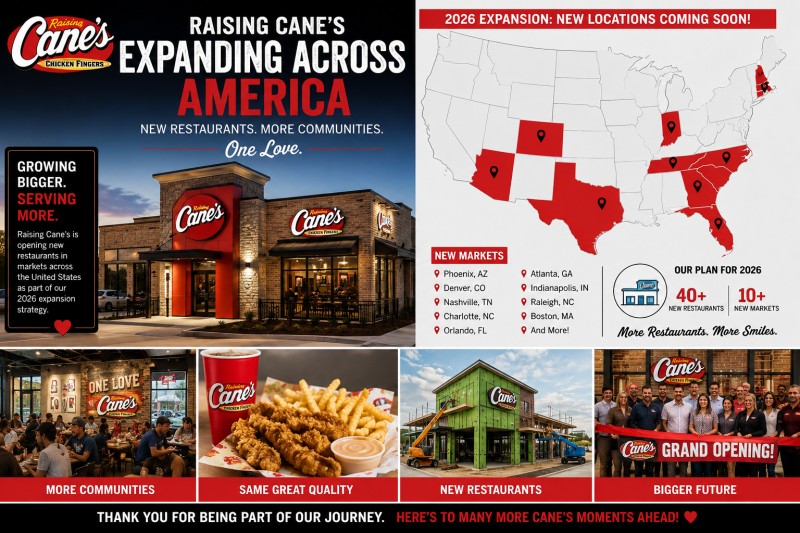
Raising Cane’s new restaurants are making headlines across the United States as the fast-growing chicken chain continues its aggressive expansion strategy in 2026. While many restaurant brands are slowing expansion due to rising operating costs, labor shortages, and changing consumer spending, Raising Cane’s is opening new locations across multiple states and entering promising new markets. This growth is not driven by chance—it reflects a disciplined business strategy centered on operational excellence, customer loyalty, and carefully selected real estate. For entrepreneurs, investors, and business leaders, the expansion of Raising Cane’s new restaurants offers valuable lessons about sustainable growth, brand consistency, and long-term competitive advantage.
Instead of viewing these restaurant openings as another fast-food news story, business leaders should see them as a case study in how focused execution can outperform aggressive diversification.
Why Raising Cane’s New Restaurants Are Expanding Across America
Recent announcements show that Raising Cane’s continues investing heavily in new restaurant development throughout 2026, following a series of successful openings earlier this year. The company is expanding into both established metropolitan markets and fast-growing suburban communities, reinforcing its position as one of America’s fastest-growing quick-service restaurant (QSR) brands.
Unlike many competitors that pursue rapid expansion without a clear strategy, Raising Cane’s carefully evaluates every new location using market research, demographic analysis, traffic data, and long-term growth potential.
Every new restaurant represents more than another store—it is a calculated investment designed to strengthen the company’s national footprint while maintaining operational consistency.
For local communities, these openings also create:
- New employment opportunities
- Increased commercial activity
- Construction investment
- Support for local suppliers
- Greater consumer choice
This disciplined approach has helped Raising Cane’s build momentum even as parts of the restaurant industry face economic uncertainty.
How Many Raising Cane’s Restaurants Are There?
From its humble beginnings near Louisiana State University, Raising Cane’s has grown into one of the fastest-expanding restaurant brands in the United States.
Today, the company operates hundreds of restaurants nationwide and continues opening new locations every year. Rather than slowing growth in response to inflation and rising operational costs, Raising Cane’s has continued investing in expansion while maintaining a consistent customer experience.
Its ability to grow during challenging economic conditions demonstrates the strength of its business model and operational discipline.
For investors and analysts, this steady expansion reflects confidence in long-term consumer demand and the company’s ability to execute at scale.
Why Raising Cane’s New Restaurants Keep Growing While Competitors Slow Down
Many restaurant chains have reduced expansion plans because of increasing labor costs, supply chain disruptions, and changing consumer behavior.
Raising Cane’s has taken a different path.
Its continued success is built on several strategic advantages that support sustainable growth.
A Simple Menu Creates Operational Excellence
One of the defining characteristics of Raising Cane’s is its intentionally focused menu.
Rather than offering dozens of products and constantly introducing limited-time promotions, the company specializes in chicken finger meals and complementary menu items.
This focused approach delivers significant business advantages.
It allows the company to:
- Reduce kitchen complexity
- Improve food consistency
- Simplify employee training
- Reduce inventory waste
- Increase operational efficiency
- Serve customers more quickly
For business leaders, the lesson is clear.
Growth does not always come from offering more—it often comes from executing fewer things exceptionally well.
Companies across industries can benefit from identifying their core strengths and resisting unnecessary complexity.
Strong Customer Loyalty Fuels Repeat Business
One of the most valuable assets any business can build is customer trust.
Raising Cane’s has developed a loyal customer base by consistently delivering:
- High-quality food
- Fast service
- Friendly employees
- Clean restaurant environments
- Consistent customer experiences
Customers know what to expect every time they visit.
This consistency builds confidence, encourages repeat visits, and strengthens long-term brand loyalty.
According to industry research, retaining existing customers is often significantly more cost-effective than constantly acquiring new ones, making customer loyalty a critical driver of sustainable growth.
Strong Unit Economics Support Expansion
Every new restaurant requires significant investment.
Successful expansion depends on each location generating healthy financial returns.
Raising Cane’s benefits from several operational advantages that strengthen unit economics:
- Streamlined restaurant operations
- Efficient labor utilization
- Faster customer throughput
- Lower inventory complexity
- Consistent product quality
These efficiencies improve profitability while making expansion more sustainable over the long term.
Many companies pursue growth before perfecting their operating model.
Raising Cane’s demonstrates why scalable systems should come before aggressive expansion.
Consumer Demand Continues Driving Growth
Consumer preferences have shifted noticeably toward premium chicken-focused restaurant concepts.
Industry analysts continue reporting strong demand for convenient, high-quality dining experiences that combine affordability with speed and consistency.
While market demand creates opportunity, execution determines success.
Numerous brands compete within the same category, but relatively few achieve Raising Cane’s level of operational consistency and customer loyalty.
The company’s disciplined approach has helped transform growing consumer demand into measurable business performance.
The Business Strategy Behind Raising Cane’s New Restaurants
Every successful restaurant opening begins long before construction starts.
Behind every new Raising Cane’s location is months of strategic planning supported by extensive market research.
Rather than selecting sites based solely on available real estate, the company appears to prioritize long-term market potential.
Demographic Analysis
Growing communities provide the strongest opportunities for long-term restaurant success.
Raising Cane’s often targets markets with:
- Population growth
- Young professionals
- University communities
- Family-oriented neighborhoods
- Increasing household incomes
These customer segments closely align with the company’s value proposition.
Traffic Patterns Matter
Location remains one of the most important factors influencing restaurant performance.
Successful locations typically feature:
- High vehicle traffic
- Strong road visibility
- Convenient accessibility
- Nearby retail destinations
- Growing commercial districts
Restaurants positioned along major commuting corridors often generate significantly higher customer traffic than locations with limited visibility.
For Raising Cane’s, strategic site selection helps maximize long-term revenue while supporting future expansion plans.
University Communities Continue Supporting Growth
Raising Cane’s originated near a college campus, and university markets remain an important part of its expansion strategy.
These communities provide:
- High customer density
- Strong brand awareness
- Frequent repeat visits
- Social media engagement
- Long-term customer relationships
College students often become loyal customers early in life, creating lasting brand recognition that continues well beyond graduation.
How Raising Cane’s New Restaurants Compete with Industry Giants
The U.S. chicken restaurant market has become one of the most competitive segments within the Quick Service Restaurant (QSR) industry. Established brands continue investing heavily in expansion, digital transformation, loyalty programs, and menu innovation to capture growing consumer demand.
Yet despite this intense competition, Raising Cane’s new restaurants continue gaining market share through a fundamentally different strategy.
Instead of competing on product variety, Raising Cane’s competes on operational excellence, speed, and consistency.
Raising Cane’s vs. Chick-fil-A vs. Wingstop vs. Popeyes
| Strategy | Raising Cane’s | Chick-fil-A | Wingstop | Popeyes |
|---|---|---|---|---|
| Primary Product | Chicken Fingers | Chicken Sandwiches | Chicken Wings | Fried Chicken |
| Menu Size | Very Limited | Moderate | Moderate | Extensive |
| Expansion Model | Company-Owned | Mixed | Franchise | Franchise |
| Customer Experience | Fast & Consistent | Hospitality-Focused | Digital & Delivery | Value-Based |
| Competitive Advantage | Operational Simplicity | Customer Service | Digital Ordering | Product Variety |
Rather than trying to become everything for everyone, Raising Cane’s has built a brand around doing one thing exceptionally well.
This disciplined positioning has helped the company develop a clear competitive identity while avoiding the operational complexity that often accompanies larger menus.
For executives, this highlights an important strategic lesson:
Differentiation does not always require offering more—it often comes from executing a focused strategy better than competitors.
Drive-Thru Strategy: The Engine Behind Raising Cane’s New Restaurants
Consumer expectations have changed dramatically over the past few years.
Speed and convenience have become deciding factors when choosing where to eat.
Modern consumers increasingly expect:
- Fast ordering
- Minimal waiting time
- Convenient pickup
- Digital payment options
- Reliable service
Recognizing these trends, Raising Cane’s has invested heavily in drive-thru-focused restaurant layouts.
Efficient drive-thru operations allow the company to:
- Increase hourly customer capacity
- Improve customer satisfaction
- Reduce congestion inside restaurants
- Improve labor productivity
- Increase average daily sales
Unlike traditional restaurant layouts that prioritize dining rooms, many modern QSR brands now design locations around vehicle traffic.
This operational approach aligns with changing consumer behavior and strengthens long-term profitability.
Digital Innovation Is Supporting Restaurant Growth
Technology has become an essential component of restaurant expansion.
Today’s customers increasingly expect seamless digital experiences before they even enter a restaurant.
Across the industry, leading brands continue investing in:
- Mobile applications
- Online ordering
- Loyalty programs
- Contactless payments
- Delivery integration
- Customer analytics
While Raising Cane’s has built its reputation through operational simplicity, digital innovation is becoming an increasingly important growth driver.
Customer data generated through digital channels enables restaurant operators to better understand purchasing behavior, optimize staffing, and improve marketing effectiveness.
For business leaders, digital transformation is no longer optional—it has become a competitive necessity.
The Economic Impact of Raising Cane’s New Restaurants
Every new restaurant opening creates value far beyond the dining experience.
A single location contributes to local economic development in multiple ways.
Job Creation
Each restaurant generates employment opportunities for:
- Restaurant managers
- Shift supervisors
- Kitchen staff
- Customer service employees
- Maintenance personnel
These positions contribute to workforce development while supporting local economies.
Construction and Real Estate Investment
Opening a new restaurant requires significant investment in:
- Commercial construction
- Real estate development
- Equipment installation
- Landscaping
- Utility infrastructure
These projects support contractors, architects, engineers, and local service providers.
Supporting Local Supply Chains
Restaurant expansion also benefits an extensive network of suppliers.
This includes businesses providing:
- Food ingredients
- Packaging materials
- Beverage products
- Cleaning services
- Equipment maintenance
- Transportation and logistics
As Raising Cane’s expands, these supplier relationships become increasingly valuable, strengthening regional business ecosystems.
Community Development
Successful restaurant developments often stimulate additional commercial investment.
New restaurants increase traffic to nearby shopping centers, attracting retailers and service providers while generating additional tax revenue for local governments.
This broader economic impact explains why restaurant expansion is often viewed positively by local communities.
Restaurant Industry Trends Driving Raising Cane’s Expansion
The success of Raising Cane’s new restaurants also reflects broader trends shaping the American restaurant industry.
Consumer Demand for Convenience
Busy lifestyles continue driving demand for:
- Quick service
- Drive-thru dining
- Mobile ordering
- Online payment
- Fast pickup
Consumers increasingly value convenience alongside food quality.
Businesses capable of delivering both are well-positioned for long-term growth.
Premium Chicken Continues Growing
Chicken remains one of the fastest-growing categories within the restaurant industry.
Consumers increasingly associate chicken-focused menus with:
- Better value
- Menu simplicity
- Convenience
- Broad family appeal
This sustained demand provides favorable conditions for specialized brands like Raising Cane’s.
Experience Is Becoming a Competitive Advantage
Consumers increasingly evaluate restaurants based on the overall customer experience rather than price alone.
Successful brands consistently deliver:
- Friendly service
- Clean environments
- Reliable quality
- Fast operations
- Consistent branding
Raising Cane’s has built much of its reputation around delivering these experiences consistently across every location.
Leadership Lessons from Raising Cane’s New Restaurants
Beyond restaurant operations, Raising Cane’s offers valuable insights for entrepreneurs and executives across industries.
1. Focus Creates Competitive Advantage
Many organizations attempt to serve every customer.
The strongest brands often succeed by serving a specific audience exceptionally well.
Specialization frequently outperforms diversification.
2. Operational Excellence Enables Growth
Expansion without operational consistency creates long-term problems.
Raising Cane’s demonstrates that standardized systems, employee training, and quality control should be established before scaling into new markets.
3. Customer Loyalty Is More Valuable Than Short-Term Promotions
Marketing campaigns attract attention.
Exceptional customer experiences create loyalty.
Businesses that consistently deliver value often spend less acquiring new customers while generating stronger long-term profitability.
4. Data Should Guide Expansion Decisions
Successful expansion depends on informed decision-making.
Rather than relying on intuition, organizations should evaluate:
- Market demand
- Consumer demographics
- Competitive landscape
- Traffic patterns
- Financial projections
- Operational readiness
Data-driven expansion reduces risk while increasing the likelihood of sustainable growth.
Future Outlook for Raising Cane’s New Restaurants
The momentum behind Raising Cane’s new restaurants shows no signs of slowing. With a disciplined expansion strategy, strong consumer demand, and an efficient operating model, the company is well-positioned to remain one of America’s fastest-growing Quick Service Restaurant (QSR) brands.
While the restaurant industry continues to face inflation, labor shortages, supply chain volatility, and changing consumer expectations, Raising Cane’s has demonstrated that businesses built on operational excellence can continue expanding even during uncertain economic conditions.
Looking ahead, several trends are expected to shape the company’s next phase of growth.
Expansion into Emerging Markets
Although Raising Cane’s has established a strong presence across many U.S. states, significant growth opportunities remain in underserved suburban communities and rapidly growing metropolitan areas.
Rather than opening restaurants indiscriminately, the company is expected to continue prioritizing locations based on:
- Population growth
- Household income
- Traffic density
- Commercial development
- Consumer demand
- Long-term profitability
This disciplined approach reduces expansion risk while improving long-term returns.
Technology Will Shape the Next Generation of Restaurants
Digital transformation is redefining the restaurant industry.
Consumers increasingly expect fast, personalized, and seamless digital experiences.
Leading restaurant brands continue investing in technologies such as:
- Mobile ordering
- Contactless payments
- Digital loyalty programs
- Self-service kiosks
- Delivery integration
- Real-time customer feedback systems
As Raising Cane’s new restaurants continue expanding, investments in digital infrastructure will likely become an even greater competitive advantage.
For modern businesses, technology is no longer simply improving operations—it is becoming central to customer experience.
Artificial Intelligence Is Changing Restaurant Operations
Artificial Intelligence (AI) is transforming how restaurant companies operate behind the scenes.
Across the industry, AI is helping organizations:
- Forecast customer demand
- Optimize employee scheduling
- Improve inventory management
- Reduce food waste
- Analyze purchasing behavior
- Personalize marketing campaigns
- Predict equipment maintenance
These capabilities enable businesses to reduce operating costs while delivering faster and more consistent customer experiences.
As AI adoption accelerates, restaurant brands that successfully combine technology with excellent service will be better positioned for sustainable growth.
What Entrepreneurs and Business Leaders Can Learn
The story behind Raising Cane’s new restaurants extends far beyond restaurant expansion.
It offers practical lessons for founders, executives, investors, and business leaders across every industry.
1. Simplicity Creates Scalability
Many organizations believe growth requires offering more products or entering more markets.
Raising Cane’s demonstrates the opposite.
A focused product offering supported by efficient operations often creates stronger competitive advantages than unnecessary diversification.
Businesses should master their core value proposition before expanding into new opportunities.
2. Build Systems Before Pursuing Growth
Growth without operational consistency creates unnecessary risk.
Successful organizations first establish repeatable systems, standardized processes, employee training programs, and quality control measures.
Only then do they scale.
This disciplined approach helps maintain customer trust while supporting sustainable expansion.
3. Customer Experience Drives Long-Term Success
Marketing campaigns may generate initial attention.
Exceptional customer experiences create lasting loyalty.
Businesses that consistently exceed customer expectations often benefit from:
- Higher customer retention
- Stronger brand advocacy
- Increased lifetime customer value
- Sustainable revenue growth
Customer experience should remain a strategic priority—not simply a marketing initiative.
4. Use Data to Make Better Decisions
One of the most valuable leadership lessons from Raising Cane’s is the importance of data-driven decision-making.
Before expanding, organizations should evaluate:
- Consumer demand
- Market demographics
- Competitive intensity
- Financial performance
- Operational capacity
- Long-term strategic fit
Leaders who rely on evidence rather than assumptions typically make more sustainable growth decisions.
5. Consistency Builds Trust
Every successful brand is built on trust.
Customers return because they know exactly what to expect.
Maintaining consistency across every location, every employee interaction, and every customer experience strengthens long-term brand equity.
Consistency may not generate headlines, but it often becomes the foundation of enduring business success.
Final Thoughts
The success of Raising Cane’s new restaurants is about far more than opening additional locations.
It demonstrates how a focused business model, disciplined execution, and unwavering commitment to customer experience can create sustainable competitive advantages in an increasingly crowded marketplace.
While many companies pursue growth through complexity, Raising Cane’s has shown that simplicity, consistency, and operational excellence can be even more powerful.
For entrepreneurs, the lesson is clear: build systems before scaling.
For executives, prioritize customer experience over short-term expansion.
For investors, look beyond rapid growth and evaluate whether a company possesses the operational discipline necessary for long-term success.
As consumer expectations continue evolving and technology reshapes the restaurant industry, Raising Cane’s appears well-positioned to remain one of the most closely watched growth stories in American retail.
Businesses that hope to replicate its success should remember one important principle:
The companies that win tomorrow will not be those that expand the fastest—they will be the ones that expand with purpose, consistency, and an unwavering focus on delivering value to every customer.