
NVIDIA AI Growth Strategy: How the Chip Giant Is Leading the AI Revolution

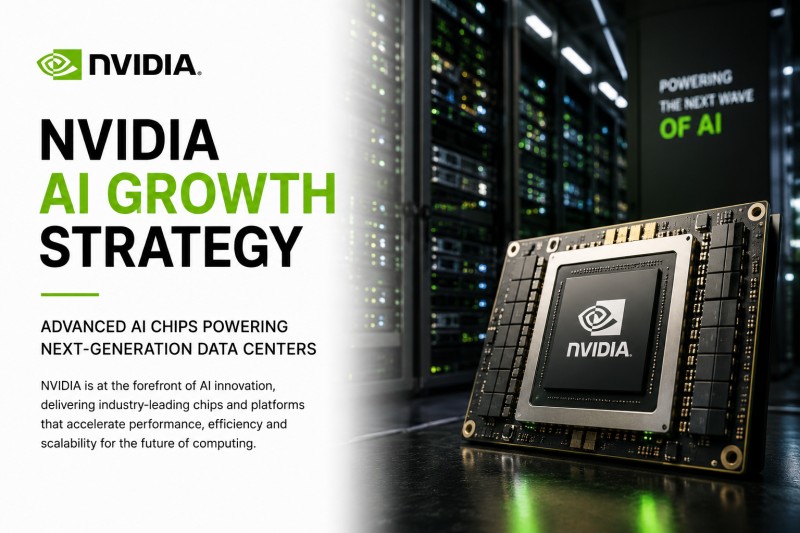
Artificial intelligence has entered a new phase of global adoption, and at the center of this transformation is NVIDIA. Once recognized primarily for powering gaming graphics, the company has evolved into the backbone of the modern AI economy. Today, its graphics processing units (GPUs) are the foundation for training large language models, enabling generative AI, accelerating scientific research, and supporting enterprise digital transformation.
The NVIDIA AI Growth Strategy has become one of the most closely watched business stories in the technology industry. As organizations invest billions in AI infrastructure, NVIDIA continues to strengthen its leadership through cutting-edge hardware, software ecosystems, and strategic partnerships with cloud providers, enterprises, and research institutions.
Rather than competing solely on chip performance, NVIDIA has built an integrated AI platform that combines advanced GPUs, networking technologies, AI software frameworks, and developer tools. This ecosystem approach has created significant competitive advantages and positioned the company at the center of the global AI revolution.
For CEOs, technology leaders, investors, and entrepreneurs, NVIDIA’s success offers valuable insights into innovation, scalability, ecosystem development, and long-term strategic execution.
Why NVIDIA Is Leading the AI Revolution
The explosive growth of artificial intelligence has dramatically increased demand for high-performance computing.
Training modern AI models requires enormous computational power capable of processing trillions of data points efficiently. Traditional processors struggle to handle these workloads, making GPUs an essential component of AI development.
NVIDIA recognized this opportunity years before AI became mainstream. By investing heavily in GPU architecture, AI software, and developer ecosystems, the company established itself as the preferred technology provider for AI innovators worldwide.
Today, NVIDIA technology powers a wide range of applications, including:
- Large Language Models (LLMs)
- Generative AI platforms
- Autonomous vehicles
- Robotics
- Healthcare research
- Drug discovery
- Financial modeling
- Scientific computing
- Industrial automation
- Cloud AI services
This broad adoption demonstrates that NVIDIA is no longer simply a semiconductor company—it has become a critical enabler of global AI infrastructure.
The Business Strategy Behind NVIDIA’s Success
One of the defining strengths of the NVIDIA AI Growth Strategy is its ecosystem-driven approach.
Instead of focusing only on selling chips, NVIDIA has created an interconnected technology platform that includes:
- High-performance AI GPUs
- CUDA software platform
- AI development frameworks
- Networking and interconnect solutions
- AI cloud infrastructure
- Enterprise AI software
- Robotics and autonomous systems
- Digital twin technologies
This integrated strategy creates high switching costs for customers while accelerating AI adoption across industries.
Organizations investing in NVIDIA hardware often continue using its software tools, development environments, and AI frameworks, creating long-term customer relationships rather than one-time hardware sales.
AI Infrastructure Is Fueling Demand
The global race to build AI infrastructure has become one of the biggest drivers of technology investment.
Cloud providers, governments, startups, universities, and multinational enterprises are investing heavily in AI-ready data centers capable of supporting increasingly complex workloads.
Demand for accelerated computing continues to grow as organizations deploy AI across customer service, manufacturing, healthcare, finance, cybersecurity, and logistics.
This trend has significantly strengthened NVIDIA’s position as businesses seek reliable, scalable, and energy-efficient AI computing solutions.
As AI adoption accelerates worldwide, infrastructure spending is expected to remain one of the strongest growth drivers for the technology sector, reinforcing NVIDIA’s central role in the future of artificial intelligence.
Blackwell: NVIDIA’s Next Generation AI Platform
A major pillar of the NVIDIA AI Growth Strategy is continuous innovation. Rather than relying on previous successes, NVIDIA consistently introduces new GPU architectures designed to meet the rapidly growing demands of artificial intelligence.
The company’s Blackwell platform represents its latest leap forward in accelerated computing. Built for training and deploying increasingly sophisticated AI models, Blackwell delivers significant improvements in computing performance, memory capacity, energy efficiency, and scalability compared with earlier GPU generations.
For enterprises investing in generative AI, digital twins, robotics, and scientific computing, these performance gains translate into faster model training, lower operational costs, and improved AI deployment capabilities.
By maintaining a rapid innovation cycle, NVIDIA continues strengthening its technological leadership while setting new industry benchmarks.
Data Centers Have Become the New Growth Engine
Although NVIDIA first gained global recognition through gaming graphics cards, its primary growth now comes from enterprise AI infrastructure.
Data centers have become the backbone of the AI economy.
Every major cloud provider, AI startup, research institution, and enterprise developing large-scale AI applications requires enormous computational resources.
These AI workloads demand thousands of interconnected GPUs capable of processing massive volumes of data simultaneously.
As organizations expand AI adoption, investment in high-performance computing infrastructure continues accelerating.
This structural shift has transformed NVIDIA from a gaming hardware company into one of the world’s most influential enterprise technology providers.
Competition Is Intensifying Across the AI Chip Market
The success of artificial intelligence has intensified competition within the semiconductor industry.
Major technology companies are investing billions of dollars to develop alternative AI processors.
Key competitors include:
- AMD, expanding its Instinct accelerator portfolio for enterprise AI.
- Intel, investing in AI processors and data center technologies.
- Google, developing custom Tensor Processing Units (TPUs) for AI workloads.
- Amazon Web Services, designing proprietary AI chips such as Trainium and Inferentia.
- Microsoft, increasing investment in custom AI infrastructure to support cloud services.
- Broadcom and several emerging semiconductor firms developing specialized AI hardware.
Despite growing competition, NVIDIA maintains significant advantages through its mature software ecosystem, extensive developer community, optimized AI frameworks, and long-standing enterprise relationships.
For many organizations, the complete NVIDIA ecosystem offers greater value than hardware performance alone.
Real-World Industries Powered by NVIDIA AI
The NVIDIA AI Growth Strategy extends far beyond technology companies.
Its computing platforms now support innovation across numerous industries.
Healthcare
Hospitals and pharmaceutical companies use accelerated computing to improve medical imaging, accelerate drug discovery, support genomic research, and enhance clinical decision-making.
Automotive
Automotive manufacturers are integrating NVIDIA technology into autonomous driving systems, advanced driver-assistance features, intelligent cockpit experiences, and vehicle simulation platforms.
Manufacturing
Industrial organizations use AI-powered robotics, predictive maintenance systems, digital twins, and automated quality inspection to improve productivity while reducing operational costs.
Financial Services
Banks and investment firms leverage accelerated computing for fraud detection, algorithmic trading, portfolio optimization, credit risk analysis, and regulatory compliance.
Scientific Research
Universities and research institutions rely on high-performance GPUs to accelerate climate modeling, physics simulations, life sciences research, and advanced engineering projects.
These applications demonstrate that NVIDIA’s technologies have become essential infrastructure supporting innovation across the global economy.
Strategic Partnerships Strengthen NVIDIA’s Ecosystem
Another defining characteristic of the NVIDIA AI Growth Strategy is collaboration.
Rather than competing independently, NVIDIA has built strategic partnerships throughout the technology ecosystem.
Its AI infrastructure supports leading cloud providers, enterprise software companies, system integrators, telecommunications providers, and research organizations.
These partnerships accelerate AI adoption while expanding NVIDIA’s reach across industries.
By enabling rather than replacing partners, NVIDIA has created a highly scalable business model that continues generating long-term growth opportunities.
Leadership Lessons from Jensen Huang
Under the leadership of CEO Jensen Huang, NVIDIA has consistently demonstrated several principles that every executive can learn from.
Invest Before Markets Mature
NVIDIA began investing heavily in accelerated computing and artificial intelligence years before generative AI became mainstream.
This long-term vision positioned the company ahead of competitors when AI demand surged.
Build an Ecosystem, Not Just a Product
Rather than selling standalone hardware, NVIDIA created an integrated platform combining chips, software, networking, and developer tools.
This ecosystem approach strengthens customer loyalty while creating sustainable competitive advantages.
Focus on Continuous Innovation
Technology leadership requires relentless innovation.
NVIDIA consistently introduces new architectures, expands software capabilities, and invests in emerging AI technologies instead of relying on previous successes.
Think Long Term
Perhaps NVIDIA’s greatest strategic lesson is patience.
Transformational businesses rarely emerge overnight.
Years of research, ecosystem development, and strategic investment enabled the company to capitalize when artificial intelligence entered the global mainstream.
For entrepreneurs, founders, and corporate leaders, NVIDIA demonstrates that sustainable competitive advantage is built through long-term strategic execution rather than short-term market reactions.
Future Outlook: What’s Next for NVIDIA and the AI Industry?
The NVIDIA AI Growth Strategy is entering a new phase as artificial intelligence moves from experimentation to enterprise-wide adoption. Organizations are no longer asking whether they should invest in AI—they are determining how quickly they can scale it.
Over the next few years, demand for AI infrastructure is expected to grow across healthcare, manufacturing, finance, retail, education, automotive, and government sectors. As businesses deploy increasingly sophisticated AI models, the need for high-performance computing, energy-efficient data centers, and advanced networking solutions will continue to rise.
While competition from AMD, Intel, and custom AI chip developers is increasing, NVIDIA’s integrated ecosystem, software leadership, and strong enterprise relationships position the company to remain one of the key players in the AI economy.
For investors and business leaders, NVIDIA’s long-term growth story is closely tied to the broader expansion of artificial intelligence rather than short-term product cycles.
Emerging AI Trends Shaping the Future
Several technological developments are expected to influence the next stage of AI innovation.
Agentic AI
AI systems are evolving from responding to prompts to performing complex tasks autonomously. Businesses are investing in AI agents capable of planning, reasoning, and executing workflows with minimal human intervention.
Physical AI and Robotics
Manufacturing, logistics, healthcare, and autonomous systems increasingly rely on AI-powered robotics.
High-performance GPUs are enabling robots to process massive amounts of sensor data, improving navigation, decision-making, and automation.
AI Factories
Organizations are building dedicated AI data centers—often referred to as AI factories—to train and deploy increasingly powerful models.
These facilities require advanced GPUs, networking infrastructure, and optimized software, creating long-term opportunities for companies supplying AI infrastructure.
Digital Twins
Businesses are using digital twins to simulate factories, supply chains, cities, and industrial operations before implementing changes in the real world.
These virtual environments help organizations reduce costs, improve efficiency, and accelerate innovation.
What Business Leaders Can Learn from NVIDIA
The NVIDIA AI Growth Strategy provides valuable lessons for executives across industries.
Invest Ahead of Market Demand
The most successful organizations anticipate technological shifts before they become mainstream.
Strategic investments made today often determine tomorrow’s market leadership.
Build an Ecosystem
Customers increasingly value complete solutions rather than individual products.
Businesses should focus on integrating products, services, software, and customer support into a seamless experience.
Prioritize Innovation
Markets evolve rapidly.
Organizations that continuously improve products, embrace emerging technologies, and encourage experimentation are better positioned for long-term success.
Develop Strategic Partnerships
NVIDIA’s collaboration with cloud providers, software companies, research institutions, and enterprise customers demonstrates the value of partnerships in accelerating innovation.
Working together often creates greater value than competing in isolation.
Key Takeaways
The NVIDIA AI Growth Strategy highlights several important trends shaping the future of technology and business.
- Artificial intelligence is driving unprecedented demand for accelerated computing.
- Data centers have become one of the fastest-growing technology markets.
- NVIDIA’s integrated ecosystem creates a strong competitive advantage.
- AI adoption is expanding across nearly every major industry.
- Continuous innovation and long-term vision remain essential for sustained growth.
- Leadership, partnerships, and customer-centric strategy are as important as technological excellence.
These lessons extend far beyond the semiconductor industry and provide valuable guidance for organizations navigating digital transformation.
Conclusion
The NVIDIA AI Growth Strategy is more than the story of one company’s success—it reflects the rapid evolution of artificial intelligence and the technologies powering the next generation of global innovation.
By combining industry-leading GPUs, a comprehensive software ecosystem, strategic partnerships, and a relentless commitment to innovation, NVIDIA has positioned itself at the center of the AI revolution.
For business leaders, investors, and entrepreneurs, the company’s journey demonstrates that sustainable competitive advantage is built through long-term vision, ecosystem development, and continuous technological advancement.
As artificial intelligence becomes increasingly embedded in every industry, organizations that invest in innovation, embrace digital transformation, and prioritize customer value will be best positioned to lead the future.
The companies that define the next decade won’t simply adopt AI—they’ll build the infrastructure, ecosystems, and strategies that enable AI to transform industries worldwide.