
Navigating the Tax Frontier: How Businesses Can Prepare for AI, Global Minimum Tax, and Digital Compliance in 2026

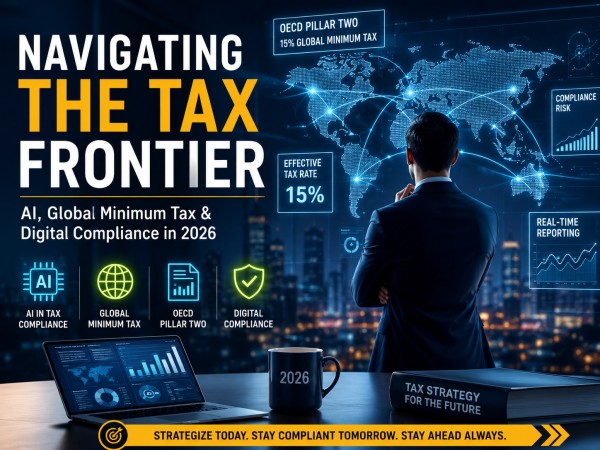
Taxation is no longer just a compliance function managed quietly by finance departments. In 2026, it has become a strategic business priority that influences investment decisions, international expansion, corporate governance, and long-term competitiveness.
Rapid technological innovation, increasingly digital business models, global regulatory reforms, and artificial intelligence are transforming how governments administer taxes and how businesses meet their obligations.
For business leaders, founders, CFOs, and multinational organizations, navigating today’s tax environment requires more than understanding tax rates. It demands a proactive approach to compliance, technology adoption, risk management, and international tax planning.
This new landscape is often referred to as the tax frontier—a rapidly evolving environment where AI, global minimum tax rules, digital taxation, and real-time compliance are redefining corporate tax strategy.
Organizations that prepare today will be better positioned to reduce risk, improve operational efficiency, and build long-term resilience.
The New Tax Frontier: Why Business Taxation Is Changing
Several global trends are reshaping tax administration.
Businesses now operate across multiple jurisdictions, generate digital revenue, store vast amounts of financial data, and increasingly rely on cloud-based operations.
Governments are responding by modernizing tax systems through:
- Digital reporting requirements
- AI-powered tax administration
- Cross-border cooperation
- Real-time compliance monitoring
- Enhanced transparency standards
Rather than reviewing historical tax returns years later, many tax authorities are moving toward continuous monitoring supported by advanced analytics.
For businesses, this means tax compliance has become an ongoing operational process rather than an annual filing exercise.
What Is the Global Minimum Tax?
One of the most significant developments in international taxation is the Global Minimum Tax.
Developed through the OECD/G20 Inclusive Framework, the initiative establishes a 15% minimum effective corporate tax rate for large multinational enterprises operating across different jurisdictions.
The primary objectives are to:
- Reduce profit shifting
- Limit tax avoidance
- Create fairer international tax competition
- Modernize global corporate taxation
Instead of allowing profits to be shifted to low-tax jurisdictions, the framework ensures qualifying multinational groups pay at least the agreed minimum tax rate.
For global businesses, implementation represents one of the largest international tax reforms in decades.
Understanding OECD Pillar Two
What Is OECD Pillar Two?
OECD Pillar Two provides the rules supporting the Global Minimum Tax framework.
Its purpose is to ensure multinational enterprises pay a minimum level of taxation regardless of where profits are reported.
The framework introduces complex calculations involving:
- Effective tax rates
- Jurisdictional reporting
- Income adjustments
- Top-up taxes
- Global information reporting
Although the rules primarily affect large multinational groups, many suppliers, subsidiaries, and business partners will also experience indirect impacts through reporting and governance requirements.
Understanding OECD Pillar Two is becoming increasingly important for finance leaders planning international expansion.
Why AI Is Transforming Tax Compliance
Artificial intelligence is changing taxation from both sides.
Governments are using AI to improve tax administration, while businesses are adopting AI to automate compliance and reduce manual work.
Modern AI systems now support:
- Fraud detection
- Risk assessment
- Audit selection
- Data validation
- Document processing
- Taxpayer assistance
For companies, AI-powered tax software can automatically identify inconsistencies, monitor regulatory changes, and improve reporting accuracy.
Instead of replacing tax professionals, AI enables finance teams to focus on strategic planning while repetitive compliance tasks become increasingly automated.
AI in Tax Compliance Is Becoming a Competitive Advantage
Organizations investing in AI in tax compliance are gaining measurable operational benefits.
These include:
Faster Compliance Processes
Automation significantly reduces manual calculations and repetitive administrative work.
Better Data Accuracy
Machine learning helps identify anomalies before returns are submitted.
Improved Risk Detection
Predictive analytics highlights potential compliance issues early.
Smarter Decision-Making
Real-time reporting enables executives to respond more quickly to changing tax obligations.
As regulations continue evolving, AI is becoming an essential component of modern corporate tax management.
Digital Taxation and Cross-Border Business Challenges
The growth of digital business models has fundamentally changed international taxation.
Companies now generate revenue through:
- Digital platforms
- Cloud software
- Online marketplaces
- Streaming services
- Digital advertising
- Cross-border e-commerce
These business models often operate across multiple countries without maintaining a traditional physical presence.
As a result, governments continue working toward coordinated approaches for digital taxation that fairly allocate taxing rights while reducing double taxation and regulatory fragmentation.
Businesses operating internationally must monitor evolving rules across every jurisdiction where they generate revenue.
Cross-Border Taxation Requires Stronger Governance
International expansion creates significant tax complexity.
Businesses must consider:
- Transfer pricing
- Permanent establishment rules
- Withholding taxes
- VAT and GST obligations
- International reporting requirements
- Local compliance standards
As cross-border operations become more sophisticated, companies need stronger tax governance frameworks that align finance, legal, technology, and executive leadership.
Tax planning is no longer isolated within accounting departments—it is becoming an enterprise-wide responsibility.
Tax Risk Management in a Data-Driven World
Traditional tax audits relied heavily on manual document reviews.
Today’s tax authorities increasingly use:
- Artificial intelligence
- Data analytics
- Real-time reporting
- Digital invoices
- Automated risk scoring
This evolution allows regulators to identify unusual transactions much earlier than before.
Businesses should therefore strengthen tax risk management by:
- Maintaining accurate financial records
- Improving internal controls
- Automating compliance workflows
- Conducting regular tax reviews
- Monitoring regulatory changes continuously
Organizations with mature governance processes are generally better prepared for increasingly sophisticated audits.
Tax Technology Is Reshaping Corporate Finance
Modern tax departments are investing heavily in technology.
Today’s tax technology ecosystem includes:
Tax Automation Platforms
Automating repetitive calculations and reporting.
Cloud-Based Compliance Systems
Managing multinational reporting from centralized platforms.
Predictive Analytics
Identifying emerging compliance risks.
Digital Document Management
Improving audit readiness.
AI-Powered Tax Research
Helping professionals interpret rapidly changing regulations more efficiently.
Technology enables tax teams to transition from reactive compliance toward proactive strategic planning.
What Business Leaders Should Do Next
Navigating the tax frontier requires leadership involvement—not just accounting expertise.
Business leaders should focus on several priorities.
Invest in Digital Tax Technology
Modern compliance increasingly depends on automation and integrated financial systems.
Prepare for OECD Pillar Two
Multinational organizations should evaluate how Global Minimum Tax rules affect future tax obligations.
Strengthen Tax Governance
Executive leadership should ensure tax policies align with broader business strategy and corporate governance.
Build Cross-Functional Collaboration
Finance, legal, compliance, IT, and executive teams should work together to address emerging tax risks.
Monitor Regulatory Developments
International tax regulations continue evolving rapidly.
Organizations should regularly review legislative updates across the jurisdictions where they operate.
Proactive preparation reduces uncertainty and supports sustainable business growth.
The Future of Corporate Taxation
Tax administration is entering a new era driven by digital transformation.
Emerging developments include:
- AI-assisted tax audits
- Continuous compliance monitoring
- Automated international reporting
- Predictive tax analytics
- Real-time financial reporting
- Greater international tax coordination
As these technologies mature, tax compliance will become increasingly integrated into everyday business operations rather than remaining an annual reporting exercise.
Forward-thinking organizations will view taxation not simply as a regulatory obligation but as an opportunity to improve governance, transparency, and strategic decision-making.
Conclusion
Navigating the tax frontier in 2026 requires far more than understanding tax legislation.
Artificial intelligence, OECD Pillar Two, Global Minimum Tax implementation, digital taxation, and increasingly sophisticated compliance requirements are transforming taxation into a strategic leadership responsibility.
Organizations that embrace tax technology, strengthen governance, invest in automation, and prepare proactively for international regulatory changes will be better equipped to manage risk and remain competitive.
For today’s business leaders, taxation is no longer simply about meeting legal obligations—it has become an essential pillar of corporate strategy, operational resilience, and sustainable global growth.