
Energy Price Rise 2026: What It Means for Households and Businesses

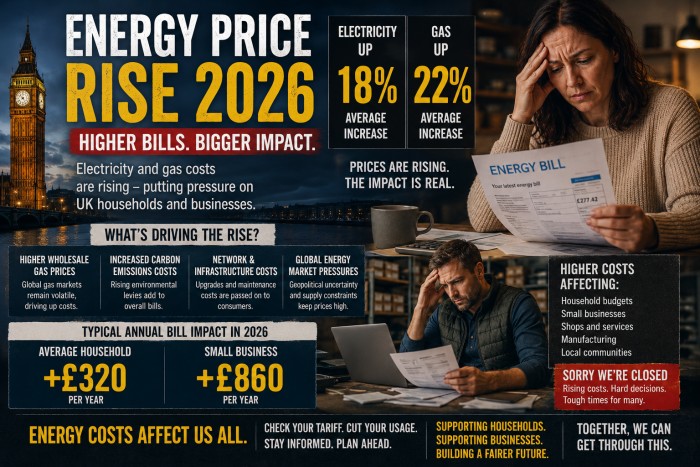
The Energy Price Rise 2026 has become one of the most significant financial challenges facing households and businesses across the United Kingdom. From July 2026, millions of consumers on variable energy tariffs are paying more for electricity and gas following a 13% increase under Ofgem’s latest energy price cap adjustment.
For many households, the immediate advice is straightforward: submit an up-to-date energy meter reading if you do not have a smart meter. Doing so ensures that previous energy usage is billed at the older rate rather than the new, higher prices.
However, the bigger story extends well beyond higher monthly bills. The latest increase reflects global geopolitical uncertainty, volatile energy markets, inflationary pressures, and the ongoing challenge of balancing energy security with affordability. For business leaders, investors, and policymakers, these developments highlight why energy costs have become a strategic economic issue rather than simply a household expense.
Why Are Energy Prices Rising Again?
The latest increase in household energy bills is primarily linked to higher wholesale natural gas prices, which remain sensitive to international geopolitical events and supply disruptions.
Recent tensions in the Middle East—including conflict involving Iran, Israel, and the United States—have contributed to market uncertainty. Even after temporary ceasefire agreements, analysts believe energy markets will remain volatile as traders continue pricing in potential supply risks.
Natural gas remains a critical component of the UK’s energy mix, meaning fluctuations in global markets are quickly reflected in domestic electricity and heating costs.
Although wholesale prices have eased slightly from earlier peaks, they remain considerably higher than historical averages, placing continued pressure on both suppliers and consumers.
Understanding Ofgem’s New Energy Price Cap
The UK’s energy regulator, Ofgem, reviews and updates its energy price cap every three months to reflect changing wholesale energy costs.
It is important to understand that the price cap does not limit the total amount households pay each year.
Instead, it sets the maximum price suppliers can charge for each unit of gas and electricity for customers on standard variable tariffs.
From July 2026:
- Energy prices under the cap increased by approximately 13%
- Gas prices rose by around 24%
- Electricity prices increased by approximately 5%
- Standing charges remained largely unchanged
The increase equates to roughly £18 extra per month for a household using a typical amount of energy.
Ofgem has also updated what it considers a “typical household,” reflecting lower energy consumption as families adopt more efficient appliances and reduce usage in response to previous price increases.
Who Will Be Affected?
The Energy Price Rise 2026 affects approximately 33 million households across England, Scotland, and Wales that are on standard variable tariffs.
However, not every household will experience the increase immediately.
Customers on Variable Tariffs
Households paying variable rates will automatically move onto the higher pricing structure.
Consumers without smart meters are encouraged to submit manual meter readings immediately before new rates take effect.
Doing so prevents energy used before the price increase from being billed at higher rates.
Customers on Fixed Tariffs
Around 40% of UK households currently have fixed-rate energy contracts.
These customers will continue paying their agreed rates until their contracts expire, providing temporary protection from market volatility.
However, once those agreements end, many may face significantly higher renewal costs depending on future market conditions.
Why This Matters Beyond Household Bills
At first glance, a rise in monthly utility bills may appear to be a personal budgeting issue.
In reality, higher energy prices have far-reaching consequences across the economy.
Energy costs influence:
- Consumer spending
- Inflation
- Business operating expenses
- Manufacturing costs
- Retail pricing
- Supply chain efficiency
- Economic growth
When households spend more on electricity and heating, they typically reduce spending in other sectors such as hospitality, retail, travel, and entertainment.
Businesses then experience weaker consumer demand while simultaneously facing higher operating costs.
This combination creates a challenging environment for economic growth.
The Business Impact of Rising Energy Costs
While households feel the immediate effect of higher utility bills, businesses often experience even greater financial pressure.
Energy-intensive industries—including manufacturing, logistics, hospitality, food production, healthcare, and retail—must absorb increasing operating expenses or pass those costs on to consumers.
For many small and medium-sized businesses, higher energy prices directly affect:
- Profit margins
- Hiring decisions
- Investment plans
- Product pricing
- Expansion strategies
Larger organisations are increasingly investing in energy efficiency, renewable technologies, and smarter operational systems to reduce exposure to future price shocks.
Companies that proactively manage energy risks are likely to remain more competitive than those relying solely on traditional cost-cutting measures.
The Link Between Geopolitics and Energy Markets
One of the most important lessons from the Energy Price Rise 2026 is how interconnected global markets have become.
Regional conflicts can influence household budgets thousands of miles away.
The recent tensions involving Iran, Israel, and the United States affected global oil and natural gas markets by increasing uncertainty around future supply.
Although temporary diplomatic progress has helped stabilise prices, analysts continue warning that energy markets remain vulnerable to further geopolitical disruptions.
For governments and businesses alike, improving energy resilience has become a strategic priority rather than simply an environmental objective.
Key Takeaways So Far
The latest rise in energy prices reflects more than changing utility costs—it highlights broader economic and geopolitical challenges shaping the UK’s financial outlook.
For households, it reinforces the importance of monitoring energy usage, reviewing tariff options, and improving efficiency.
For businesses, it demonstrates why energy management should be integrated into long-term strategic planning rather than treated solely as an operational expense.
As energy markets continue evolving, organisations that invest in resilience, efficiency, and innovation will be better positioned to navigate future uncertainty.
How Households Can Reduce the Impact of the Energy Price Rise 2026
Although households cannot control wholesale energy prices, they can take practical steps to reduce the financial impact of the Energy Price Rise 2026.
The first and most immediate action is to submit an accurate meter reading if you are on a variable tariff and do not have a smart meter. This helps ensure that energy consumed before the price increase is billed at the previous rate rather than the new, higher prices.
Beyond meter readings, consumers can reduce long-term energy costs by:
- Comparing fixed and variable energy tariffs
- Improving home insulation
- Replacing older appliances with energy-efficient models
- Using programmable thermostats
- Reducing standby electricity consumption
- Monitoring daily energy usage through smart devices
Small efficiency improvements may seem minor individually, but together they can significantly lower annual household energy expenses.
Rising Energy Bills Are Changing Consumer Spending
Higher utility bills do more than increase monthly expenses—they influence how people spend money across the wider economy.
When households devote a larger share of their income to essential services like electricity and gas, discretionary spending often declines.
Consumers typically reduce spending on:
- Dining out
- Retail shopping
- Travel
- Entertainment
- Home improvements
- Luxury purchases
For businesses, this shift can lead to slower sales growth, changing customer priorities, and increased pressure to deliver value.
Understanding these behavioral changes is becoming increasingly important for retailers, manufacturers, and service providers.
Why Businesses Should Rethink Their Energy Strategy
The Energy Price Rise 2026 is also a strategic challenge for businesses.
Energy is no longer simply an operating expense—it has become a key factor influencing competitiveness, profitability, and long-term resilience.
Organizations across sectors are reassessing how they consume and manage energy.
Many companies are now investing in:
- Energy-efficient equipment
- LED lighting systems
- Smart building technology
- Renewable energy solutions
- Solar power installations
- Battery storage systems
- Automated energy management platforms
These investments not only reduce operating costs but also strengthen resilience against future price volatility.
Forward-thinking businesses increasingly view energy efficiency as a strategic investment rather than a cost-saving exercise.
Small Businesses Face the Greatest Pressure
Large corporations often have greater financial flexibility and dedicated energy management teams.
Small and medium-sized enterprises (SMEs), however, frequently operate with tighter margins and fewer resources.
For these businesses, higher utility costs can directly affect:
- Cash flow
- Hiring decisions
- Product pricing
- Business expansion
- Investment plans
Restaurants, cafés, manufacturers, retailers, and hospitality businesses are among the sectors most exposed to rising energy costs because of their high electricity and gas consumption.
To remain competitive, SMEs are increasingly focusing on operational efficiency, waste reduction, and digital tools that optimize energy usage.
Geopolitical Events Continue to Influence Energy Markets
One of the biggest drivers behind the Energy Price Rise 2026 is geopolitical uncertainty.
Global energy markets remain highly sensitive to conflicts, trade disruptions, and supply chain challenges.
Recent tensions in the Middle East have demonstrated how quickly international events can affect domestic energy prices.
Even when military conflict eases, uncertainty often persists in commodity markets, leading to continued volatility in oil and natural gas prices.
For governments, businesses, and investors, energy security has become a strategic priority alongside economic stability.
Diversifying energy sources and strengthening domestic infrastructure are increasingly viewed as essential components of long-term resilience.
Could Energy Prices Rise Again This Winter?
Market analysts suggest that while wholesale prices have stabilized somewhat, uncertainty remains.
Future energy costs will depend on several factors, including:
- Global natural gas supply
- Weather conditions
- Geopolitical developments
- Storage capacity
- International demand
- Government energy policies
Many experts believe that energy prices are likely to remain elevated compared with pre-2022 levels, even if short-term fluctuations occur.
This means households and businesses should prepare for continued volatility rather than expecting a rapid return to historically low prices.
Energy Efficiency Is Becoming a Competitive Advantage
For businesses, reducing energy consumption is no longer just about lowering bills.
Energy efficiency now delivers multiple strategic benefits:
- Lower operating expenses
- Greater resilience against price shocks
- Improved sustainability performance
- Stronger investor confidence
- Enhanced corporate reputation
- Better compliance with environmental regulations
Organizations that integrate energy management into broader business strategy are often better positioned to compete in uncertain economic environments.
Many investors also view efficient operations as an indicator of strong leadership and effective risk management.
Leadership Lessons from the Energy Price Rise 2026
The current energy market offers several important lessons for executives and entrepreneurs.
1. Prepare for External Risks
Businesses cannot control geopolitical events, but they can prepare for their consequences through proactive planning and risk management.
2. Invest Before a Crisis
Organizations that improve efficiency during stable periods are often better equipped to handle unexpected market disruptions.
3. Build Financial Resilience
Maintaining healthy cash reserves, controlling operating costs, and diversifying suppliers help organizations navigate periods of economic uncertainty.
4. Use Data to Drive Better Decisions
Modern energy management systems provide valuable insights into consumption patterns, helping businesses identify inefficiencies and reduce unnecessary costs.
Data-driven decision-making has become a competitive advantage across every industry.
Future Outlook: What Comes Next for Energy Prices?
While the Energy Price Rise 2026 has already increased household energy costs, many economists and energy analysts believe volatility is likely to continue over the coming months rather than disappear completely.
Although wholesale gas prices have eased slightly following improved geopolitical stability, the global energy market remains fragile. Supply chain disruptions, changing weather patterns, international conflicts, and fluctuating demand could all influence future energy prices.
Industry forecasts suggest that energy prices may stabilize if global gas supplies remain secure, but households and businesses should prepare for continued uncertainty instead of expecting a rapid return to pre-crisis pricing levels.
For business leaders, the key takeaway is simple: energy planning should become part of long-term strategic planning rather than a short-term financial exercise.
Will Government Support Increase?
As energy bills continue to place pressure on household finances, policymakers face growing calls to provide additional support.
Several organizations, including consumer advocacy groups and trade unions, have proposed measures such as:
- Social energy tariffs for vulnerable households
- Expanded energy efficiency grants
- Greater investment in renewable infrastructure
- Financial assistance for low-income families
- Support for home insulation and heating upgrades
Supporters argue these initiatives would help reduce fuel poverty while improving long-term energy resilience.
However, governments must balance affordability with public spending, making future policy decisions a complex economic challenge.
Businesses should also monitor regulatory developments, as future energy policies could influence operating costs, investment decisions, and sustainability requirements.
Why Energy Efficiency Is Becoming a Business Priority
The Energy Price Rise 2026 reinforces an important reality for organizations of every size: reducing energy consumption is no longer simply about lowering utility bills.
Energy efficiency now contributes directly to:
- Operational resilience
- Financial performance
- Risk management
- Environmental sustainability
- Investor confidence
- Corporate reputation
Organizations investing in energy-efficient technologies today are likely to benefit from lower operating costs, improved competitiveness, and greater protection against future market volatility.
Many leading companies are integrating energy management into broader Environmental, Social, and Governance (ESG) strategies, recognizing that sustainability and profitability increasingly go hand in hand.
The Long-Term Shift Toward Renewable Energy
The current energy landscape is accelerating investment in renewable energy sources across the UK and globally.
Businesses, governments, and households are increasingly adopting:
- Solar power
- Wind energy
- Battery storage
- Smart grids
- Electric heating systems
- Energy-efficient building technologies
These investments are helping reduce dependence on imported fossil fuels while supporting long-term energy security.
Although the transition requires significant upfront investment, renewable technologies are expected to play a growing role in stabilizing energy costs over the coming decade.
For business leaders, embracing renewable energy is becoming both a sustainability initiative and a strategic financial decision.
What Business Leaders Should Do Now
Rather than reacting to every fluctuation in energy prices, executives should develop long-term strategies that strengthen resilience.
Diversify Energy Sources
Reducing dependence on a single energy source can improve operational stability and lower future risk.
Invest in Energy Efficiency
Modern equipment, smart building systems, and automation technologies can significantly reduce long-term operating costs.
Strengthen Financial Planning
Organizations should include energy price scenarios within budgeting and risk management processes to prepare for future market uncertainty.
Build Sustainable Operations
Companies that combine operational efficiency with sustainability initiatives are better positioned to meet investor expectations and evolving regulatory requirements.
Monitor Market Developments
Energy markets are influenced by geopolitical events, government policy, and global demand.
Staying informed allows businesses to respond proactively rather than react after costs have already increased.
Final Thoughts
The Energy Price Rise 2026 is more than a temporary increase in household utility bills—it reflects broader shifts in global energy markets, geopolitical dynamics, and economic uncertainty.
For consumers, the immediate priority is managing higher costs through smarter energy use, accurate meter readings, and informed tariff choices.
For businesses, rising energy prices highlight the importance of operational efficiency, strategic planning, and investment in sustainable technologies.
The organizations that navigate this period most successfully will not simply react to higher costs. They will strengthen resilience, embrace innovation, and treat energy management as a core component of long-term business strategy.
In an increasingly unpredictable world, the ability to anticipate change and adapt proactively will separate resilient organizations from those that struggle to keep pace. The Energy Price Rise 2026 serves as a reminder that economic resilience begins with preparation, informed decision-making, and a commitment to sustainable growth.