The Rise of Digital Marketing, Freelancing & Creator Economy

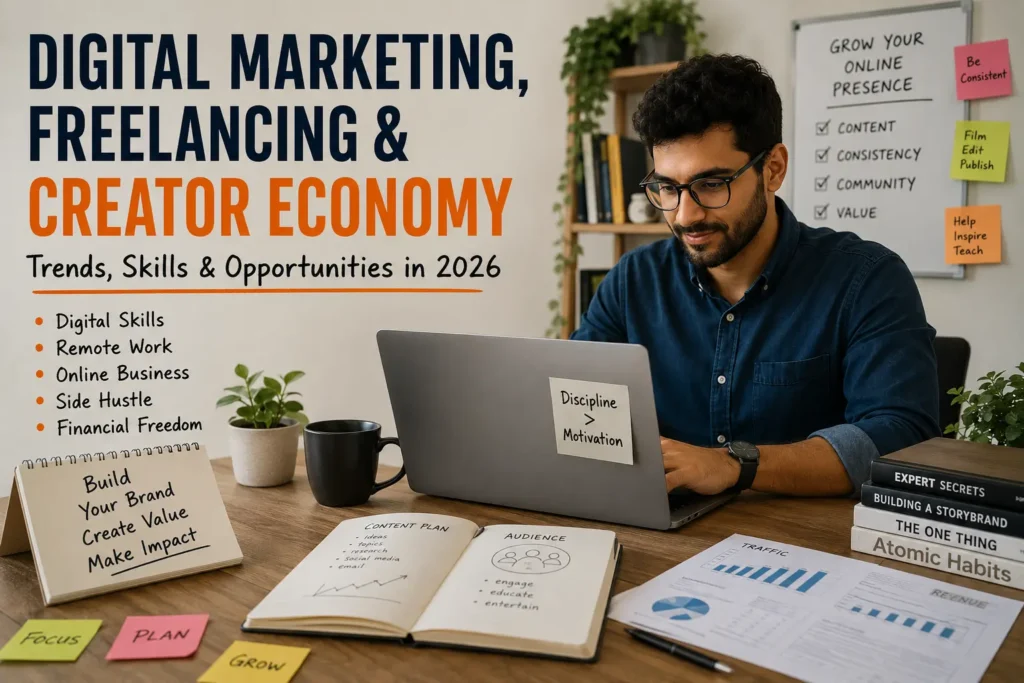
The Digital Marketing, Freelancing & Creator Economy has evolved from a niche opportunity into one of the world’s fastest-growing economic movements. Today, businesses no longer rely solely on traditional advertising agencies or large corporate teams. Instead, they collaborate with freelance specialists, content creators, remote professionals, and digital entrepreneurs who deliver expertise from anywhere in the world.
This shift represents more than a workplace trend—it signals a fundamental transformation in how value is created, distributed, and monetised. As organisations accelerate digital transformation, professionals equipped with digital marketing expertise, advanced digital skills, and entrepreneurial thinking are becoming increasingly valuable across industries.
The creator economy has further accelerated this change. Individuals are no longer dependent on conventional career paths to build sustainable incomes. Through content creation, personal branding, online communities, digital products, and subscription-based business models, creators are transforming knowledge and creativity into scalable businesses.
For executives, founders, and investors, understanding this landscape is becoming a strategic necessity rather than an optional skill.
Why This Topic Matters
Global organisations continue to digitise customer engagement, sales, education, and operations. This has created unprecedented demand for professionals who understand:
- Digital marketing strategy
- Search engine optimisation (SEO)
- Social media marketing
- Performance advertising
- Content marketing
- Marketing automation
- Email marketing
- Data analytics
- AI-powered marketing tools
At the same time, millions of professionals are embracing freelancing as an alternative to traditional employment. Flexible work arrangements, remote collaboration technologies, and global talent platforms have made it possible for businesses to hire specialists regardless of geography.
This convergence of technology, talent, and entrepreneurship is redefining the global labour market.
The Creator Economy Has Become a Business Ecosystem
The creator economy now extends far beyond influencers posting on social media. Modern creators operate as entrepreneurs who manage multiple revenue streams, including:
- Digital products
- Membership communities
- Brand partnerships
- Affiliate marketing
- Consulting
- Online coaching
- Educational content
- Paid newsletters
- Podcast sponsorships
- Software and digital tools
Many creators function like small media companies, employing editors, marketers, designers, and virtual assistants while building global audiences.
This entrepreneurial approach is changing how brands identify partnerships and how consumers discover products and services.
Digital Marketing Powers Every Modern Business
Every successful online business depends on effective digital marketing.
Whether a company sells software, financial services, healthcare solutions, consumer products, or educational programmes, its ability to attract and retain customers increasingly relies on digital channels.
Key disciplines include:
- Search Engine Optimisation (SEO)
- Pay-Per-Click (PPC) advertising
- Social media marketing
- Email marketing
- Conversion rate optimisation
- Marketing analytics
- AI-driven customer targeting
- Content strategy
Organisations investing in these capabilities often gain stronger customer engagement, improved marketing efficiency, and greater competitive advantage.
Freelancing Is Becoming Mainstream
The perception of freelancing has changed dramatically over the past decade.
Rather than serving only as supplemental income, freelancing has become a preferred career path for professionals across technology, finance, marketing, design, consulting, software development, legal services, and education.
Several factors are driving this trend:
- Increased workplace flexibility
- Growing acceptance of remote work
- Access to global clients
- Digital payment platforms
- AI productivity tools
- Cloud-based collaboration software
For businesses, freelancers provide specialised expertise without the long-term costs associated with permanent hiring.
For professionals, freelancing offers greater autonomy, income diversification, and opportunities to work with international clients.
Online Learning Is Closing the Skills Gap
The rapid pace of technological innovation means that continuous learning has become essential.
Professionals are increasingly turning to online courses and online learning platforms to develop new competencies in AI, digital marketing, cybersecurity, leadership, programming, analytics, and business strategy.
Unlike traditional education, digital learning enables professionals to update their knowledge continuously while balancing work responsibilities.
As industries continue evolving, organisations that encourage lifelong learning are likely to maintain stronger innovation capabilities and workforce adaptability.
Market Transformation, AI, and the New Digital Workforce
AI Is Redefining Digital Marketing
Artificial intelligence has become one of the biggest catalysts for the Digital Marketing, Freelancing & Creator Economy. Businesses are increasingly using AI to automate repetitive tasks, personalise customer experiences, analyse consumer behaviour, and improve campaign performance.
Modern marketers now use AI to:
- Generate marketing ideas
- Create content drafts
- Optimise SEO strategies
- Analyse advertising performance
- Build customer segments
- Automate email campaigns
- Improve customer support through AI chatbots
However, AI is not replacing skilled professionals—it is enhancing their productivity. The greatest advantage belongs to marketers who combine creativity, strategic thinking, and data-driven decision-making with AI-powered tools.
For business leaders, investing in AI-enabled marketing capabilities can improve efficiency while allowing teams to focus on higher-value strategic work.
Remote Work Has Expanded Global Opportunities
The rise of remote work has fundamentally changed how organisations build teams and access talent.
Instead of recruiting only within a specific city or country, companies can now hire specialists from around the world. This has opened new opportunities for businesses to scale quickly while accessing expertise in areas such as digital marketing, software development, design, content creation, and consulting.
Remote-first organisations often benefit from:
- Access to global talent pools
- Greater operational flexibility
- Lower infrastructure costs
- Faster hiring processes
- Increased employee satisfaction
- Around-the-clock productivity across time zones
For professionals, remote work provides greater career flexibility and the ability to work with international clients without relocating.
Freelancing Has Become a Strategic Talent Model
Many organisations no longer view freelancing as a temporary staffing solution. Instead, freelancers have become an essential part of modern business operations.
Companies frequently engage freelance professionals for:
- Digital marketing campaigns
- Website development
- Graphic design
- Copywriting
- Video production
- Data analysis
- Business consulting
- SEO optimisation
- Brand strategy
This flexible workforce model enables organisations to access specialised expertise without maintaining large permanent teams.
For executives, the ability to integrate freelance talent into business strategy is becoming an important competitive advantage.
The Creator Economy Is Building New Businesses
The creator economy continues to evolve from content creation into full-scale entrepreneurship.
Today’s creators generate revenue through multiple business models, including:
- Digital products
- Online communities
- Subscription memberships
- Brand collaborations
- Affiliate marketing
- Educational programmes
- Live events
- Merchandise
- Licensing opportunities
- Premium newsletters
Rather than relying on a single income source, successful creators diversify their revenue streams to build more resilient businesses.
This entrepreneurial mindset is inspiring professionals across industries to transform expertise into scalable online ventures.
Online Courses and Digital Skills Drive Career Growth
Technology continues to reshape nearly every profession, making continuous learning essential for long-term success.
Professionals increasingly invest in online courses and online learning to strengthen their digital skills in areas such as:
- Artificial intelligence
- Data analytics
- Digital marketing
- Cybersecurity
- Programming
- Leadership
- Project management
- Financial technology
- Cloud computing
For organisations, upskilling employees helps improve innovation, productivity, and adaptability in rapidly changing markets.
For individuals, continuous learning creates new opportunities for career advancement and business growth.
Side Hustles Are Becoming Sustainable Businesses
What begins as a side hustle increasingly evolves into a profitable online business.
Digital platforms have lowered the barriers to entrepreneurship, allowing individuals to launch businesses with relatively modest investment. Freelancers, consultants, educators, designers, and creators can now reach global audiences through websites, marketplaces, social platforms, and digital payment systems.
Successful side hustles often expand into businesses offering:
- Consulting services
- Online coaching
- Digital downloads
- Software products
- Educational programmes
- Marketing agencies
- Content studios
- E-commerce brands
This shift reflects a broader change in how professionals approach career development—building multiple income streams instead of relying on a single employer.
Leadership Perspective: Building a Future-Ready Workforce
For CEOs, founders, and business leaders, the rise of Digital Marketing, Freelancing & Creator Economy requires a new leadership mindset.
Future-ready organisations are:
- Investing in digital skills development
- Embracing AI-powered productivity
- Supporting flexible work models
- Collaborating with freelance specialists
- Encouraging innovation and experimentation
- Building strong digital brands
- Developing content-driven customer engagement
Leaders who combine technology adoption with continuous learning will be better positioned to attract talent, strengthen customer relationships, and remain competitive in the evolving digital economy.
Future Outlook, Executive Insights, and Strategic Takeaways
Real-World Companies Leading the Digital Economy
Some of the world’s most valuable companies have built their success around digital marketing, the creator economy, and scalable online platforms.
- Google continues to dominate digital advertising through Search, YouTube, and AI-powered marketing solutions.
- Meta has transformed Facebook, Instagram, and Threads into creator-first ecosystems where businesses and individuals reach global audiences.
- LinkedIn has become the leading platform for professional networking, B2B marketing, and thought leadership.
- Amazon enables entrepreneurs to build profitable online businesses through e-commerce, advertising, and fulfilment services.
- Shopify empowers millions of merchants to launch independent online stores and digital brands.
- Canva has democratised content creation, enabling freelancers and businesses to produce professional marketing materials without specialised design expertise.
- OpenAI has accelerated the adoption of AI tools that help marketers, creators, and entrepreneurs improve productivity and content quality.
These organisations demonstrate that digital innovation is no longer confined to technology companies—it is becoming central to every industry.
Emerging Trends Shaping the Future
The Digital Marketing, Freelancing & Creator Economy continues to evolve rapidly. Several trends are expected to define its next phase of growth:
AI-Driven Marketing
Artificial intelligence will further personalise customer experiences, automate campaigns, improve analytics, and enhance marketing decision-making.
Creator-Led Brands
More creators will launch their own products, services, and businesses rather than relying solely on advertising revenue or sponsorships.
Skills-Based Hiring
Employers are increasingly prioritising demonstrated skills and portfolios over traditional qualifications for many digital roles.
Global Freelance Collaboration
Businesses will continue expanding international hiring strategies, accessing specialised talent regardless of geographic location.
Lifelong Learning
Continuous online learning and professional development will become essential as technology evolves at an unprecedented pace.
Multi-Income Careers
Professionals will increasingly combine full-time employment with freelancing, consulting, digital products, or a side hustle to diversify income and build financial resilience.
Challenges Business Leaders Must Address
While the opportunities are significant, executives must also navigate important challenges.
Key considerations include:
- Rapid technological change
- AI governance and responsible use
- Data privacy and cybersecurity
- Increasing global competition
- Talent retention
- Platform dependency
- Constant skills development
- Content saturation
Organisations that proactively address these issues will be better positioned for sustainable growth in the digital economy.
Why CEOs and Founders Should Care
For business leaders, Digital Marketing, Freelancing & Creator Economy is no longer simply a marketing trend—it is reshaping how organisations compete.
Leaders should focus on:
- Building strong digital brands
- Investing in employee digital skills
- Integrating AI into business operations
- Leveraging freelance expertise where appropriate
- Supporting continuous learning
- Expanding remote work capabilities
- Developing scalable online business models
- Creating authentic customer engagement
Businesses that embrace these priorities are more likely to improve agility, attract top talent, and strengthen long-term competitiveness.
Future Outlook
The future belongs to organisations and professionals who combine technology with human creativity.
As AI automates routine work, uniquely human capabilities—including strategic thinking, innovation, leadership, communication, and relationship building—will become even more valuable.
The creator economy will continue expanding beyond social media into education, consulting, software, digital products, and specialised professional services. At the same time, digital marketing will become increasingly data-driven, personalised, and AI-assisted.
For professionals, freelancing, remote work, and online business opportunities will continue growing as companies seek flexible expertise and global talent.
Executive Takeaways
- Digital marketing is now a core business capability across every industry.
- Freelancing has become a mainstream workforce strategy for both professionals and organisations.
- The creator economy is creating scalable entrepreneurial opportunities worldwide.
- AI is enhancing productivity but will reward professionals with strong strategic and creative skills.
- Continuous online learning and digital skills development are essential for long-term career success.
- Businesses that embrace flexible work, innovation, and digital transformation will gain a competitive advantage.
Conclusion
The Digital Marketing, Freelancing & Creator Economy represents one of the most significant shifts in modern business. It is transforming how companies market products, how professionals build careers, and how entrepreneurs create value in an increasingly connected world.
Success in this new era will depend on adaptability, continuous learning, and a willingness to embrace emerging technologies while maintaining a human-centred approach to leadership. Organisations that invest in digital capabilities, encourage innovation, and empower skilled professionals will be best positioned to thrive in the next generation of the global economy.
Rather than viewing these trends as temporary disruptions, forward-thinking leaders should recognise them as the foundation of tomorrow’s business landscape. Those who act today will shape the future of work, commerce, and digital entrepreneurship for years to come.