
Bloom Energy Stock Is Surging. The Bigger Story Is AI Data Centers’ Growing Power Problem

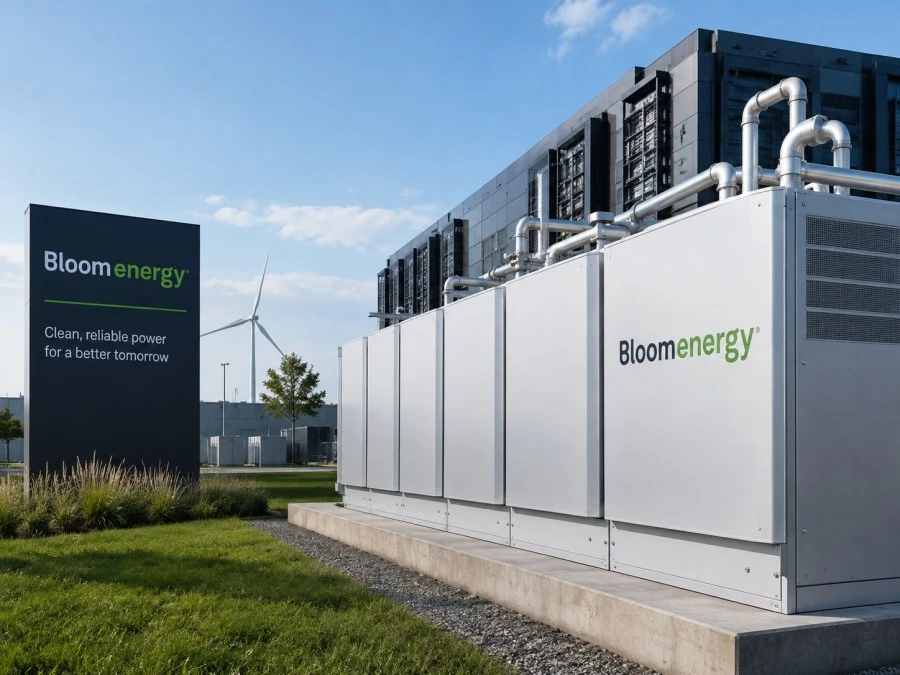
Bloom Energy has moved from a specialized fuel-cell company into the center of the AI infrastructure power debate. In Q2 2026, Bloom reported $1.0654 billion in revenue, up 165.5% year over year, with product revenue rising 215.4% to $935.4 million. The company also raised full-year 2026 revenue guidance to $3.9 billion–$4.2 billion.
The stock’s rise has reflected that shift. Bloom shares gained sharply during the first half of 2026 as investors increasingly treated the company as an AI infrastructure beneficiary rather than solely as a fuel-cell investment.
But the investment case for Bloom Energy stock is no longer simply about fuel cells or clean electricity. It rests on a harder question: can Bloom convert AI’s growing need for rapid, reliable power into repeatable deployments, durable margins and sustained cash generation?
Boardroom Briefing: Key Takeaways
- Bloom Energy generated $1.0654 billion in Q2 2026 revenue, up 165.5% year over year, while product revenue increased 215.4% to $935.4 million.
- AI infrastructure is an increasingly important part of Bloom’s growth strategy as data-center operators seek faster access to power alongside conventional grid infrastructure. Bloom says its solutions have been validated by major U.S. hyperscalers and more than a dozen U.S. neoclouds, AI labs and colocation operators.
- Brookfield expanded its Bloom Energy financing framework from $5 billion to $25 billion, a fivefold increase intended to finance power projects supporting AI infrastructure.
- Oracle intends to procure up to 2.8 gigawatts of Bloom fuel-cell capacity under an expanded partnership, with 1.2 GW initially contracted and deployment underway.
- Profitability improved sharply, with Bloom reporting a 33.4% GAAP gross margin and $182.2 million of GAAP operating income in Q2 2026.
- Valuation remains the central investment question because rapid AI-related demand does not guarantee that revenue growth will translate into equivalent shareholder returns.
- Enterprise buyers should evaluate Bloom through speed-to-power, total cost of ownership, reliability, deployment scalability and capital efficiency rather than the stock narrative alone.
Bloom Energy Has Become an AI Infrastructure Trade—But the Stock Is Pricing in More Than Energy Demand
Bloom Energy stock is increasingly being valued as an AI infrastructure play because Bloom provides onsite power systems that can serve customers facing constraints on conventional grid capacity.
Bloom Energy’s Q2 results provide a strong operating basis for that shift. Revenue reached $1.0654 billion, compared with $401.2 million in Q2 2025. Product revenue rose 215.4% to $935.4 million, while GAAP gross margin reached 33.4%. GAAP operating income reached $182.2 million.
The company also raised its full-year 2026 revenue guidance to $3.9 billion–$4.2 billion, with non-GAAP operating-income guidance of $800 million–$900 million.
Those numbers explain why investors are paying closer attention to Bloom. They do not, however, establish what the stock should be worth.
The more important question is whether the demand supporting Bloom’s growth is structural. If AI data centers increasingly require electricity before conventional grid infrastructure can deliver additional capacity, Bloom is addressing an infrastructure constraint rather than simply selling another energy technology.
That distinction matters to the AI data-center infrastructure boom. The value proposition is not only the price of electricity. It is the economic value of getting usable electricity into service quickly enough to support productive computing capacity.
Bloom CEO KR Sridhar said in the company’s Q2 results that “The demand for Bloom Energy’s solutions keeps accelerating every quarter.” Bloom also said major U.S. hyperscalers and more than a dozen U.S. neoclouds, AI labs and colocation data-center operators had validated and approved its power solutions for AI facilities. Those statements are Bloom’s own claims and should not be treated as independent guarantees of future revenue.
The Real Scarce Resource in AI May Be Megawatts, Not GPUs
For AI data centers, usable electricity is becoming a critical infrastructure constraint because computing hardware cannot generate economic returns until sufficient power and supporting infrastructure are available.
A developer can secure land, financing and computing equipment and still face delays in bringing a facility online if the required electrical capacity is unavailable.
That makes speed-to-power an increasingly important business metric.
For an AI campus with billions of dollars of computing infrastructure, a delayed power connection can delay productive capacity. The economic value of an alternative power source therefore depends not only on its electricity cost but also on how quickly it can support revenue-generating compute.
Bloom’s strategy increasingly centers on this proposition. The company markets its fuel-cell systems as onsite power for customers seeking reliable electricity without relying exclusively on the timing of conventional grid expansion. Bloom’s own data-center materials identify timely access to reliable electricity as a major limitation for data-center development.
The Oracle relationship illustrates the scale of the opportunity. Under an expanded agreement announced in April 2026, Oracle intends to procure up to 2.8 GW of Bloom fuel-cell systems. An initial 1.2 GW has been contracted, with deployment underway and continuing into 2027.
For executives, the relevant question is not simply, “What does a megawatt cost?”
It is: “What is one month of delayed productive computing capacity worth?”
That calculation can materially change the economics of onsite power.
Why Onsite Power Changes the Data-Center Investment Equation
Onsite power can change the data-center investment equation by allowing electricity generation to be located closer to the customer instead of depending entirely on the timing of new grid infrastructure.
Bloom’s Energy Server technology uses solid oxide fuel cells to generate electricity onsite. Bloom positions the systems as reliable, scalable onsite power for data centers and other commercial and industrial customers.
But onsite generation is not automatically the superior option.
A serious enterprise evaluation has to compare deployment speed, total cost of ownership, reliability, fuel exposure, capital intensity and regulatory requirements. Natural-gas availability, emissions requirements, equipment financing, maintenance and operating conditions can all change the final economics.
For a data-center CFO, the comparison should include more than the electricity tariff.
A grid connection may offer attractive long-term economics but require infrastructure upgrades that take years. An onsite system may involve different equipment and fuel costs but bring capacity online earlier. If earlier capacity generates enough additional economic value to outweigh those costs, the apparently more expensive power source can become economically rational.
That is why enterprise energy strategy is becoming part of AI investment planning.
The decision is not fundamentally about choosing a preferred technology. It is about choosing the power architecture that provides sufficient reliability and capacity at an acceptable total cost and within the required deployment window.
Bloom’s Growth Is Accelerating—Can Its Economics Scale With It?
Bloom’s 2026 financial results show exceptional revenue acceleration and improving profitability, but the next test is whether those economics remain durable as deployments scale.
Q2 revenue increased 165.5% year over year, while product revenue climbed 215.4% to $935.4 million. GAAP gross margin reached 33.4%, and GAAP operating income rose to $182.2 million from a $3.5 million operating loss in the prior-year quarter.
Bloom also reported $226.4 million of operating cash flow in Q2 2026.
The first-quarter results provide additional context. Bloom reported $751.1 million of Q1 2026 revenue, up 130.4% year over year, while product revenue increased 208.4% to $653.3 million.
The Q2 result therefore followed an already-strong first quarter rather than representing the first sign of acceleration.
Bloom’s 2026 guidance now calls for $3.9 billion–$4.2 billion in revenue and $800 million–$900 million in non-GAAP operating income.
The next questions are operational.
Can manufacturing capacity expand without eroding margins? Can large customer projects convert into revenue on schedule? Can working capital remain controlled? Can Bloom diversify demand sufficiently to reduce dependence on individual large deployments?
Bloom CFO Simon Edwards said Q2 represented the company’s strongest quarter and described the business as generating profitable growth and positive operating cash flow while investing in capacity.
For investors, AI infrastructure capital spending should be treated as a demand signal, not as a substitute for examining Bloom’s own cash conversion, margins and capital requirements.
The Contrarian Case: AI Demand Does Not Automatically Make Bloom a Great Stock
AI-driven electricity demand can expand Bloom’s addressable market without guaranteeing that Bloom Energy stock will produce equivalent shareholder returns.
That distinction is essential.
A growing market creates an opportunity. Shareholder value depends on how much of that market a company captures, the margins it earns, the capital required to capture it and the valuation investors assign to future earnings.
The first risk is valuation compression. A company can deliver excellent operational results while its stock performs poorly if expectations embedded in the valuation rise faster than actual earnings.
The second risk is deployment conversion. A framework, customer announcement or financing commitment is not automatically recognized revenue or recurring cash flow.
The third risk is technology competition. AI data centers can evaluate grid expansion, natural-gas generation, nuclear power, renewables, batteries and hybrid configurations alongside fuel cells.
The fourth risk is capital intensity. Rapid growth in physical infrastructure can require substantial manufacturing investment, working capital and project financing.
That creates a more demanding benchmark for the stock: Bloom has to execute against expectations, not merely participate in a growing market.
This is where enterprise technology investment risks intersect with the stock thesis. The addressable market can expand while shareholder returns still disappoint if competition, capital requirements or valuation absorb much of the economic benefit.
From Oracle and Hyperscalers to AI Infrastructure Developers: Where Bloom Fits
Bloom’s commercial position is strengthening as hyperscalers, AI infrastructure developers and infrastructure investors seek faster ways to secure electricity for computing facilities.
Oracle is one of the clearest examples. Under the expanded agreement, Oracle intends to procure up to 2.8 GW of Bloom fuel-cell systems, while 1.2 GW has been contracted and is already deploying across Oracle projects in the United States.
Bloom said the Oracle agreement is intended to support Oracle’s AI and cloud infrastructure in the United States.
The financing side is equally important.
On June 30, Bloom and Brookfield increased their AI infrastructure financing framework from $5 billion to $25 billion, a fivefold expansion. Bloom said the increased framework is intended to finance power projects for AI infrastructure globally.
The significance extends beyond the dollar amount. Financing capacity can determine whether a power project moves from a customer requirement to an engineered and deployed asset.
Bloom Chief Commercial Officer Aman Joshi said the expanded commitment reflected market momentum and recently announced large-scale deals. Brookfield’s Sikander Rashid said the expansion reflected the firm’s broader AI infrastructure strategy.
Bloom also said major U.S. hyperscalers and more than a dozen U.S. neoclouds, AI labs and colocation data-center operators had validated and approved its power solutions. That remains a company-reported customer-validation claim, not independent confirmation of future revenue.
The implication for AI infrastructure investment strategy is straightforward: power availability and financing are increasingly being considered alongside compute and data-center capacity when AI infrastructure projects are planned.
The Executive Playbook: How to Evaluate Bloom Energy Beyond the Share Price
Executives evaluating Bloom Energy should use five variables: power-delivery speed, total cost of ownership, reliability, deployment scalability and capital efficiency.
A practical framework is:
- Calculate the value of time.
Estimate the revenue, customer commitments and computing utilization potentially affected by each month of delayed power availability. - Measure total project economics.
Include equipment, fuel, maintenance, financing, grid costs, backup systems and expected operating life. - Test reliability against workload requirements.
AI facilities have high-value computing loads, making power reliability an important part of the total infrastructure equation. - Separate contracted capacity from deployed capacity.
A signed agreement has strategic value, but installed and operating capacity provides stronger evidence of execution. - Track capital efficiency.
Compare revenue growth with working capital, manufacturing investment, operating cash flow and financing requirements.
This five-factor framework should sit alongside an executive AI investment strategy, not replace it.
A CTO planning an AI campus should not begin by asking which energy technology has the strongest narrative.
The better question is: Which power architecture provides the fastest economically viable route to productive compute?
That question forces the organization to evaluate energy, infrastructure and computing as one capital-allocation decision.
The Outlook: Bloom Energy’s Biggest Test Is Converting AI’s Power Shortage Into Durable Economics
Bloom Energy’s long-term thesis depends on whether today’s AI power constraints create sustained profitable demand rather than a temporary surge in infrastructure spending.
The financial evidence has strengthened materially. Bloom generated $2.02 billion of revenue in 2025, and quarterly revenue then accelerated from $751.1 million in Q1 2026 to $1.0654 billion in Q2.
The company also raised its full-year revenue guidance to $3.9 billion–$4.2 billion while expanding its Brookfield financing framework and its commercial relationship with Oracle.
The next 12–24 months will determine whether those results represent a durable operating trajectory or an unusually favorable phase of AI infrastructure spending.
Investors should watch six indicators:
- Revenue conversion: Do announced AI projects become recognized sales?
- Margin durability: Can gross margins remain resilient as volumes increase?
- Cash generation: Does operating growth continue to translate into cash?
- Customer diversification: Does demand broaden beyond a limited number of large projects?
- Deployment velocity: Can Bloom deliver systems at the pace implied by customer demand?
- Competitive economics: Does onsite fuel-cell power remain compelling as utilities, nuclear projects and other generation options expand?
For enterprise leaders, the implication reaches beyond Bloom.
Data-center power demand is becoming a capital-planning issue, not simply an electricity-procurement issue. A facility that secures computing capacity but cannot secure sufficient electricity cannot fully monetize that infrastructure.
For Bloom Energy stock, that creates a credible AI infrastructure opportunity. It also creates a higher standard of proof.
Bloom does not need AI electricity demand to remain merely large.
It needs the economic value of fast, reliable power to remain significant long enough for the company to convert exceptional demand growth into repeatable deployments, durable margins and sustained cash generation.
That is the metric executives and investors should watch beyond the next stock-market headline.
Why is Bloom Energy stock attracting investor attention in 2026?
Bloom Energy stock is attracting investor attention because Bloom has become closely associated with rising demand for power from AI infrastructure. Q2 2026 revenue reached $1.0654 billion, up 165.5% year over year, and Bloom raised its full-year revenue guidance to $3.9 billion–$4.2 billion.
The stock thesis has consequently shifted from a conventional fuel-cell story toward a broader question about AI infrastructure and the economics of obtaining electricity quickly.
Is Bloom Energy benefiting from the AI data-center boom?
Yes, Bloom Energy is benefiting from rising AI-related demand for onsite power, although customer validation does not guarantee future revenue. Bloom says major U.S. hyperscalers and more than a dozen U.S. neoclouds, AI labs and colocation operators have validated and approved its solutions for AI facilities.
The strategic opportunity comes from data-center operators seeking power without waiting exclusively for conventional grid infrastructure.
What is driving Bloom Energy’s revenue growth?
Bloom Energy’s recent revenue acceleration is being driven heavily by product demand, with Q2 2026 product revenue increasing 215.4% year over year to $935.4 million. Total quarterly revenue reached $1.0654 billion.
The company’s Q1 results also showed product revenue growth of 208.4%, indicating that strong product growth was already visible before Q2.
Why is onsite power important for AI data centers?
Onsite power is important because it can give data-center operators an alternative to relying exclusively on the timing of new grid capacity and interconnection infrastructure.
The economic benefit is not necessarily a lower electricity price. It can be the ability to bring revenue-generating computing capacity online sooner.
Is Bloom Energy stock undervalued or overvalued?
Bloom Energy stock cannot be judged by AI demand alone because its valuation must be assessed against sustainable growth, margins, cash generation, deployment visibility and capital requirements.
A rapidly expanding addressable market can support a strong business opportunity while still producing disappointing investment returns if expectations already reflect exceptional future growth.
What are the biggest risks to the Bloom Energy stock thesis?
The biggest risks include valuation compression, deployment delays, manufacturing execution, customer concentration, technology competition, fuel economics, regulation and changes in AI infrastructure demand.
The central risk is a mismatch between the market’s expectations for future growth and Bloom’s ability to convert those expectations into profitable, cash-generating deployments.
What does Bloom Energy’s $25 billion Brookfield partnership mean?
Bloom Energy’s $25 billion Brookfield framework means the financing capacity associated with their AI infrastructure partnership has increased fivefold from the original $5 billion framework. Bloom and Brookfield announced the expansion on June 30, 2026.
The expanded arrangement is intended to finance power projects supporting AI infrastructure; it should not be interpreted as $25 billion of already-deployed capital or recognized Bloom revenue.
What should investors watch next for Bloom Energy?
Investors should watch revenue conversion, gross-margin durability, operating cash flow, customer diversification, deployment velocity, manufacturing scalability and competitive power economics.
The strongest evidence will come from actual deployments and financial results rather than announcements alone.