
Why Hardware Startups Are Rethinking Six-Figure Manufacturing Contracts for a $2,500 Machine

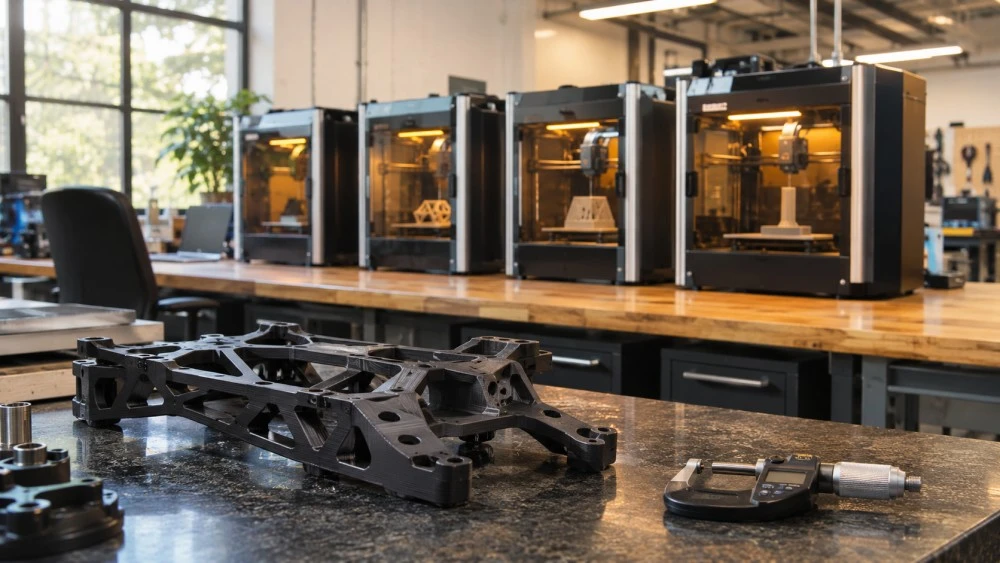
The additive manufacturing market has entered an aggressive price-to-performance collapse as sub-$2,500 prosumer tool-changers with active chamber heating and engineering thermoplastic capabilities begin matching the mechanical output of six-figure industrial systems. While hardware startups rush to slash early capital expenditure by replacing traditional overseas injection mold tooling with decentralized desktop print farms, deploying prosumer platforms without hardened local area network (LAN) isolation risks catastrophic intellectual property leakage and uncontrolled batch failure rates. By deploying structured micro-factory print farms governed by automated quality assurance, closed-loop material validation, and strict air-gapped networks, hardware executives can compress bridge manufacturing cycles from months to days while cutting early-stage capital expenditure by up to 90%.
Boardroom Briefing
- Capital expenditure for industrial-grade additive manufacturing has collapsed from historical benchmarks of $100,000–$250,000 down to sub-$3,000 prosumer platforms like the Bambu Lab H3C.
- Tool-changing architectures eliminate the single-nozzle purge waste and thermal degradation cycle, reducing multi-polymer fabrication times by up to 70% compared to legacy filament-retraction systems.
- Bridge manufacturing using engineering thermoplastics allows hardware companies to fulfill customer deliveries and iterate production units without committing to six-figure overseas steel injection tooling.
- Legacy industrial additive manufacturers face acute margin compression as proprietary material lock-ins and mandatory $15,000 annual service contracts fail to defend their price premium against open-material prosumer hardware.
- Enterprise risk mitigation requires enforcing strict local-only network operation to protect proprietary CAD assets from third-party cloud telemetry and offshore data pipelines.
The Prosumer Encroachment: Dismantling the $100,000 Industrial Additive Moat
The Bambu Lab H3C is a prosumer additive manufacturing platform featuring a 9-toolhead “SwapTek” system, 65°C active chamber heating, and a 350°C hotend that allows rapid switching between functional engineering polymers without single-nozzle purge waste.
For three decades, industrial additive giants like Stratasys and 3D Systems held an iron grip on enterprise engineering departments. They justified six-figure purchase orders through heated build chambers, closed material cartels, and strict service-level agreements. Prosumer machines, while affordable, remained confined to aesthetic visual models due to thermal instability, poor dimensional repeatability, and excessive filament waste.
That technological moat has evaporated. The influx of hardware startup venture financing into agile robotics, defense tech, and medical devices demands rapid hardware iteration cycles that traditional vendor procurement cannot support. When an engineering team can purchase forty professional-grade tool-changing printers for the price of a single legacy industrial machine, the balance-sheet justification for high-capital equipment dissolves.
Industrial Monolith vs. Prosumer Micro-Factory
Single Industrial Machine
Centralized production reliant on proprietary systems and mandatory maintenance.
Parallel Tool-Changer Cluster (x10)
Distributed array delivering continuous multi-material bridge manufacturing.
The Mechanics of SwapTek: How Discrete Toolheads Solved the Multi-Material Bottleneck
Single-nozzle multi-material systems operate by retracting filament, cutting it, purging the melt zone into a waste bin, and feeding the second polymer through the same hotend. This mechanism generates extreme material waste—often exceeding the volume of the part itself—while adding hours of unproductive mechanical cycles to every print.
Discrete toolhead switching fundamentally changes this operational math. By docking inactive extruders in an environmentally regulated chamber and picking up a dedicated toolhead in under six seconds, the machine eliminates purge blocks entirely. Thermal degradation is averted because each polymer stays at its distinct melting temperature, allowing seamless bonding between incompatible polymers such as rigid carbon-fiber skeletons and elastomeric sealing gaskets.
The CAPEX Inversion: Unit Economics of the $2,500 Micro-Factory vs. Offshore Steel Tooling
Manufacturing economic benchmarks reveal that for production volumes below 3,000 units, additive bridge manufacturing reduces per-part amortization costs by up to 65% compared to rapid-tooling aluminum injection molds.
Startups scaling physical products face a brutal financing trap known as the tooling chasm. Machining hardened production molds in East Asia requires upfront non-recurring engineering capital ranging from $40,000 to $120,000, accompanied by a twelve-week lead time. If an early customer identifies a critical thermal or mounting flaw in field trials, that steel mold becomes scrap metal, resetting the company’s financial runway.
Deploying on-premise print farms facilitates reshoring agile manufacturing supply chains. Instead of deploying scarce seed equity into tooling assets that depreciate instantly upon arrival, operations teams run bridge production in-house. They produce customer-ready units on demand, financing scaling through operational revenue rather than premature dilution.
| Production Strategy | Upfront Tooling (NRE) | First 1,000 Units Time | Tooling Modification Cost | Unit Margin Flexibility |
| Class-A Steel Injection Mold | $65,000 – $140,000 | 14–18 weeks | $15,000 – $40,000 (Slow) | Static / Fixed CAD |
| Bridge Aluminum Rapid Tooling | $25,000 – $45,000 | 6–8 weeks | $8,000 – $18,000 (Moderate) | Limited revisions |
| Distributed H3C Micro-Farm | $0 (Machine CAPEX: $25K) | 2–3 weeks | $0 (Instant CAD change) | Continuous iteration |
Eradicating Non-Recurring Engineering (NRE) Costs in Bridge Production
Non-recurring engineering expenses are balance-sheet anchors for hardware ventures. When an enterprise commits to injection molding, every design iteration requires re-sparking electrodes, CNC recutting, and manual tool polishing.
Operating desktop micro-factories transforms capital allocation by optimizing operational capital allocation. A ten-printer fleet amortizes its total capital acquisition cost across the very first 800 finished assemblies. Once that initial batch ships, the equipment remains a paid-for corporate asset ready to pivot to an entirely new product geometry with zero tooling write-offs.
Engineering Thermoplastics on the Desktop: Bridging the Mechanical Property Chasm
Modern prosumer systems with active chamber heating can process advanced engineering thermoplastics including Polyphenylene Sulfide (PPS), Polyphthalamide (PPA), Polycarbonate (PC), carbon-fiber-reinforced Nylons, and flexible elastomeric TPUs down to 75A.
Historically, desktop 3D printers were restricted to cosmetic materials like PLA and PETG, which deform under moderate heat and shatter under mechanical strain. Industrial applications demand materials that withstand continuous automotive under-hood temperatures, chemical washdowns, and cyclic structural loading.
The technical shift in prosumer architecture unlocks advanced materials enterprise engineering. With continuous hotend ratings reaching 350°C and active thermal management stabilizing chamber temperatures at 65°C, prosumer hardware can crystallize semi-crystalline polymers during the deposition process. This prevents layer delamination and ensures isotropic strength across the Z-axis that rivals injection-molded counterparts.
High-Performance Polymer Deposition Pipeline
Feedstock Ingestion
Engineering thermoplastics (PPS-CF, PPA-GF, and flexible 75A TPU) fed through moisture-regulated dry loops.
65°C Chamber Control
Active convective heat regulation ensures continuous semi-crystalline polymer crystallization and suppresses warping.
Discrete Tool Swapping
Dedicated 350°C toolheads switch in under 6 seconds, preventing thermal degradation and eliminating purge towers.
Finished Assembly
Monolithic production part combining rigid structural composite shells with co-extruded elastomeric sealing gaskets.
Thermal Management: 65°C Active Chamber Heating and Composite Fiber Ingestion
Chamber temperature management governs whether an engineering thermoplastic achieves its rated tensile properties or curls off the build plate. Without an actively regulated chamber, polymers with high glass transition temperatures cool unevenly, introducing severe internal stresses that cause part failure during torque testing.
Active 65°C air circulation maintains uniform crystallization throughout multi-hour print jobs. When combined with carbon-fiber-reinforced filaments, the chopped carbon strands align along the print vector, elevating tensile modulus while mitigating anisotropic shrinkage. The result is dimensional stability that holds tolerances within 0.08 millimeters across a 250-millimeter span.
Hybrid Tooling: Co-Extruding Structural Skeletons and Elastomeric Gaskets
Hardware assemblies rarely consist of a single uniform material. Industrial housings require rigid, impact-resistant external shells paired with soft, compliant elastomeric seals to achieve IP67 water and dust ingress protection ratings.
Traditional fabrication requires producing the plastic shell, stamping a secondary rubber gasket, and paying human technicians to manually assemble the components on a line. Tool-changing platforms automate this integration entirely. By dedicating one toolhead to carbon-reinforced polyphthalamide and an adjacent toolhead to a low-durometer thermoplastic polyurethane, the machine co-extrudes the sealing gasket directly into the chassis groove during fabrication, eliminating secondary assembly steps.
The Enterprise IP Dilemma: Cloud Firmware Vulnerabilities in Consumer-Origin Hardware
The primary cybersecurity risks of using prosumer-grade 3D printers in enterprise R&D center on proprietary CAD files, print trajectories, and engineering metadata traversing offshore cloud networks.
Consumer-focused 3D printer manufacturers build their operating models around mobile push notifications, remote video streaming, and proprietary cloud slicing servers. For an enterprise defense contractor or a medical robotics startup, routing unreleased intellectual property through third-party consumer cloud infrastructure violates basic compliance regimes like ITAR and ISO 27001.
This vulnerability presents a major test for enterprise IoT supply chain security. When engineering teams bring consumer hardware onto corporate networks without security oversight, proprietary toolpaths containing precise geometric models can be intercepted, exposed, or cached on offshore infrastructure.
Enterprise Zero-Cloud Perimeter Architecture
Direct local socket dispatch. Print instructions never leave corporate on-premise infrastructure.
Third-party cloud slicing, remote monitoring, and telemetry servers completely blocked at firewall level.
The Air-Gap Mandate: Operating at Scale Without Third-Party Cloud Telemetry
Enterprise engineering leaders must enforce strict network hygiene before integrating prosumer equipment into production environments. Printers must be placed on isolated virtual local area networks (VLANs) with zero external internet routing.
Firmware configurations must be toggled strictly to local-only network mode, routing print jobs exclusively through internal secure sockets layer connections. If a hardware platform demands mandatory cloud handshakes for basic tool-changing operations, it must be barred from production floors containing sensitive corporate intellectual property.
Inside the 20-Machine Farm: How Hardware Startups Scale Low-Volume Final Assemblies
Clustering 10 to 30 low-cost prosumer tool-changers transforms centralized capital expenditures into scalable operational costs, allowing hardware startups to produce end-use parts in parallel while maintaining the agility to alter designs mid-run without tooling write-offs.
Consider an industrial automation scale-up manufacturing custom robotic end-effectors. Under traditional sourcing, the company orders 2,000 units from an overseas supplier to achieve acceptable unit pricing. That capital sits tied up in finished inventory sitting in a warehouse, vulnerable to engineering obsolescence if customer requirements shift.
By operating a micro-factory of twenty tool-changing machines, the company adopts lean hardware product development workflows. The fleet operates in parallel, running twenty distinct customer jobs simultaneously or churning out 200 identical assemblies overnight to fulfill immediate commercial orders.
“When you calculate total cost of ownership across a 1,500-unit pilot run, deploying an array of prosumer tool-changers delivers finished carbon-fiber nylon housings at $18 per unit versus committing $75,000 upfront to overseas injection molds,” says Sarah Lin, Vice President of Hardware Engineering at a venture-backed autonomous mobility company. “The financial advantage is clear: we can alter a structural rib in our CAD model at noon and have twenty validated production units coming off the print beds before the start of the morning shift.”
From Weeks of Prototyping Latency to Continuous 48-Hour Design Iteration
Offshore prototyping introduces systemic administrative drag. A typical tooling modification involves multi-week communications, customs clearance, shipping delays, and incoming inspection overhead.
In-house additive production shortens these feedback loops into hours. Engineering teams test a design on Tuesday, discover a stress fracture during bench testing on Wednesday morning, optimize the internal lattice structure before lunch, and resume full batch production by Wednesday evening. The velocity of product iteration compounds into a decisive commercial time-to-market advantage.
The COO Blueprint: Integrating Low-CAPEX Additive Manufacturing into the Supply Chain
A successful COO deployment of low-CAPEX additive manufacturing integrates decentralized print farms into enterprise production by establishing strict dimensional tolerance bands, automated batch serialization, and in-line metrology verification.
Adopting prosumer hardware requires rigorous operational controls. Treating affordable 3D printers like office appliances leads to high scrap rates and inconsistent mechanical properties across production runs. Operations executives must implement an industrial management structure.
COO 60-Day Micro-Factory Implementation Roadmap
- Deploy centralized dry-air pneumatic feed loops maintaining dew points below -40°C.
- Integrate dedicated high-volume HEPA and activated carbon filtration exhaust.
- Isolate hardware cluster onto a segmented, non-routing industrial local VLAN.
- Standardize compounding lots across certified PPA-CF, PPS, and engineering resins.
- Establish laser-scan dimensional calibration baselines ensuring tolerances under 0.08mm.
- Validate automated optical toolhead calibration protocols across all active print beds.
- Connect fleet status and material telemetry to enterprise ERP / MES systems.
- Formalize modular toolhead hot-swap and maintenance schedules for floor technicians.
- Transition initial bridge-manufacturing run (500–2,000 units) from overseas tooling to the internal farm.
Following this structured distributed manufacturing operational architecture
guarantees repeatable part quality while preserving the capital flexibility that makes micro-factories financially compelling.
Qualifying Functional Tolerances and Instituting In-Line Metrology
Repeatability is the benchmark of enterprise manufacturing. A machine that produces an exceptional part on Monday must deliver the identical dimensional performance across five hundred cycles on Friday.
Operations teams must deploy structured statistical process control across their print fleets. Laser profiling, touch-probe mesh bed leveling, and optical toolhead offset calibrations must be completed automatically before each build cycle. By pairing machine telemetry with coordinate measuring machines (CMM) for batch validation, companies ensure every shipped component adheres to strict automotive and aerospace tolerance bands.
The Future of Distributed Production: How Micro-Tooling Redefines Hardware Venture Scale
The future of distributed production centers on autonomous micro-factory clusters that decouple hardware commercialization from centralized global supply chains and massive minimum order quantities.
The rise of high-performance prosumer tool-changers is not a hobbyist trend; it is the early stage of a structural shift in global manufacturing. The historical economic model—relying on massive offshore capital expenditures, long-distance container shipping, and rigid centralized factories—is giving way to localized, on-demand fabrication nodes.
Forward-looking hardware startups are already proving that software-style agility can finally be applied to physical atoms. By leveraging autonomous micro-factory production models, hardware founders can build profitable, multi-million-dollar physical product enterprises on a fraction of the venture capital historically required. The legacy industrial additive monopoly has been broken, and the competitive advantage now belongs to whoever iterates fastest on the factory floor.