
How AI Assistants Are Changing Workplace Productivity in 2026

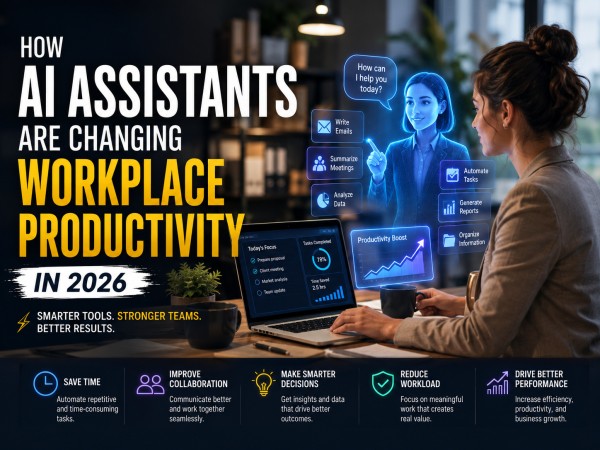
The workplace is experiencing one of the most significant technological transformations in history.
Artificial intelligence is no longer limited to specialized software or complex enterprise systems. Today, AI assistants are becoming everyday tools that help employees work smarter, faster, and more efficiently.
From drafting emails and analyzing data to automating repetitive tasks and supporting decision-making, AI assistants are rapidly changing how organizations operate.
In 2026, businesses across industries are adopting AI-powered assistants to improve productivity, reduce operational inefficiencies, and enable employees to focus on higher-value work.
For business leaders, understanding the impact of AI assistants is essential for preparing organizations for the future of work.
What Are AI Assistants?
AI assistants are software tools powered by artificial intelligence that help users complete tasks, answer questions, generate content, analyze information, and automate workflows.
Unlike traditional software, AI assistants can understand natural language and interact with users conversationally.
Common capabilities include:
- Writing and editing content
- Research assistance
- Data analysis
- Meeting summaries
- Customer support
- Workflow automation
- Scheduling and organization
As AI technology continues to improve, these assistants are becoming increasingly capable and valuable.
Why AI Assistants Matter for Businesses
Modern organizations face growing demands for speed, efficiency, and innovation.
Employees often spend significant time on repetitive administrative tasks that limit productivity.
AI assistants help businesses:
- Save time
- Increase efficiency
- Reduce manual workloads
- Improve decision-making
- Enhance collaboration
- Support innovation
By automating routine activities, organizations can redirect human talent toward strategic and creative initiatives.
AI Assistants Are Automating Repetitive Tasks
One of the most immediate benefits of AI assistants is automation.
Employees spend countless hours on tasks such as:
- Drafting emails
- Creating reports
- Scheduling meetings
- Managing documentation
- Organizing information
AI assistants can perform many of these activities within seconds.
This allows professionals to focus on work that requires critical thinking, creativity, and leadership.
Automation is becoming a major driver of workplace productivity improvements.
Enhancing Communication and Collaboration
Effective communication is critical for business success.
AI assistants help teams communicate more efficiently by:
Drafting Professional Content
Creating emails, proposals, reports, and presentations quickly.
Summarizing Meetings
Generating concise summaries and action items.
Improving Internal Communication
Helping employees share information more effectively.
Supporting Global Teams
Assisting with language translation and communication across regions.
As workplaces become increasingly distributed, AI-powered communication tools are becoming more valuable.
AI Assistants Are Improving Decision-Making
Business leaders rely on data to make informed decisions.
However, analyzing large volumes of information can be time-consuming.
AI assistants help organizations:
- Process data faster
- Identify patterns
- Generate insights
- Create forecasts
- Support strategic planning
Rather than replacing decision-makers, AI assistants provide valuable information that helps leaders make better choices.
Data-driven decision-making is becoming more accessible across organizations.
Customer Service Is Becoming More Efficient
Customer expectations continue to rise.
Businesses are using AI assistants to improve customer experiences through:
- Instant responses
- 24/7 support availability
- Personalized interactions
- Faster issue resolution
- Automated service processes
AI-powered customer support systems help organizations scale service operations while maintaining high levels of customer satisfaction.
AI Assistants and Knowledge Management
Organizations generate enormous amounts of information every day.
Finding and using that knowledge efficiently can be challenging.
AI assistants help employees:
- Locate information quickly
- Summarize documents
- Organize knowledge resources
- Access relevant insights
This improves productivity while reducing time spent searching for information.
Knowledge management is becoming a major application of workplace AI.
The Impact of AI Assistants on Employees
One of the most discussed topics surrounding artificial intelligence is its impact on jobs.
In reality, AI assistants are primarily enhancing human capabilities rather than replacing workers.
Benefits include:
- Reduced administrative burden
- Increased productivity
- Improved work quality
- Better focus on strategic tasks
- Enhanced learning opportunities
Organizations that combine human expertise with AI tools often achieve stronger outcomes than either approach alone.
Challenges of AI Assistant Adoption
Despite their advantages, AI assistants present several challenges.
Data Privacy
Organizations must protect sensitive information.
Accuracy
AI-generated outputs should be reviewed and verified.
Employee Training
Workers need guidance on how to use AI effectively.
Ethical Considerations
Businesses must establish responsible AI usage policies.
Addressing these issues is essential for successful implementation.
What Business Leaders Should Do Next
Leaders seeking to improve productivity with AI assistants should focus on:
Identifying High-Impact Use Cases
Prioritize areas where AI can create measurable value.
Supporting Employee Adoption
Provide training and education.
Establishing Clear Policies
Develop guidelines for responsible AI usage.
Measuring Results
Track productivity improvements and business outcomes.
Organizations that implement AI strategically are more likely to achieve sustainable success.
The Future of AI Assistants
AI assistants are expected to become even more capable during the coming years.
Future developments may include:
- Advanced workplace automation
- Intelligent business advisors
- Real-time decision support
- Personalized productivity tools
- Autonomous workflow management
As technology continues to evolve, AI assistants will likely become standard tools across most industries.
Conclusion
AI assistants are transforming workplace productivity by automating routine tasks, improving communication, supporting decision-making, and enhancing collaboration.
For organizations seeking efficiency and innovation, AI assistants represent one of the most practical applications of artificial intelligence.
Businesses that embrace these tools strategically can improve performance, empower employees, and strengthen competitiveness in an increasingly digital economy.
The future workplace will not simply be powered by technology—it will be enhanced by intelligent assistants working alongside human talent.