
Inside Duetti’s $665M Raise: How Asset-Backed Securitization Is Turning Long-Tail Music IP Into an Institutional Yield Engine

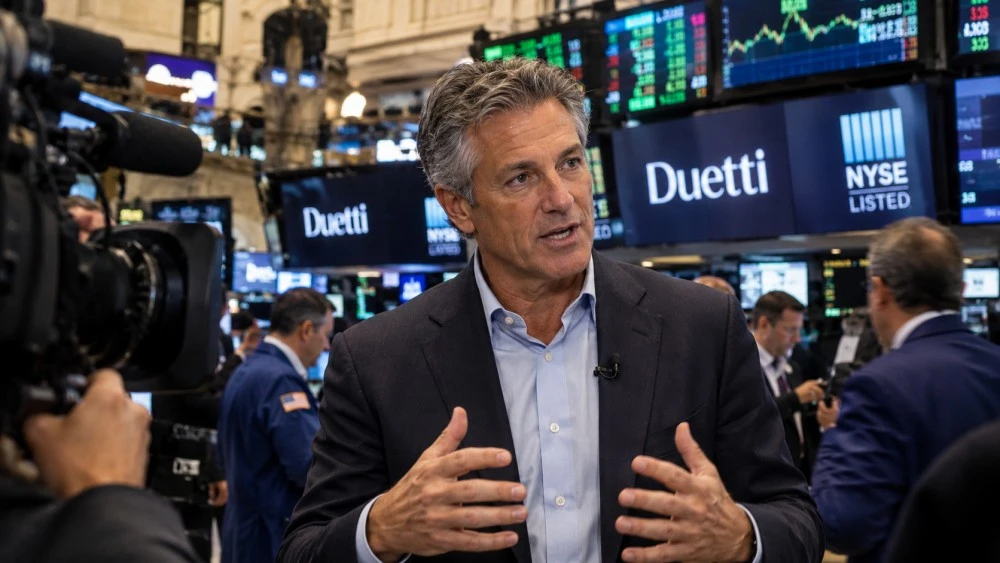
For a decade, Wall Street’s bet on music intellectual property meant writing nine-figure checks for superstar songbooks—a strategy that quickly hit a wall of compressed yields and concentration risk. When Duetti CEO Lior Tibon stepped onto the New York Stock Exchange floor on November 20, 2026, to discuss the company’s newly announced $665 million financing round, he signaled a decisive structural pivot in how private credit underwrites intangible assets. Instead of chasing blue-chip trophies, institutional capital is now industrializing the fragmented long tail through high-velocity, data-driven securitization.
The Boardroom Briefing: Capital Velocity in Fragmented IP
Duetti’s $665 million capital injection pushes its cumulative funding past $1.3 billion since Lior Tibon and Christopher Nolte founded the firm in 2022. The transaction pairs a $450 million asset-backed securitization (ABS)—Duetti’s third such issuance, anchored by global investment giant Carlyle—with $165 million in additional credit capacity and fresh equity commitments.
The macro thesis driving institutional allocators into this structure is straightforward: non-correlated yield. While traditional private equity and real estate credit face refinancing friction, streaming royalties generated by seasoned music catalogs move independently of public equity volatility and interest-rate cycles. Yet legacy catalog funds stumbled because bidding wars for iconic catalogs drove acquisition multiples above 20x Net Publisher Share (NPS), leaving virtually no margin for error when debt costs rose. By aggregating thousands of smaller, independent master and publishing rights at disciplined multiples, Duetti converts fragmented creator assets into institutional fixed-income collateral.
The Capital Stack: Deconstructing the $665M Debt-and-Equity Engine
Securitizing independent music rights requires solving a math problem that traditionally kept rating agencies on the sidelines: individual songs decay unpredictably, but large pools of seasoned tracks behave like predictable annuities. Duetti achieves this statistical stability by bundling over 1,600 distinct catalog investments into diversified collateral pools, drastically lowering its weighted average cost of capital (WACC) compared to standalone corporate debt.
The speed of institutional adoption is visible in Duetti’s own balance-sheet expansion. In January 2026, the company closed a $200 million financing tranche to accelerate catalog acquisitions; ten months later, institutional demand supported a facility more than three times that size. Rather than relying solely on dilutive venture equity to fund asset purchases, Duetti uses equity to build its proprietary underwriting software and seed initial catalog warehouses, then refinances seasoned cohorts into senior ABS tranches once cash flows stabilize.
| Capital Dimension | Legacy Mega-Catalog Model | Duetti’s Tech-Enabled Long-Tail Model |
|---|---|---|
| Target Asset Profile | Blue-chip, decades-old superstar catalogs | 1,600+ independent, mid-tier, and emerging artist catalogs |
| Financing Structure | High-leverage corporate debt & public equity funds | Blended equity + Asset-Backed Securities (ABS) |
| Deal Execution | Bespoke, high-touch M&A ($50M–$500M+ per deal) | High-velocity, algorithmically underwritten micro-M&A |
| Primary Yield Driver | Multiple expansion & passive royalty collection | Acquisition multiple arbitrage + active algorithmic catalog marketing |
| Risk Concentration | Single-artist reputational or catalog-specific shock | Granular diversification across 1,600+ uncorrelated revenue streams |
Unit Economics of the Independent Long Tail vs. Legacy Blockbusters
Independent music catalogs outperform legacy mega-catalogs on risk-adjusted yield because they capture both acquisition multiple arbitrage and post-purchase operational upside. When a public fund acquires a household-name discography, global distribution and sync licensing are already maximized, forcing the buyer to rely purely on passive royalty collection.
In contrast, independent artists, songwriters, and producers frequently lack the capital and data infrastructure to optimize global digital service providers (DSPs). Once Duetti acquires master or publishing rights, its operating teams execute targeted post-acquisition interventions:
- Metadata and Royalty Reconciliation: Auditing international performance rights organizations (PROs) and neighboring rights societies to capture uncollected “black box” royalties.
- Algorithmic Playlist Optimization: Deploying cross-catalog promotional data to place back-catalog tracks onto mood, genre, and regional algorithmic playlists.
- High-Margin Sync Placement: Packaging pre-cleared master and publishing rights—a major friction point for Hollywood and gaming supervisors—to accelerate commercial licensing.
Contrarian Pitfalls: Where IP Roll-Up Models Fracture
Treating streaming royalties as perpetual fixed-income cash flows ignores two structural vulnerabilities: aggressive royalty decay curves in newer music and platform payout dilution. Unlike a 40-year-old classic rock song whose listener base has plateaued, a three-year-old independent track often experiences steep streaming attrition after its initial viral cycle fades. If an aggregator underwrites a catalog during a temporary algorithmic spike without discounting for natural decay, the collateral pool risks cash-flow shortfalls before the senior ABS notes amortize.
Here is the disconnect for credit underwriters: platform economics are shifting beneath the collateral. Major DSPs have moved toward “artist-centric” royalty models that penalize low-stream tracks and redistribute pool payouts toward top-tier labels, while generative AI audio threatens to flood algorithmic discovery feeds with synthetic tracks. Institutional buyers evaluating media ABS facilities must stress-test collateral against both platform demonetization thresholds and rising competition for listener share.
Enterprise Case Study: Industrializing High-Frequency Micro-M&A
Executing over 1,600 catalog acquisitions in four years would bankrupt a traditional media company through legal and accounting overhead alone. Duetti solved this bottleneck by replacing bespoke investment banking diligence with automated data ingestion. Prospective sellers connect their distributor and royalty dashboards directly into Duetti’s valuation engine, which parses historical track-level payouts across dozens of territories in hours rather than months.
This operational blueprint extends well beyond entertainment. B2B roll-up operators in vertical SaaS, e-commerce brand aggregation, and niche patent licensing face the exact same unit-economic trap: human diligence costs destroy the margin on sub-$5 million acquisitions. The winners in fragmented asset aggregation are rarely the firms with the cheapest initial equity; they are the operators whose software ingests raw transaction ledgers, automates standardized legal closing, and predicts post-close cash-flow decay with enough precision to satisfy rating agencies.
The C-Suite Playbook: Monetizing Illiquid Intangible Assets
Enterprise CFOs and private credit allocators can apply Duetti’s capital-markets playbook directly to balance-sheet intellectual property and recurring revenue streams:
- Isolate Seasoned Cash Flows for ABS Warehousing: CFOs sitting on predictable, contracted IP—such as enterprise software maintenance renewals, franchise royalties, or patent licensing pools—should ring-fence cohorts with at least 36 months of audited payout history to unlock non-dilutive securitized debt.
- Underwrite the Data Pipeline, Not Just the Asset: Private credit allocators evaluating tech-enabled aggregators must audit the borrower’s automated ingestion and decay-modeling accuracy; without proprietary underwriting software, high-frequency M&A quickly becomes adverse selection.
- Build Active Post-Close Value Creation: Never price an IP acquisition solely on historical run-rate cash flows; require a repeatable operational playbook—whether metadata cleanup, cross-selling, or pricing optimization—that expands net yield after closing.
As private credit expands beyond physical real estate and corporate buyouts, software-driven securitization is turning previously unbankable intangible assets into Wall Street’s next standardized fixed-income asset class.