
The Multi-Billion-Dollar Wet Lab Problem: Why Investors Are Pouring Capital into AI Drug Discovery Platforms

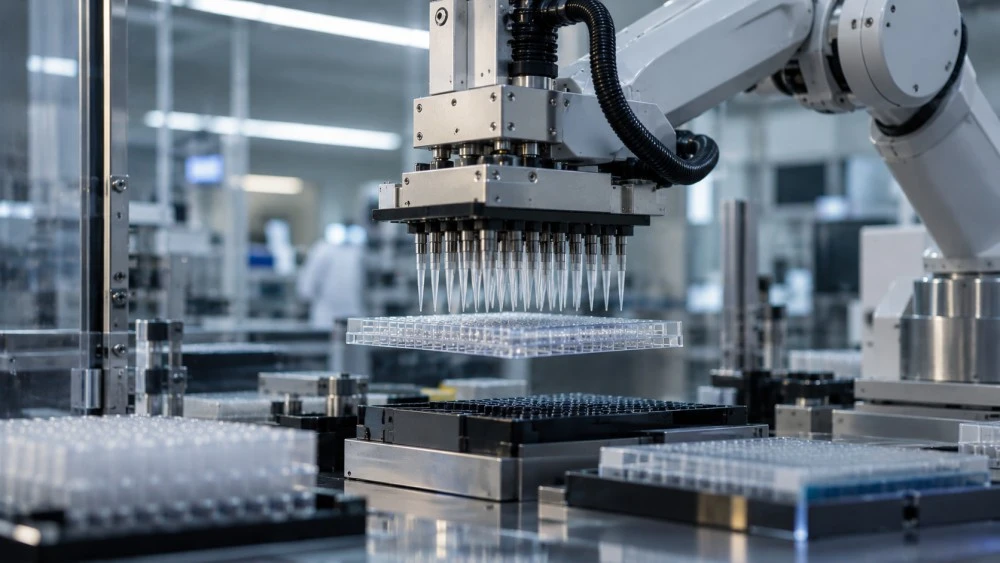
With the capitalized cost of bringing a single novel therapy to market surpassing $2.6 billion and early-stage wet-lab discovery cycles consuming up to five years of burn rate, venture capital has deployed tens of billions into AI-driven drug discovery platforms to compress preclinical lead times. Yet, replacing manual pipettes with in silico screening has revealed a stark systemic trap: generating millions of computational candidates without proprietary, high-fidelity biological assay validation merely shifts the multi-billion-dollar failure bottleneck into Phase II clinical trials. This briefing dissects the emerging “closed-loop wet lab” operating model, unpacking how top-tier biotech leaders and institutional investors are re-engineering the economics of pharmaceutical R&D to convert algorithmic speed into clinically viable assets.
Boardroom Briefing
- Eroom’s Law remains the primary economic drag on biopharmaceutical development, with inflation-adjusted drug approvals per billion dollars of R&D halving roughly every nine years since 1950.
- Closed-loop automation delivers measurable financial returns only when computational predictions are paired directly with robotic wet assays that validate candidates within 48 to 72 hours.
- Proprietary assay data has superseded generic algorithmic architectures as the primary valuation moat for venture funds evaluating Series A and Series B TechBio platforms.
- Phase II clinical trials continue to claim approximately 90% of development-stage assets, proving that rapid molecular generation does not insulate programs against systemic biological failure.
- Platform-plus-pipeline deal structures now dominate enterprise biopharma transactions, requiring early-stage biotechs to prove both an internal pipeline and an industrialized discovery engine.
- Regulatory frameworks from the FDA and EMA through recent 2025 and 2026 machine learning validation guidelines demand audit-ready data provenance before computational targets enter human trials.
Beyond Eroom’s Law: The Mathematical Collapse of Traditional Wet-Lab Economics
Eroom’s Law describes the persistent economic reality that pharmaceutical R&D efficiency halves approximately every nine years, driving the real capitalized development cost per approved therapy past $2.6 billion under legacy screening methods. While computing power has expanded exponentially under Moore’s Law, drug discovery has experienced the inverse. The Tufts Center for the Study of Drug Development confirms that post-discovery clinical translation remains stubbornly inefficient, weighed down by physical lab operations that rely on manual trial and error.
The life sciences sector is responding with unprecedented capital reallocation. According to industry valuation data, the global market for AI in drug discovery reached $3.1 billion in 2025 and is projected to expand past $16.8 billion by 2032, maintaining a compound annual growth rate above 27%. This influx reflects acute balance-sheet pressures across the enterprise. Patent expiries on blockbuster biologics are forcing corporate development teams to replenish clinical pipelines under tightening macroeconomic pressures on early-stage life sciences capital. The traditional wet lab, characterized by rows of manual pipettes, static petri dishes, and bespoke human execution, has become a liability to financial sustainability.
The Inverted Funnel: Why High-Throughput Screening (HTS) Delivers Diminishing Marginal Yields
High-throughput screening was designed to industrialize molecule discovery, yet it operates on a fundamentally flawed premise: brute force testing of random chemical libraries. Research teams routinely run millions of physical compound assays against an isolated biological target, only to emerge with hit rates below 0.1%. Most identified hits dissolve into irreproducible noise during downstream validation.
The financial cost of these false trails is staggering. A single chemical optimization campaign requires synthesis teams to manually manufacture hundreds of molecular analogues over 18 to 36 months. The resulting structure-activity relationship models are fragmented and slow to generate. Physical screening alone fails because biology operates as a dynamic network of complex cellular pathways, not a static lock-and-key mechanism.
Deconstructing the $2.6 Billion Asset: Where Preclinical R&D Bleeds Enterprise Capital
The capitalized expenditure of bringing a novel drug to market is heavily front-loaded into early target identification, compound optimization, and manual assay cycles that burn capital before establishing clinical proof-of-concept. The landmark financial analyses by Scannell and colleagues demonstrate that cost inflation stems primarily from cumulative candidate failure rather than individual experimental expenses.
When institutional allocators examine the preclinical balance sheet, timeline drag emerges as the primary destroyer of net present value. Spending four years in early hit-to-lead development burns millions in operational overhead while shortening the window of market exclusivity post-patent approval. Institutional allocators are actively adjusting their venture capital asset allocation models in deep tech to prioritize platforms that truncate this capital bleed. By shifting candidate design to predictive machine learning architectures, biopharma leadership teams can eliminate unviable chemical families before commissioning physical synthesis.
Burn Rate vs. Biological Ground Truth: The High Cost of Assay False Positives
The true expense in early-stage discovery is not the experiment that fails quickly; it is the experiment that succeeds spuriously. Artifact hits that display artificial binding activity in clean in vitro assays often trigger multi-million-dollar lead optimization programs before demonstrating severe in vivo toxicity.
These false positives consume dry powder that early-stage biotechs cannot afford. When a lead compound fails 18 months into an optimization cycle due to previously undetected clearance issues, the entire capital tranche allocated to that target is permanently lost. Biopharma executives must recognize that generating biological ground truth early is the only viable hedge against balance-sheet destruction.
The Closed-Loop Paradigm: Orchestrating Dry-Lab In Silico Design with Automated Wet Labs
A closed-loop TechBio platform functions by cyclically generating de novo molecular candidates through generative neural networks, testing them via automated robotic assays, and piping real-world biological feedback back into the training architecture within hours. Rather than treating computational models and physical laboratories as disconnected business units, modern platform operators link them into a continuous operational loop.
Algorithms generate novel chemical structures targeted at specific binding pockets. Automated acoustic liquid handlers and robotic imaging stations immediately test these predictions against cellular targets. The quantitative assay data returns directly to the computational model to recalibrate its neural weights. This operational feedback loop mirrors agile product development, transforming biotechnology from an artisanal scientific endeavor into an industrialized engineering discipline. Forward-thinking executive teams are adopting these methodologies as core components of their broader enterprise AI deployment strategies
The Continuous Data Feedback Architecture
Active Learning Loops: Reducing Preclinical Hit-to-Lead Optimization from 4 Years to 9 Months
Active learning transforms the traditional discovery sequence from a static pipeline into an iterative cycle. Under legacy protocols, medicinal chemists design a molecule, wait six weeks for contract research synthesis, wait another month for biological screening, and manually review the results.
In a closed-loop platform, the model selects only the chemical variants that maximize information gain. It identifies the gaps in its own predictive confidence and tasks automated liquid handlers to run the exact assays required to resolve that uncertainty. Companies operating these closed systems have demonstrated reductions in hit-to-lead timelines from four years down to nine months.
Data Moat Architecture: Why Proprietary ‘Negative Data’ Outweighs Foundation Model Scale
The primary strategic moat in computational life sciences is not access to public datasets or foundational transformer architectures; it is the systematic accumulation of proprietary negative data. Public databases like ChEMBL and academic literature are distorted by positive-publication bias. They document what worked, systematically ignoring the 99% of experiments that failed.
“Foundational models trained solely on public data hit an immediate ceiling,” explains Dr. Elena Rostova, General Partner at Cambridge Deep Tech Ventures. “When you ask a model to predict molecular stability based only on published successes, it hallucinates unviable chemistry. The enduring enterprise value belongs to the teams generating millions of automated data points weekly, capturing precisely why and where a molecule failed. In the boardroom, proprietary negative data is the only defensible IP.”
The Phase II Mirage: Why Faster Target Discovery Has Not Yet Fixed Clinical Attrition
Rapid computational candidate generation fails to reduce clinical attrition when algorithms optimize purely for binding affinity while ignoring the complex systemic biology and unexpected off-target toxicities that derail 90% of assets in human clinical trials. Speed in target discovery does not inherently equal clinical validity. Generating an optimized lead in three months is financially meaningless if the biological target itself does not drive disease progression in human tissue.
Industry clinical trial data reveals that Phase II remains the primary valuation graveyard, accounting for the vast majority of developmental terminations. The underlying reasons are consistent: lack of clinical efficacy and unforeseen systemic toxicity. Algorithmic platforms that focus solely on molecular docking often fail to predict how a molecule behaves within complex human organs. TechBio leadership must ensure their computational models account for systemic pharmacokinetics, tissue distribution, and off-target metabolomic reactions long before human trials commence.
Algorithmic Confirmation Bias: The Risk of Training Next-Gen AI on Flawed Historical Literature
Large language and chemical models trained on historical research absorb decades of human confirmation bias. Academic literature is filled with targets that achieved initial validation in flawed rodent models or contaminated cell lines, only to fail repeatedly in commercial translation.
If an enterprise trains its predictive discovery engine on these historical corpora, the algorithm simply learns to optimize candidates for unviable targets faster. The recent regulatory guidance from the FDA and EMA for AI/ML tools emphasizes this exact risk. Regulators are shifting scrutiny from algorithmic code to the provenance and biological relevance of the training data. Computational biopharma startups that cannot provide clear documentation for target selection risk complete regulatory paralysis during Investigational New Drug (IND) filings.
Inside the New TechBio Blueprint: How Market Leaders Bridge the Silicon-Biology Divide
Enterprise life sciences leaders succeed by establishing capital-efficient hybrid organizational structures that integrate computational machine learning directly into robotic laboratory workflows rather than siloing software engineers from laboratory researchers. Pioneer organizations such as Recursion Pharmaceuticals, Isomorphic Labs, Insilico Medicine, and Insitro have moved past the initial software-only hype.
Recursion, for instance, has constructed massive automated wet labs that generate petabytes of high-content cellular imaging data weekly. Their models do not merely predict molecular binding; they analyze morphological changes across diseased cells treated with thousands of compounds. Similarly, Insilico Medicine has advanced internal candidates from target discovery to Phase II trials entirely through end-to-end generative AI engines. These organizations are structuring joint ventures with global biopharma majors facing impending biopharma M&A and patent cliff exposure, using their computational engines to rapidly replenish expiring enterprise drug franchises.
Comparative Analysis: Software Licensing vs. Internal Clinical Pipeline Development
TechBio management teams must navigate a foundational corporate structure dilemma: operate as a pure-play software vendor or develop an internal clinical asset pipeline.
TechBio Capital Allocation Split
SaaS Multiples vs. Clinical Asset Equity Upside
Software & Platform Licensing
- • Lower CapEx: Minimal capital exposure to wet lab burn
- • Predictable Margins: High gross software margins & fast recognition
- • Exit Valuation: 5x – 8x EV/Revenue traditional multiples
- • Strategic Tradeoff: Zero clinical asset ownership or drug royalties
Internal Clinical Asset Pipeline
- • High Capital Intensity: Heavy clinical trial balance-sheet requirements
- • Valuation Arbitrage: Massive step-ups upon hitting clinical milestones
- • Exit Valuation: 15x – 30x Multiples on Phase II clinical readouts
- • Commercial Rights: Full retention of worldwide drug monetization
While software licensing offers predictable recurring revenue and higher software-style gross margins, it caps enterprise valuation upside. The true value accretion in life sciences occurs when an asset clears Phase I and Phase II trials. Leading TechBio enterprises are increasingly adopting a hybrid posture: licensing their platforms to enterprise pharma for upfront cash and milestone royalties, while retaining full equity ownership of two or three high-conviction internal drug candidates.
The Executive Investment Playbook: Conducting Due Diligence on AI-Native Biopharma Platforms
Rigorous due diligence on computational biology platforms requires evaluating the proprietary origin of experimental training data, the empirical speed of laboratory feedback loops, and verified progression into human trials rather than abstract parameter counts. C-suite teams and investment committees cannot evaluate TechBio startups through standard SaaS valuation frameworks.
Building an enduring life sciences business requires managing executive alignment during technological transformation, especially when bridging cultural divides between software engineers and laboratory biologists. Furthermore, board members must maintain strict criteria for measuring ROI on capital-intensive AI infrastructure. Deploying tens of millions of dollars into high-performance GPU clusters delivers zero enterprise value if those processors are fed on poorly curated wet-lab data.
4 Non-Negotiable Benchmarks for Evaluating Computational Biology Startups
- Assay Feedback Latency: The platform must execute wet-lab verification and pipe biological readouts back into model training within 72 hours of molecular generation.
- Proprietary Negative Data Share: More than 40% of the training corpus must consist of internally generated non-binding or failed experimental assays to prevent algorithmic confirmation bias.
- Phase I Translation Efficiency: Preclinical development candidates must demonstrate target engagement in translationally relevant human tissue models, not just simplified rodent proxies.
- Capital Burn per Lead Optimization: The platform must demonstrate a minimum 50% reduction in capital expenditure required to advance an asset from initial screen to IND submission compared to legacy peers.
The Future of Biopharma Valuation: From Bespoke Science to Industrialized Computational Discovery
The biopharma valuation model is shifting permanently from single-molecule lottery tickets to industrialized biological operating systems that produce recurring, de-risked clinical candidates. The historic justification for pharmaceutical pricing—that billions in revenue are required to offset an inherently broken discovery process—is losing its economic foundation.
As closed-loop architectures standardize cellular modeling and regulatory authorities formalize machine-learning compliance standards, the premium on pure wet-lab capacity will deteriorate. Enterprise value will consolidate around firms that control both the predictive algorithms and the automated biological engines generating continuous ground truth. For executive leadership, the mandate is unambiguous: modernize the physical laboratory or watch capital migrate to platforms that can engineer biological outcomes with computational precision.