Meta’s $145B AI capex drove its first cash deficit since 2012. Here is how the 2027 Class C stock split shields founder control while funding compute.

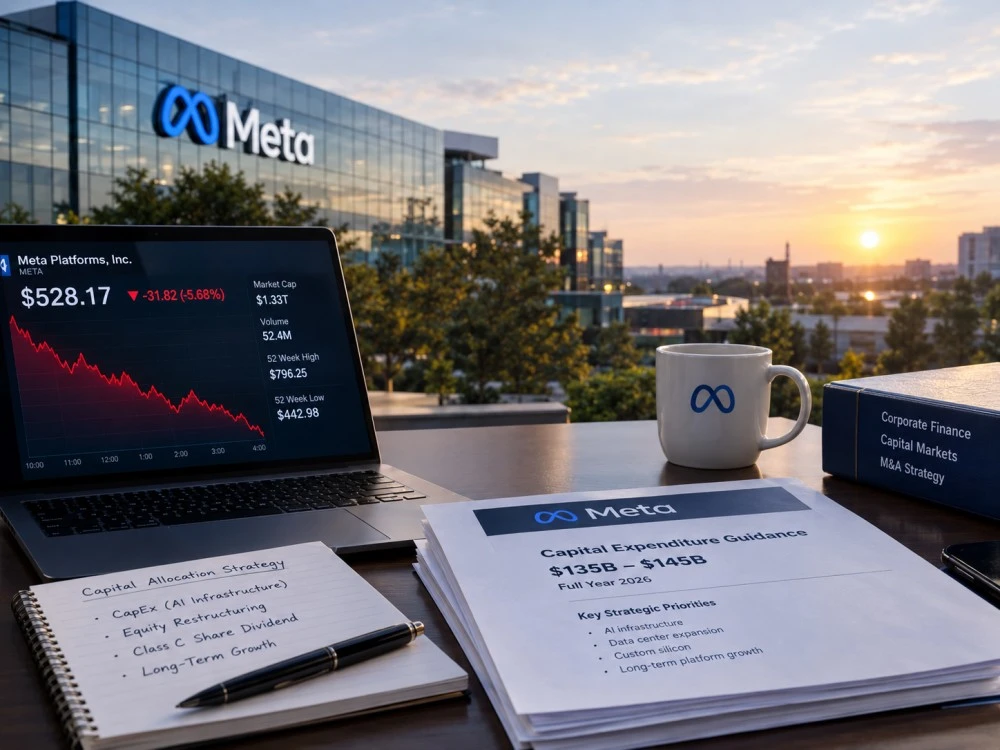
Meta Platforms expanded its full-year capital expenditure guidance to a historic ceiling between $135 billion and $145 billion, driving the company into its first quarterly free cash flow deficit of $2.12 billion since 2012 despite an annualized revenue growth rate of 26 percent. Mainstream financial desks misread the subsequent trading drop as an operational stumble, missing the critical corporate finance reality: sovereign-scale artificial intelligence infrastructure cannot be funded indefinitely through operational cash flows without either diluting existing equity or accepting restrictive debt covenants. This analysis outlines the mechanics of Meta’s planned 2027 Class C stock dividend, presenting enterprise leaders with a blueprint for insulating founder control while generating the equity reserves required for generational computing investments.
Boardroom Briefing
- Negative Free Cash Flow: Meta recorded a negative quarterly free cash flow of $2.12 billion in late 2026, marking its first operating cash deficit in fourteen years due to unprecedented data center procurement and a $9.89 billion state litigation charge.
- The Class C Defense: The scheduled January 19, 2027 stock split functions as a 1:1 non-voting Class C share dividend, generating liquid currency for future acquisitions without diminishing Mark Zuckerberg’s 61 percent voting power.
- Institutional Selling: The drop in Meta stock price reflects Wall Street’s unease with compressed hardware depreciation windows, pulling tech benchmark indices lower as markets reassess enterprise return profiles.
- Hyperscale Balance Sheet Shift: The transaction signals that multi-billion-dollar artificial intelligence roadmaps will require fundamental equity restructuring rather than pure balance-sheet cash allocation.
- Founder Governance Benchmark: Dual-class capitalization frameworks are rapidly becoming the preferred operational barrier against activist hedge funds during capital-intensive infrastructure buildouts.
Inside Meta’s First Free Cash Flow Deficit Since 2012
Meta’s negative free cash flow of $2.12 billion stems from an aggressive upward revision of its annual capital expenditures to $145 billion alongside an immediate $9.89 billion legal settlement with state attorneys general.
According to regulatory disclosures filed with the Securities and Exchange Commission, top-line quarterly revenue reached $51.2 billion, up 26 percent year-over-year. The core digital advertising machine generated operating income sufficient to sustain normalized expansion. The problem sits on the infrastructure ledger. Chief Financial Officer Susan Li confirmed on the company’s Q3 earnings call that server procurements and custom silicon fabrication commitments absorbed all operational cash generation.
| Financial Metric | Q3 Figure |
|---|---|
| Top-Line Revenue | $51.2 billion (+26% YoY) |
| Operating Cash Generated | $24.8 billion |
| Capital Expenditure (CapEx) | $17.1 billion |
| Projected CapEx Run Rate | Toward $145 billion |
| One-Time State Settlement | $9.89 billion |
| Net Free Cash Flow | -$2.12 billion |
When multi-billion-dollar litigation charges collided with the purchase of next-generation server clusters, operating cash flows failed to cover total commitments. The company dipped into its liquid cash reserves for the first time in fourteen years.
This operational pivot highlights the severe dynamics of hyperscale enterprise compute economics
. Building proprietary computing clusters requires capital commitments that exceed the cash generation capacity of even high-margin software platforms. Enterprise leadership teams must recognize that staying competitive at the frontier requires structural capital management rather than modest line-item adjustments.
Why Is Meta Stock Down Today? Market Volatility and Accelerated Depreciation
Meta stock is down today because institutional portfolio managers are repricing the company’s operating margins after management shortened server hardware depreciation schedules from five years to three years.
When markets opened, the meta stock price dropped 5.8 percent, pulling the meta share price down toward technical support levels. Retail forums raised the question of why is meta stock down today, pointing to the top-line revenue beat as evidence of market irrationality. On institutional trading desks, the reaction centered entirely on margin compression.
Accelerating hardware depreciation timelines across hundreds of thousands of enterprise processors introduces immediate, recurring non-cash amortization charges. When high-performance hardware becomes obsolete in 36 months instead of 60 months, net operating margins drop automatically.
The sell-off extended across broad indices. Because Meta carries substantial weighting in both capitalization-weighted tech portfolios and the broader market, the downward momentum triggered institutional tech portfolio rebalancing
. The tech-heavy nasdaq composite dropped 1.4 percent within the opening hour of trading, while high-liquidity index vehicles like qqqm stock and the S&P 500-tracking voo stock experienced immediate outflows. The drop was not a sign of operational failure; it was an institutional repricing of how long it takes to see financial returns on advanced computing hardware.
| Ticker / Index | Asset Role | Impact / Dynamics |
|---|---|---|
| META | Hyperscale Operator | Down 5.8% on capital expenditure guidance |
| NVDA | Hardware Vendor | Direct beneficiary of hyperscaler spending |
| GOOG / GOOGL | Enterprise Peer | Evaluating multi-class capital flexibility |
| QQQM / QQQ | Nasdaq-100 Index ETF | Intraday decline driven by Big Tech valuation multiple resets |
| VOO / SPY | S&P 500 Index ETF | Broad-market valuation multiple compression |
The 2027 Class C Share Architecture: Engineering Equity Without Governance Loss
A Class C non-voting stock dividend is defined as an equity recapitalization mechanism wherein a company issues non-voting common shares to existing shareholders on a pro-rata basis to create an acquisition and compensation currency without diluting insider voting control.
On January 19, 2027, Meta will execute a 1:1 stock dividend, effectively completing a corporate recapitalization. Every registered owner of Class A or Class B common stock will receive one share of newly minted Class C non-voting stock. The move addresses the search spike around meta stock split 2027 and the broader mechanics of the meta stock split.
Engineering the 1:1 Stock Dividend Without Voting Dilution
The planned split preserves the existing ten-to-one voting ratio enjoyed by Class B super-voting shares, which Mark Zuckerberg controls. Under traditional corporate structures, issuing hundreds of millions of new shares to recruit machine learning engineers or complete major acquisitions dilutes founding leadership.
By creating a parallel Class C trading class with zero voting rights, executive leadership protects itself through dual-class voting share mechanisms.
“Public markets are effectively being asked to underwrite the single largest capital deployment in corporate history without receiving a proportional voice in capital allocation,” notes Marcus Vance, Managing Partner at Vance Securities Law Group. “This recapitalization builds a corporate structure that allows the board to sustain consecutive quarters of negative cash flow while keeping hostile takeovers and activist interventions completely off the table.”
Building an Equity War Chest for Generative Compute & M&A
Class C equity provides Meta’s treasury with liquid paper that can be issued freely on the open market. Over the next five years, competition for frontier AI startups will intensify. Paying all-cash premiums for multi-billion-dollar model developers would completely drain corporate reserves.
With Class C stock trading on public exchanges under its own ticker, corporate development teams can execute equity-driven frontier tech acquisitions
without giving target founders or outside venture funds board seats or proxy voting rights.
The Myth of the “Retail-Friendly” Stock Split
Framing corporate stock splits as democratization tools for retail liquidity fails because fractional-share execution technology renders share nominal price reductions operationally irrelevant compared to strategic voting power retention.
Mainstream commentary often praises stock splits for lowering the nominal price, claiming it brings everyday investors back into the market. That logic fell apart years ago. Modern retail brokerages allow market participants to buy fractional slices of equity down to single dollars. The corporate decision to split shares has nothing to do with retail accessibility.
The primary objective is the entrenchment of executive authority. Dual-class recapitalizations insulate founders against environmental, social, and governance (ESG) coalitions and institutional shareholder proposals. When corporate leadership enters a multi-year cycle of massive capital investment with delayed returns, activist funds typically try to step in, demand stock buybacks, and push for lower R&D spend. By using Class C equity to absorb future capital needs, Meta strips outside investors of any leverage to challenge its infrastructure roadmap.
Meta vs. Big Tech: The Diverging Paths of Capital Allocation
Capital allocation strategies across Big Tech have split into two distinct models: pure hardware suppliers extracting immediate cash margins, and platform hyperscalers funding balance-sheet-heavy computing infrastructure.
| Metric / Profile | Meta Platforms (META) | Nvidia (NVDA) |
|---|---|---|
| Primary Balance Sheet Role | Infrastructure Builder | Hardware Vendor (Supplier) |
| Free Cash Flow Trend | Deficit (-$2.12 billion) | Expanding (+78% YoY) |
| Governance Structure | Dual/Tri-Class (Founder-Insulated) | Single-Class Common (Standard Board Control) |
| CapEx-to-Operating Cash Ratio | High (>55%) | Asset-Light, Fabless Model
The contrast between Meta and Nvidia illustrates this dynamic. While investors tracking nvda stock enjoy expanding operating margins from selling high-priced hardware, Meta has become a captive buyer of those same systems. Nvidia extracts cash from the market; Meta converts its cash into physical data center assets that lose value over 36 months.
The dynamic is equally clear when comparing Meta to Alphabet. Facing activist demands around search monetization, Alphabet launched its own non-voting Class C equity structure (trading as GOOG) a decade ago, setting the precedent that Meta is now replicating. While google stock maintains cash diversification across enterprise cloud contracts and software subscriptions, Meta’s business model relies heavily on its core digital advertising engine to support massive infrastructure investments.
Microsoft chose a third path, offloading significant upfront computing liability through joint ventures and multi-partner off-balance-sheet commitments. Meta, by contrast, is internalizing the entire stack, betting that full ownership of proprietary data centers will yield structural cost advantages over the coming decade.
The Strategic Playbook: The Enterprise CFO Guide to Capital-Intensive Tech Pivots
Enterprise infrastructure sustainability dictates that annual capital expenditures exceeding 40 percent of operating cash flow will trigger negative free cash flow cycles unless mitigated by external equity restructuring or debt facilities.
For finance chiefs and executive boards managing large-scale infrastructure investments, Meta’s capital maneuver offers four clear operating lessons:
1. Establish Tiered Share Classes Before Peak Spend
Do not wait for cash flow to turn negative before proposing governance restructuring. Launch non-voting equity classes during periods of strong market performance, establishing a non-dilutive equity currency years ahead of major investment cycles.
2. Stress-Test Hardware Depreciation Cycles
Recalibrate internal hurdle rates against 36-month hardware depreciation timelines. Running software-style five-year amortization schedules on specialized accelerator chips misrepresents balance sheet strength and invites sudden market corrections. Deploy enterprise balance-sheet stress-testing
across all infrastructure programs.
3. Protect Baseline Shareholder Yield
When operational cash flows decline, protect base dividend distributions and share buyback programs to prevent automatic divestment by institutional index funds. Use debt facilities to smooth out dividend obligations rather than canceling capital returns and triggering institutional sell-offs.
4. Provide Transparent Utilization Metrics
Counter market skepticism by linking capital expenditure updates to direct workload efficiency metrics. Disclose revenue yield per megawatt of data center capacity rather than just sharing total capital spent. This transparency helps institutional analysts evaluate operational progress instead of fixating entirely on cash burn.
Executive Outlook: Sovereign AI, Founder Autocracy, and the 2027 Horizon
Dual-class corporate governance represents a permanent structural transformation in how major technology platforms build physical and digital capacity.
The strategic choice facing enterprise leadership teams is clear. Companies that rely on standard single-class equity structures remain vulnerable to quarterly market pressures, activist campaigns, and cost-cutting mandates that can disrupt multi-year technology buildouts. Meta’s planned 2027 restructuring shows how far founder-led corporations will go to protect their long-term vision from outside interference.
This model carries real corporate governance risks. Concentrating power around founder governance and board accountability
gives leadership the freedom to move fast, but it strips public shareholders of an effective check against prolonged capital misallocation. As Meta approaches its January 2027 Class C distribution date, boards across every industry will be watching closely to see if founder control can turn an unprecedented infrastructure bet into durable shareholder value.