
The Hidden Economics of Forestry Mulching—and What Contractors Must Get Right

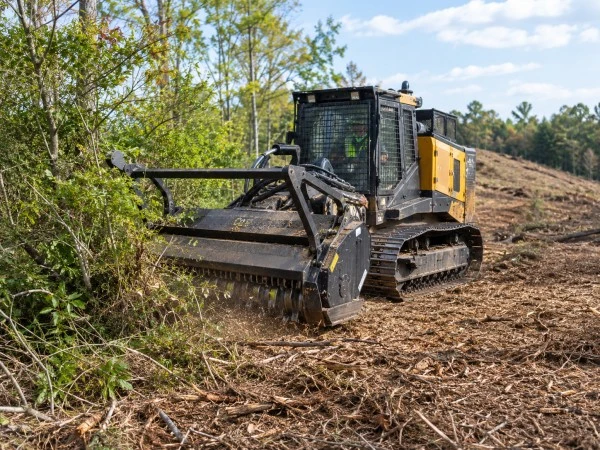
Forestry mulching gives land-clearing contractors a way to serve construction, agricultural, utility, and vegetation-management customers with specialized equipment. But a high hourly rate or a large contract does not guarantee a profitable business: underused machinery, underestimated production time, and unpriced operating costs can erode margins. For contractors and investors, the critical decision is how to match equipment investment with dependable demand, realistic job economics, and disciplined capital allocation.
Boardroom Briefing: Key Takeaways
- Forestry mulching economics depend on productive machine hours, site-specific output, and the full cost of delivering each job.
- Equipment utilization determines how effectively contractors spread fixed ownership costs across productive work.
- Project pricing must reflect terrain, vegetation density, transport, cutting-tool wear, and the required finish.
- Equipment ownership offers greater operational control but exposes contractors to financing costs, repairs, and idle capacity.
- Recurring contracts can improve workload visibility, although payment terms, penalties, and uncertain work volumes still create risk.
- Operating data helps contractors improve bids, measure project margins, and decide when to expand their fleets.
Forestry Mulching Is an Equipment-Services Business, Not Just a Land-Clearing Method
Forestry mulching is a mechanical vegetation-management process that uses specialized cutting equipment to shred brush, saplings, and woody vegetation into mulch at or near the work site. Its commercial value depends on the site conditions, customer requirements, and cost of achieving the required result.
Demand can come from several sources:
- Commercial and residential site preparation.
- Agricultural land management and property maintenance.
- Utility rights-of-way and infrastructure corridors.
- Public-sector vegetation management and habitat restoration.
- Selective clearing and wildfire-fuel reduction where appropriate.
A documented procurement example illustrates the breadth of the opportunity. In January 2026, the City of Charlotte, North Carolina, issued a request for proposals for forestry-mulching services covering city-managed properties and rights-of-way. The solicitation included vegetation clearing, invasive-species management, erosion control, and ecological maintenance. Its evaluation assigned equal weight to technical approach, qualifications, equipment and resources, and cost.
The procurement matters because it shows that commercial buyers may evaluate more than the lowest quoted price. Equipment capability, documented experience, work planning, and compliance can influence a contractor’s ability to compete.
The operating method also has limits. Mulching, conventional clearing, hauling, and other vegetation-management methods produce different results and have different costs. A contractor should select the method that meets the customer’s specifications rather than assume mulching is automatically the cheapest or most environmentally suitable option.
The Real Cost of a Mulching Rig Begins Before the First Billable Hour
The fully loaded cost of a forestry mulcher is the total relevant cost of owning or accessing the equipment and operating it, divided by the productive hours or completed work those costs support.
The U.S. Forest Service’s technical report, Determining Fixed and Operating Costs of Logging Equipment, provides an established framework for examining equipment investment, depreciation, labor, and operating expenses. Although it is not a current forestry-mulcher price guide, its cost-accounting principles remain useful for building a contractor’s own model.
Separate fixed costs from variable costs
Fixed and capacity-related expenses include financing or depreciation, insurance, storage, and certain administrative costs. Variable costs include fuel, wear parts, repairs, and other expenses that increase with operating activity.
Labor and transportation need careful treatment. An operator may be paid for a full shift even when the machine is productive for only part of it. Likewise, a job requiring a long haul can consume substantial time and money before any vegetation is cleared.
| Cost category | What to track | Financial implication |
|---|---|---|
| Equipment and attachment | Financing, depreciation, or rental | Capital burden |
| Fuel and consumables | Fuel and wear parts per productive hour | Variable cost |
| Labor | Wages, payroll burden, benefits | Crew expense |
| Maintenance and downtime | Repairs, service, lost capacity | Reliability risk |
| Transport and mobilization | Hauling, travel, setup | Project-level expense |
| Insurance and overhead | Relevant allocated costs | Full-cost recovery |
Contractors should also distinguish cash flow from accounting profit. Loan principal affects cash flow but is not an accounting expense in the same way as interest or depreciation. Counting the same capital cost twice can distort the investment decision.
Calculate the true cost of productive hours
The basic calculation is:
Fully loaded cost per productive hour = Total relevant costs for the period ÷ Productive machine hours during that period.
The denominator matters. Engine hours are not necessarily productive hours, and productive hours are not necessarily billable hours.
A machine that runs for 1,000 hours does not automatically generate 1,000 hours of revenue. Travel, repositioning, repairs, waiting for access, and unpriced cleanup can all reduce the share of operating time that earns money.
Productivity and Utilization Decide Whether the Business Can Earn an Adequate Return
Equipment utilization determines how effectively a contractor spreads ownership and capacity-related costs across productive work, while production rate determines how much completed work the machine delivers per hour.
Build bids around site-specific output
Acres per hour is not a universal equipment specification. Production changes with vegetation density, tree diameter, terrain, ground conditions, slope, access, machine configuration, operator experience, and required finish.
A contractor clearing light brush on accessible ground may achieve a different output from one working through dense woody growth on uneven terrain. Quoting both projects at the same rate without accounting for those differences can create a substantial pricing error.
The solution is to collect actual job data and classify it by site conditions. Estimates should reflect comparable projects, not the best production result ever achieved.
Model utilization instead of guessing
Consider a hypothetical machine with $60,000 in annual fixed and capacity-related costs. The following scenarios are illustrative calculations, not industry averages or recommendations.
| Annual productive hours | Fixed cost per productive hour |
|---|---|
| 400 | $150 |
| 600 | $100 |
| 800 | $75 |
| 1,000 | $60 |
The formula is annual fixed costs divided by annual productive hours. Variable operating costs, labor, and other applicable expenses must still be added.
The table demonstrates why an additional machine can damage profitability if the business cannot secure enough work. More available capacity does not create demand.
Production speed also changes project economics. If direct machine operating cost is $200 per productive hour, completing two acres per hour produces a direct machine cost of $100 per acre. At one acre per hour, that cost rises to $200 per acre.
The implication is straightforward: contractors need both a utilization forecast and a realistic production estimate before committing to an equipment purchase.
Ownership, Rental, or Subcontracting? Choose the Capital Model That Fits Demand
Owning a forestry mulcher is most attractive when reliable demand supports its total cost; renting or subcontracting can be preferable when workload is uncertain or intermittent.
When ownership makes sense
Ownership gives contractors greater control over equipment availability and scheduling. It may also make sense when a business has recurring work, qualified operators, dependable maintenance support, and sufficient financial capacity to absorb repairs or slow periods.
The decision should include financing terms, expected service life, residual value, insurance, maintenance, and the cost of capital. A signed contract helps, but only if its volume, duration, pricing, and payment terms support the investment.
When flexibility is worth paying for
Rental and subcontracting can reduce the need to commit capital before demand is established. They also introduce different risks, including limited equipment availability, rental minimums, subcontractor pricing, and less direct control over delivery.
| Decision factor | Ownership | Rental | Subcontracting |
|---|---|---|---|
| Upfront capital | Generally highest | Generally lower | Generally lower |
| Availability | Subject to machine uptime | Subject to rental supply | Subject to contractor capacity |
| Maintenance | Primarily owner’s responsibility | Depends on agreement | Primarily subcontractor-managed |
| Flexibility during slow periods | Lower | Higher, subject to terms | Higher, subject to availability |
| Operational control | Generally high | High while rented, subject to terms | Depends on contract |
| Principal risk | Idle capital and repairs | Rental expense and availability | Pricing and delivery dependence |
A practical decision is to compare the total cost of each option for the same workload and period. Include mobilization, operator labor, maintenance obligations, downtime exposure, and the cost of scheduling uncertainty.
Equipment financing and capital allocation for growing contractors is a relevant internal-link placement here. The editorial connection is capital discipline: equipment should be purchased because expected demand supports the investment, not because financing makes the monthly payment appear affordable.
The Per-Acre Pricing Trap Can Turn a Busy Contractor Into an Unprofitable One
Forestry-mulching cost per acre depends on direct operating cost, actual production, and the work included in the contract; a single headline rate cannot establish profitability.
Separate production cost from the quoted price
The basic calculation is:
Direct machine cost per acre = Direct machine operating cost per productive hour ÷ Acres completed per productive hour.
That result is only one part of the bid. Contractors must account for mobilization, non-machine labor, site-specific expenses, overhead where appropriate, contingency, and their required profit contribution.
Before submitting a price, establish:
- The vegetation and terrain included in the scope.
- The required cutting height and finish.
- Access restrictions and transport requirements.
- Treatment of obstacles, protected vegetation, and unexpected conditions.
- Whether cleanup, repeat visits, or additional work will be charged separately.
- How delays, changed conditions, and scope changes will be handled.
These terms matter because a seemingly profitable quote can become a loss if the customer expects work that was never included in the original estimate.
Stress-test the assumptions before signing
A contractor should model at least three cases: expected production, slower production, and a downside case involving a repair or significant delay.
For example, if a project requires twice as many productive machine hours as forecast, direct machine costs can rise sharply even if the quoted contract price remains unchanged. A long mobilization or an unexpected access restriction can compound the loss.
The contrarian point is that more acres and more revenue do not necessarily produce more profit. Growth can worsen cash flow when equipment commitments, operating expenses, and unpaid invoices expand faster than profitable demand.
Recurring Vegetation-Management Contracts Can Improve Visibility—but Not Eliminate Risk
Recurring vegetation-management contracts can improve workload visibility when customers provide credible work schedules and commercially viable terms, but contracted revenue is not automatically guaranteed profit.
Evaluate the quality of contracted revenue
Executives should look beyond the total contract value. Relevant factors include:
- Guaranteed versus estimated work volumes.
- Contract duration and cancellation rights.
- Payment schedules and collection risk.
- Fuel or other cost-escalation provisions.
- Performance requirements and penalties.
- Renewal conditions and customer concentration.
A large contract with uncertain volumes or unfavorable payment terms may create more risk than several smaller, well-priced projects.
Understand the buyer’s operating priorities
Public-sector and infrastructure buyers may evaluate equipment, technical methodology, qualifications, cost, reporting, and compliance together.
Charlotte’s 2026 forestry-mulching solicitation offers a concrete example: the city evaluated four categories equally, including technical approach, qualifications, equipment and resources, and cost. The request also specified work-planning and reporting requirements.
For contractors, this suggests that commercial competitiveness involves more than buying a powerful machine. Reliable documentation, clear work plans, competent operators, and the ability to meet the scope can affect access to larger contracts.
Working-capital management for equipment-intensive businesses is a useful related editorial topic. A contractor must be able to pay operators, fuel suppliers, and maintenance providers while waiting for customer payments.
No executive interview or independently verified contractor financial dataset was supplied for this article. The Charlotte procurement is a documented public-sector example, not proof that any specific contractor earned a particular margin or achieved a specific return.
What Contractors Should Measure Before Expanding the Fleet
A forestry-mulching operating dashboard should connect field productivity to project margins and cash flow, allowing management to identify which jobs and equipment investments generate acceptable returns.
The most useful measures include:
- Productive hours versus available hours: Shows how much potential capacity generates actual work.
- Billable hours versus paid operating time: Identifies time that the business is absorbing without equivalent revenue.
- Acres completed by site type: Improves estimates for comparable future projects.
- Fuel and wear-part cost per productive hour: Tracks major variable expenses.
- Unplanned downtime: Highlights reliability problems and lost capacity.
- Mobilization cost per job: Reveals whether travel and setup are eroding small-project margins.
- Contribution margin by project: Measures revenue remaining after the costs directly attributable to the work.
- Days sales outstanding: Shows how long customer invoices remain unpaid.
- Revenue concentration: Identifies dependence on a small number of customers.
- Forecast versus actual production: Helps management refine bids and identify recurring estimating errors.
The dashboard is useful only if definitions remain consistent. For example, a utilization measure based on engine hours cannot be compared directly with one based on billable hours.
Predictive maintenance and industrial equipment telematics can support this process when machine data helps operators anticipate service needs, record operating time, or identify recurring downtime. Technology should be evaluated against measurable improvements in maintenance planning, productive capacity, or cost—not purchased on the assumption that data collection automatically improves performance.
The Strategic Playbook: Five Checks Before Buying Another Mulcher
Contractors should treat fleet expansion as an investment decision supported by validated demand, realistic production assumptions, and downside analysis.
1. Validate demand. Build a forecast from signed contracts, credible customer commitments, qualified opportunities, and historical seasonality. Separate confirmed work from speculative pipeline revenue.
2. Verify productivity. Use actual job records and site-specific estimates. Record the conditions that produced each result so that exceptional jobs do not become misleading planning assumptions.
3. Calculate full costs. Include equipment costs, labor, fuel, wear parts, repairs, downtime, transport, insurance, and relevant overhead. Keep cash-flow and accounting-profit calculations separate.
4. Stress-test the downside. Model slower production, lower utilization, repair events, delayed payments, and price pressure. Confirm that the business can meet its financial commitments if expected work fails to materialize.
5. Set an investment hurdle. Compare the incremental cash flow and risk-adjusted return from ownership against rental, subcontracting, and alternative uses of capital. Define the conditions that would justify the purchase before signing a financing agreement.
For a growing operator, building a scalable field-services business requires more than increasing machine count. It requires consistent estimating, repeatable field processes, capable crews, effective contract management, and sufficient working capital.
The competitive advantage will belong to contractors who measure more than acres. Businesses that connect operating data to bid accuracy, customer profitability, and capital allocation will be better positioned to distinguish sustainable growth from expensive expansion.