
Why Verizon Stock Fell: How SpaceX’s Spectrum Deal Threatens Telecom Competition

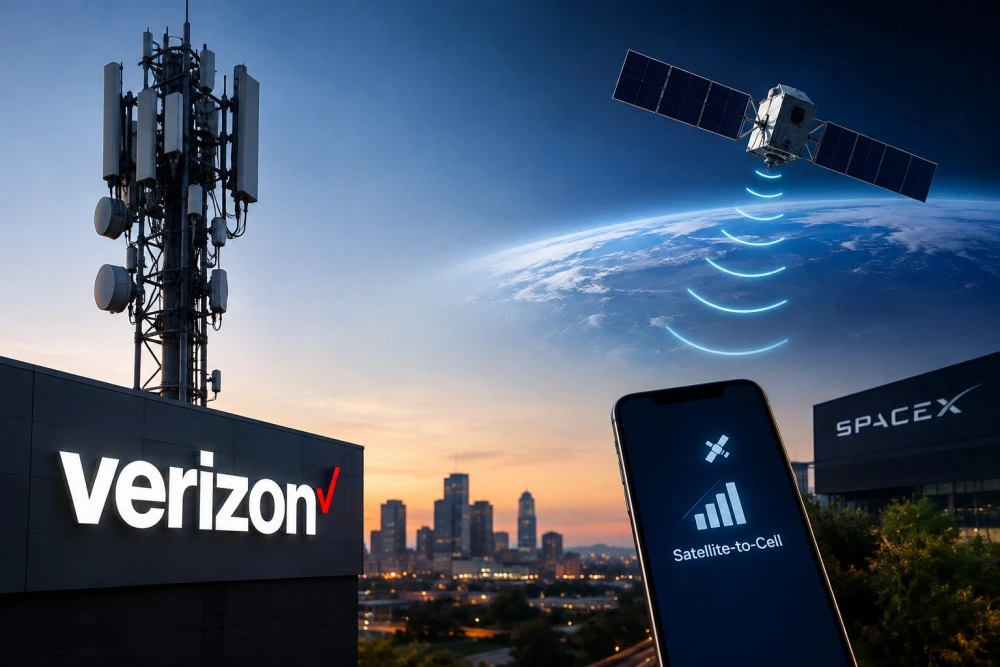
Verizon stock came under pressure on October 9 after SpaceX agreed to acquire a nationwide low-band spectrum portfolio in a deal reportedly valued at $8 billion, raising concerns about the future of U.S. wireless competition. The immediate selloff reflects expectations of disruption, not evidence that Verizon has already lost customers or earnings to Starlink Mobile. For executives and investors, the critical question is whether satellite connectivity can eventually weaken carrier pricing power, subscriber retention, and the cash flow that supports network investment and shareholder returns.
Boardroom Briefing: Key Takeaways
- Verizon Stock: Verizon shares fell during a broad telecom selloff after SpaceX’s spectrum announcement, but the price reaction alone does not establish a deterioration in Verizon’s operating performance.
- SpaceX Spectrum: The proposed acquisition covers Grain Management’s nationwide 800 MHz spectrum portfolio, including up to 14 MHz of paired frequencies, subject to regulatory approval.
- Wireless Competition: Starlink Mobile could challenge conventional carriers in underserved markets before becoming a meaningful alternative for mainstream urban subscribers.
- Cash-Flow Resilience: Verizon’s subscriber churn, service revenue, capital expenditure, and free cash flow will help determine whether satellite competition creates a material financial threat.
- Market Signals: Telecom tower operators rose as wireless carriers fell, suggesting investors are considering how satellite services might interact with terrestrial infrastructure.
- Investment Discipline: Investors must separate the market’s immediate reaction, including any ex-dividend price adjustment, from evidence of lasting competitive disruption.
Why Verizon Stock Fell on October 9: The SpaceX Spectrum Deal Behind the Selloff
Verizon stock fell in premarket trading as investors reassessed the threat of a new competitor with ambitions to combine satellite coverage and conventional mobile services. Reuters reported that Verizon, AT&T, and T-Mobile declined between 5.5% and 7.4% in premarket trading on October 9, following news of SpaceX’s spectrum agreement.
The proposed transaction involves Grain Management’s nationwide 800 MHz spectrum portfolio, with up to 14 MHz of paired frequencies. The deal was reported to be worth approximately $8 billion, although the companies did not disclose financial terms in their initial announcement. The transaction remains subject to Federal Communications Commission approval and other closing conditions.
Low-band spectrum matters because signals can travel farther and penetrate buildings more effectively than higher-frequency signals under comparable conditions. For SpaceX, the acquisition could strengthen the terrestrial component of its Starlink Mobile strategy and expand the range of services it can offer customers.
But a spectrum acquisition is not the same as a functioning nationwide wireless network. SpaceX must still navigate regulatory requirements, technical integration, deployment economics, and customer adoption.
The market reaction also requires careful interpretation. October 9 was reported as Verizon’s ex-dividend date, which can mechanically reduce a share price by approximately the dividend amount, all else being equal. Investors should not attribute the entire decline to SpaceX without examining the adjusted price movement and the broader market context.
The immediate selloff signals a reassessment of competitive risk. It does not prove that Verizon’s subscriber base, revenue, or earnings have already been damaged.
How Starlink Mobile Could Challenge Verizon’s Wireless Business Model
Satellite-to-cellular connectivity links compatible mobile devices to satellite networks, potentially extending service beyond the reach of conventional terrestrial networks. Its competitive significance depends on whether the technology can deliver reliable service at a price that customers consider attractive.
Traditional carriers such as Verizon have invested heavily in terrestrial infrastructure, spectrum licenses, network capacity, and customer distribution. Satellite connectivity offers a different route to coverage, particularly in remote locations where building and maintaining cell sites can be expensive.
SpaceX’s spectrum acquisition could help it pursue a more direct role in mobile communications. Reuters reported that Morgan Stanley analysts viewed the transaction as evidence of a more aggressive spectrum acquisition strategy, with competitive pressure likely to emerge gradually, beginning in rural markets.
Three markets deserve particular attention:
- Rural and remote coverage: Satellite connectivity could improve service in areas where terrestrial coverage is limited or costly to extend.
- Industrial operations: Mining, logistics, agriculture, energy, and transport operators may value connectivity across large geographic areas.
- Mainstream mobile service: Direct competition for ordinary smartphone customers would pose a larger threat, but would require sufficient capacity, dependable service, compatible devices, and compelling pricing.
The distinction between a complementary service and a substitute is critical. A customer may use satellite connectivity as a backup without cancelling a Verizon subscription. The financial threat grows when customers can replace their existing mobile service or use the new option to negotiate lower prices.
For enterprise buyers, the relevant question is not simply whether satellite coverage exists. It is whether the service meets operational requirements for availability, latency, throughput, security, and cost.
The Financial Stakes: Verizon’s Pricing Power, Churn, and Free Cash Flow
The financial impact of satellite competition will depend on whether it changes Verizon’s subscriber economics, service revenue, or cash generation—not simply whether another company enters wireless communications.
Verizon’s second-quarter 2026 results provide a useful baseline. The company reported $10.2 billion in free cash flow for the first half of 2026, up 16% from $8.8 billion in the comparable 2025 period. It also reported $18.4 billion in operating cash flow and $8.2 billion in capital expenditure during the first six months.
Those figures matter because Verizon enters this competitive debate with a substantial existing network and a cash-generating business. Its challenge is to maintain those economics while responding to changing customer expectations and possible new competitors.
Executives and investors should focus on five measures:
- Subscriber churn: Are customers cancelling or switching providers at a faster rate?
- Average revenue per user (ARPU): Is competitive pressure forcing lower prices or weaker plan upgrades?
- Customer acquisition costs: Does Verizon need more promotions or retention spending to keep subscribers?
- Capital expenditure: Must the company invest more aggressively to maintain coverage and service quality?
- Free cash flow: Can operating cash generation continue to support network investment, debt management, and dividends?
Verizon’s second-quarter guidance projected full-year 2026 capital expenditure of $16 billion to $16.5 billion and free-cash-flow growth of 9% to 10%. These are company forecasts issued before the SpaceX announcement, not guarantees of future performance.
The key analytical test is whether subsequent operating results force Verizon to revise those expectations. A stock-price decline can precede a fundamental change, but it can also reflect investors pricing in a risk that takes years to materialize.
For investors examining Verizon’s free cash flow and dividend sustainability, the distinction is central: a lower share price does not automatically make a stock undervalued if future earnings power is also weakening.
Three Scenarios for Verizon as Satellite-to-Cellular Competition Scales
Verizon faces three plausible competitive outcomes, ranging from satellite connectivity that complements existing networks to a more direct challenge to mainstream mobile services.
Scenario One — Complementary Coverage and Limited Subscriber Displacement
Satellite services improve connectivity in rural areas, on remote routes, and at industrial sites where terrestrial coverage is weak. Verizon retains its core customer relationships and urban network advantages, while satellite connectivity serves as a supplement or partner service.
In this scenario, the acquisition could expand consumer choice without materially damaging Verizon’s pricing power. The carriers might also explore partnerships rather than treating every satellite provider as a direct retail rival.
Scenario Two — Targeted Disruption in Underserved Markets
Starlink Mobile attracts customers in selected regions or specialized use cases. Traditional carriers respond with targeted pricing, coverage improvements, or wholesale arrangements.
The financial consequences may initially be concentrated in specific markets. Executives would need to track local churn, pricing differences, and the cost of retaining affected customers rather than assuming that nationwide subscriber losses are inevitable.
Scenario Three — Structural Competition for Mainstream Wireless Customers
Satellite capacity, device integration, and service economics improve enough to make satellite-enabled plans a credible substitute for conventional wireless service across a broader customer base.
This is the most consequential scenario for Verizon. A meaningful shift in subscriber retention or average revenue per user could change long-term cash-flow expectations and force a reassessment of capital allocation.
The evidence that separates these scenarios is measurable: commercial launch milestones, retail pricing, compatible-device adoption, subscriber migration, and changes in carrier guidance. None should be inferred from the initial market reaction alone.
The Contrarian Case: Why SpaceX’s Spectrum Acquisition Does Not Automatically Make Verizon Obsolete
SpaceX’s spectrum acquisition increases the credibility of its wireless ambitions, but spectrum ownership alone does not establish a commercially successful mobile network.
Reuters reported that Verizon challenged the assumption that the acquisition automatically gives SpaceX a functioning network. Verizon spokesperson Rich Young said the company still faced substantial hurdles after the purchase.
That objection identifies the core distinction between owning a scarce resource and converting it into a profitable service.
A mobile network must manage capacity, interference, device compatibility, service reliability, and the cost of delivering connectivity where customers need it. Satellite systems also face different constraints from terrestrial networks, particularly when serving dense urban areas with heavy simultaneous demand.
Existing carriers have advantages of their own: established customer relationships, retail distribution, operational experience, and extensive terrestrial infrastructure. Those assets do not make them immune to disruption, but they complicate the idea that a new spectrum owner can quickly replicate a nationwide carrier.
The strongest contrarian argument is not that SpaceX will fail. It is that the timeline and economic scale of disruption remain uncertain.
Citi analyst Michael Rollins, as reported by Barron’s on October 9, argued that near-term disruption could remain limited, pointing to customer-retention trends and a longer device-replacement cycle. That is an attributed analyst assessment, not a confirmed forecast or a guarantee that telecom stocks will recover.
For leadership teams, the appropriate response is to prepare for competitive change without treating a single transaction as proof that the existing business model has become obsolete.
What the Market Is Signaling: Verizon, AT&T, T-Mobile, and Telecom Infrastructure
The October 9 selloff suggests investors are reassessing the competitive economics of telecommunications, but the contrasting performance of infrastructure companies shows that the implications may extend beyond wireless carriers.
Reuters reported that American Tower, Crown Castle, and SBA Communications rose between 6.7% and 8.3% while major telecom stocks declined in premarket trading. Investors were considering whether SpaceX’s expansion could increase demand for terrestrial infrastructure supporting its services.
That divergence is significant, but it requires careful interpretation. A one-day share-price movement does not establish that tower operators will receive additional contracts or generate higher earnings.
The infrastructure investment question is whether satellite-enabled mobile networks will need more ground-based equipment to provide reliable coverage and sufficient capacity. Towers, rooftops, small cells, and terrestrial backhaul may remain important, particularly where customer density makes satellite-only service less practical.
For infrastructure investors, the opportunity depends on actual deployment plans, lease agreements, and capital spending. For carrier executives, the same development raises a strategic question: should terrestrial networks be viewed exclusively as a cost base to optimize, or also as assets that could support new connectivity partnerships?
The broader lesson is that disruption rarely affects every participant in an industry in the same way. A technology that pressures one business model may create demand for complementary infrastructure elsewhere.
The Strategic Playbook: What Telecom Executives and Investors Should Monitor
Telecom executives should assess satellite competition through a disciplined monitoring framework that connects technological developments to customer behavior, operating costs, and financial returns.
Six priorities deserve attention:
- Subscriber economics: Track postpaid churn, net additions, retention costs, and average revenue per user for evidence of customer substitution.
- Network economics: Evaluate capital expenditure, spectrum utilization, network capacity, and the cost of serving additional customers.
- Competitive positioning: Monitor Starlink Mobile pricing, compatible devices, commercial launches, coverage claims, and carrier partnerships.
- Financial resilience: Test free cash flow, leverage, dividend coverage, and returns on invested capital against alternative competitive scenarios.
- Regulatory developments: Follow FCC approval, spectrum-use conditions, interference protections, and satellite deployment requirements.
- Infrastructure exposure: Assess whether satellite-to-cellular deployments create new requirements for towers, rooftops, small cells, and backhaul.
For companies planning multi-year investments, scenario analysis is more useful than reacting to daily market volatility. A finance team can model how a modest increase in churn or customer acquisition costs would affect cash flow, then compare those results with the cost of network upgrades or commercial partnerships.
The same approach applies to capital expenditure strategy for telecommunications networks. Investment should follow evidence of customer demand, technical requirements, and expected returns—not the assumption that every new competitor requires an immediate spending response.
Investors should also distinguish reported results from management guidance. Verizon’s next scheduled quarterly earnings report is October 26, 2026, providing a forthcoming opportunity to assess operating performance and updated management commentary.
Verizon Stock Outlook: The Evidence That Will Determine the Next Move
Verizon’s outlook will depend on whether SpaceX’s competitive ambitions translate into measurable changes in customer behavior, operating economics, or long-term earnings expectations.
The October 9 market reaction establishes that investors consider the spectrum acquisition important. It does not establish how many Verizon subscribers might switch providers, how quickly satellite services can scale, or whether the company’s financial guidance will change.
The next phase of analysis should focus on three evidence points:
- Regulatory and deployment milestones: Whether the spectrum transaction receives approval and how quickly SpaceX can turn the acquired assets into commercially viable services.
- Verizon’s operating performance: Whether subscriber growth, churn, service revenue, capital expenditure, and free cash flow remain consistent with its existing outlook.
- Competitive economics: Whether satellite services gain sufficient capacity, pricing appeal, and customer adoption to pressure traditional carriers beyond remote coverage markets.
Investors should also account for Verizon’s dividend mechanics when interpreting the October 9 share-price movement. Verizon’s official dividend history lists a quarterly payment of $0.7075 per share, with October 9 as the ex-dividend date. That adjustment is distinct from any additional decline attributable to new information about competition.
The decisive question is not whether satellite connectivity will become more important. It is whether SpaceX can deliver it at a scale and cost that materially changes Verizon’s pricing power and cash-flow outlook.
The Executive Takeaway
SpaceX’s spectrum acquisition gives investors a credible reason to reassess the future of wireless competition, but the financial consequences remain uncertain. Verizon’s established customer base, network infrastructure, and cash generation provide a starting position—not immunity from disruption.
For executives, the priority is to identify measurable competitive signals before committing capital. For investors, it is to separate short-term sentiment from evidence of a lasting change in earnings power.
The most important signal will not be another volatile trading session. It will be evidence that satellite-to-cellular services are changing subscriber behavior, pricing, or the economics of delivering mobile connectivity.