Nancy Grace Roman Space Telescope Launch: The Business and Technology Impact of NASA’s $4 Billion Mission

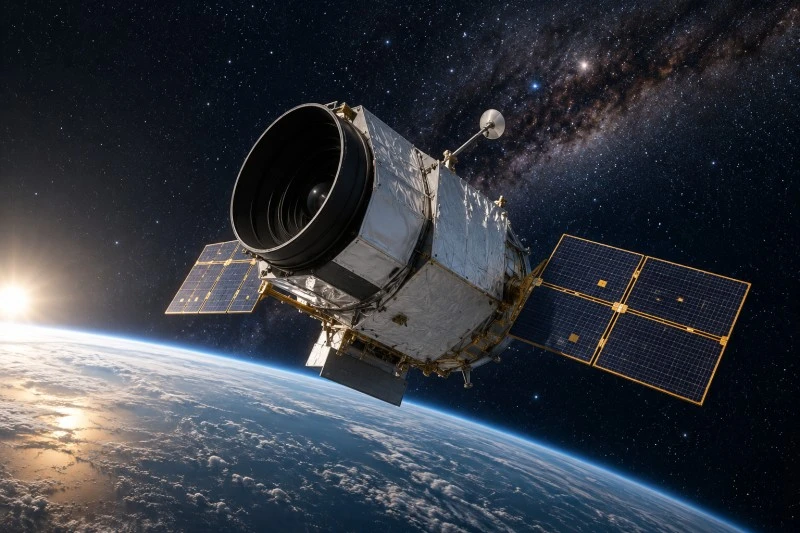
NASA’s successful launch of the Nancy Grace Roman Space Telescope has sent a roughly $4 billion scientific asset toward deep space, but the management lesson begins long before the observatory reaches its operating position. The mission shows how public institutions, specialized suppliers and commercial launch providers can coordinate decade-long technology programs when short-term revenue is not the primary measure of value.
The immediate story is astronomy. The larger business story is the architecture required to finance, build and operate frontier infrastructure. For CEOs, CTOs, investors and deep-tech founders, Roman offers a live case study in long-horizon capital allocation, government procurement and capability creation.
Boardroom Briefing
- Roman Mission: NASA launched the roughly $4 billion Roman Space Telescope aboard a SpaceX Falcon Heavy from Kennedy Space Center on August 30, 2026.
- Wide-Field Capability: Roman is designed to map more than two billion galaxies and survey the universe at a scale that complements Hubble and the James Webb Space Telescope.
- Industrial Partners: NASA identifies BAE Systems, L3Harris Technologies and Teledyne Scientific & Imaging as primary industrial partners on the mission.
- Commercial Launch Model: SpaceX provided the Falcon Heavy launch, demonstrating how government science missions increasingly rely on commercially operated infrastructure.
- Capital Discipline: Roman’s development illustrates why frontier technology programs must be evaluated through capability creation and strategic optionality, not near-term revenue alone.
- Enterprise Opportunity: The strongest commercial opportunities may emerge around advanced components, scientific data processing, specialized manufacturing and mission infrastructure rather than the spacecraft itself.
Roman’s $4 Billion Launch Is Really a Test of Long-Horizon Technology Strategy
The Nancy Grace Roman Space Telescope is a case study in how organizations can sustain large-scale technology investment when financial returns are indirect, delayed and difficult to quantify.
Reuters reports that NASA’s new flagship observatory carries a project cost of roughly $4 billion, while other contemporary reporting places the figure at approximately $4.3 billion. Roman will study dark energy, dark matter, gravity and exoplanets from the Sun-Earth Lagrange Point 2, about one million miles from Earth. Its initial mission is planned for five years, with the possibility of extension depending on fuel reserves.
That timeline is central to the executive lesson. A conventional corporate investment committee would normally demand a clearer path from capital expenditure to revenue. A national scientific program operates differently. Its return can include strategic knowledge, industrial capability, supplier development, talent accumulation and future technology options.
The business question is not whether every company should fund its own version of Roman. It is whether leadership teams have frameworks sophisticated enough to distinguish a poorly disciplined long-term investment from a strategically necessary one.
That distinction matters for leaders assessing long-term capital allocation in AI infrastructure, quantum computing, advanced energy, semiconductors and aerospace. Roman demonstrates that some technology programs must survive planning cycles that are far shorter than the value they are intended to create.
The Economics Behind a Flagship Scientific Infrastructure Program
The economics of Roman are based on strategic capability creation rather than direct commercial revenue, making traditional ROI analysis insufficient on its own.
NASA is not launching Roman to generate subscription revenue or sell access to a proprietary service. The mission’s value proposition is scientific output. Yet the program still creates significant economic activity through engineering contracts, component manufacturing, launch procurement and mission operations.
The critical executive insight is that not all capital-intensive infrastructure should be judged by one financial horizon. A deep-tech investment can be strategically valuable when it produces capabilities that support multiple future applications, even if the first application has no immediate commercial model.
Roman also demonstrates why public investment can influence private markets without guaranteeing private profits. Government spending can create technically demanding customer requirements that push suppliers to build new capabilities. Companies then carry those capabilities into later contracts and markets.
The danger is using “strategic importance” as an excuse for weak capital discipline. Long-horizon projects still require measurable decision gates. Leaders should track technology readiness, schedule performance, supplier concentration, mission risk and the development of reusable capabilities.
Patient capital is not the absence of accountability. It is accountability designed around the actual development cycle of the technology.
How NASA Turned a Decades-Long Scientific Vision Into an Industrial Program
Roman reached launch because NASA converted a long-term scientific objective into a distributed industrial program with defined institutional and supplier roles.
Program Leadership and Institutional Alignment
NASA’s Roman program is managed through a network of government, research and scientific institutions. That model reflects a broader reality of frontier technology: no single organization necessarily owns every critical capability.
Large programs need alignment across scientific priorities, engineering requirements, budgets, launch schedules and operational readiness. The leadership challenge is maintaining continuity while individual institutions and political priorities change.
Roman’s journey also shows the vulnerability of long-cycle projects to budget shifts. Reuters reported that the telescope survived previous attempts to eliminate its funding, illustrating why executive sponsors of major technology programs need both technical and institutional resilience.
Specialized Suppliers and Risk Distribution
NASA identifies BAE Systems, L3Harris Technologies and Teledyne Scientific & Imaging as primary industrial partners for Roman.
That supplier structure offers a practical lesson in aerospace supply chain management. Complex systems distribute technical risk across organizations with highly specialized capabilities. The trade-off is greater coordination complexity.
A CEO assessing a similar deep-tech program should ask:
- Which capabilities are strategically differentiated?
- Which suppliers represent single points of failure?
- Can critical components be sourced or manufactured elsewhere?
- Does the project create proprietary capabilities that remain valuable after the initial contract ends?
Those questions matter as much in enterprise AI hardware and semiconductor manufacturing as they do in space.
Why Government Procurement Can Function as Deep-Tech Market Creation
Government procurement strategy can create demand for technologies before a broad commercial market is mature.
NASA’s procurement role is especially important because the mission requires suppliers to meet specifications that ordinary commercial customers may not yet demand. The public sector becomes an anchor customer for technically difficult work.
That does not mean every government contract creates a viable market. The strongest opportunities emerge when suppliers can adapt the capabilities built for public programs into adjacent applications.
For founders pursuing deep-tech investment strategy, that distinction should shape fundraising. A government contract may validate technical capability, but investors should still ask whether the technology has a second and third market.
Roman’s Real Technology Asset May Be the Data Infrastructure It Creates
Roman’s wide-field observations will generate scientific data at a scale that makes data processing and interpretation a strategic capability alongside the telescope hardware itself.
NASA describes Roman as a wide-field infrared observatory designed to study some of the universe’s largest questions. Its field of view is more than 100 times larger than Hubble’s, while Reuters reports that the mission aims to map more than two billion galaxies.
The executive parallel is clear: data generation is not the same as value creation.
A high-volume data system requires processing infrastructure, storage, quality control, analytical tools and skilled users who can turn observations into decisions. This is where Roman intersects conceptually with AI infrastructure investment.
The commercial implications should not be overstated. NASA’s science mission is not a direct AI infrastructure business. But the mission illustrates a wider technology principle: when the volume and complexity of data increase, the systems needed to process that information become strategically important.
Roman’s data is also intended to become publicly available after processing, according to NASA’s mission materials. The value of such infrastructure can extend through the research and analytical capabilities that others build around it.
The Myth of Immediate ROI Is Distorting How Leaders Evaluate Frontier Technology
Frontier technology should not be judged solely by immediate revenue because its highest-value returns may come from future capabilities, but strategic optionality must still be measurable.
The common corporate mistake is to apply short-cycle software metrics to long-cycle hardware and research programs. That can produce two failures.
The first is underinvestment. Organizations cancel technically important projects because the financial payoff is too distant. The second is the opposite: leaders continue funding weak projects because the investment has been described as strategically essential.
Roman points toward a more disciplined framework. Leaders should separate:
- Direct returns: Revenue, margin and contract growth.
- Capability returns: New engineering, manufacturing or software competencies.
- Strategic returns: Reduced dependency on external suppliers or improved access to critical technologies.
- Option value: Future markets made possible by capabilities that do not yet have an immediate customer base.
A project should not survive because its mission sounds ambitious. It should survive when its leadership can explain what capability is being built, what evidence demonstrates progress and what future decisions that capability enables.
That is the practical test for technology investment trends that involve unusually long development cycles.
SpaceX and Roman Show How Public Missions Are Reshaping the Commercial Space Stack
Roman’s Falcon Heavy launch shows how commercial providers can become strategic infrastructure suppliers to government science missions.
SpaceX launched Roman from Kennedy Space Center, placing a commercial company at the center of a major NASA science mission.
Government as Anchor Customer
Government agencies can provide a base level of demand for technically complex infrastructure. That demand can help companies develop operational experience and invest in capacity.
The strategic implication for investors is significant. A government customer can reduce early market uncertainty, but it can also create concentration risk. A company dependent on one public procurement program remains exposed to political and budget cycles.
Private Launch Infrastructure as a Strategic Utility
Commercial space technology increasingly depends on infrastructure that other organizations can access rather than build independently.
That changes the economics of participation. A research institution can focus on a spacecraft or instrument rather than developing an entire launch capability. Startups can similarly concentrate on differentiated technologies while purchasing transportation and other services.
The same model is visible in cloud computing and AI. Organizations increasingly buy foundational infrastructure from specialized providers and compete on the capabilities they build above it.
Roman reinforces a broader investment thesis: the infrastructure provider may capture durable value even when the end application changes.
The Enterprise Playbook for Investing in Long-Cycle Deep Technology
Leaders should evaluate long-cycle technology investments through a structured framework that combines financial discipline with strategic capability measurement.
The Roman mission suggests seven practical questions:
- Time horizon: Is the investment being evaluated against a realistic development cycle?
- Strategic optionality: What future products, markets or capabilities could the project enable?
- Supply-chain concentration: Which specialized suppliers could delay or jeopardize the program?
- Data ownership: Who controls the information generated by the infrastructure, and what rights create future value?
- Public funding exposure: Could political or budget changes materially alter the investment case?
- Commercialization pathways: Is there a credible market beyond the original customer or mission?
- Talent accumulation: Does the program create scarce expertise that strengthens the organization after the initial project ends?
A practical governance model should review these factors at predetermined milestones rather than waiting for a final financial outcome. The right question is not “Has the investment paid off yet?” but “Has the investment created the capabilities we expected at this stage?”
Executive Outlook: The Next Space Economy Opportunity May Sit Beyond the Spacecraft
The most important commercial opportunities created by missions like Roman may emerge in the technologies required to build, operate and analyze advanced scientific infrastructure.
The telescope itself is the headline. The broader business activity sits around the specialized components, engineering talent, launch capacity and data systems that make the mission possible.
For founders, this creates an important strategic filter. The best opportunity may not be to compete directly with a national space program. It may be to identify a capability with demand across multiple missions and industries.
For investors, the same logic favors companies with reusable technical assets over businesses dependent on a single headline project. For corporate leaders, Roman offers a reminder that infrastructure investments often create value gradually and unevenly.
NASA expects Roman’s first science images in early 2027, according to mission information released ahead of launch.
The business lesson is already visible. Infrastructure creates economic activity before it produces a conventional revenue model. The organizations best positioned to benefit from that activity are often those that recognize where the most transferable capabilities are being built.