
Entrepreneurship & Business Innovation in 2026

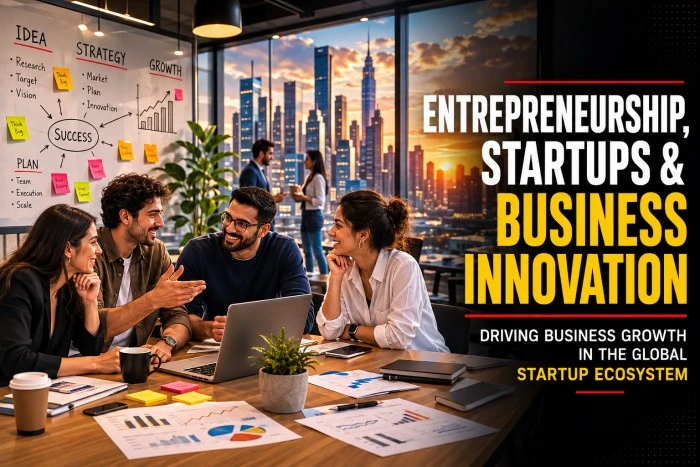
Innovation has always shaped the future of business, but the rules of entrepreneurship are changing faster than ever. Advances in artificial intelligence, digital technologies, and changing consumer expectations are creating new opportunities for founders while increasing competition across every industry. As a result, Entrepreneurship, Startups & Business Innovation have become central to economic growth, technological progress, and long-term business success.
Today’s startups are doing much more than launching new products. They are redefining industries, improving customer experiences, solving complex global challenges, and creating entirely new markets. From fintech and healthcare to climate technology and enterprise software, entrepreneurs are using innovation to build businesses that can scale rapidly and compete on a global stage.
At the same time, investors are becoming more selective. Access to startup funding and venture capital remains strong, but funding now depends on more than a great idea. Investors want to see sustainable business models, clear market demand, experienced leadership, and measurable growth. Companies that can combine innovation with disciplined execution are attracting the greatest attention from customers and investors alike.
For business leaders, entrepreneurs, and aspiring founders, understanding how the startup ecosystem is evolving has never been more important. Success today depends on identifying emerging opportunities, adapting quickly to market changes, and building organizations capable of continuous innovation.
Why Entrepreneurship Is Entering a New Growth Phase
The barriers to starting a business have fallen dramatically over the past decade. Cloud computing, AI-powered software, digital payment platforms, and remote collaboration tools have made it possible for entrepreneurs to launch companies with fewer resources than ever before.
Instead of requiring significant upfront investment, many founders can now validate business ideas, build products, and reach customers globally using affordable digital platforms. This has accelerated the pace of innovation while making entrepreneurship more accessible to people from diverse backgrounds.
However, greater accessibility also means greater competition. Thousands of new startups enter the market every year, making differentiation one of the biggest challenges for modern entrepreneurs. Building a successful company now requires more than technical expertise. Founders must understand customer behavior, market positioning, branding, operational efficiency, and long-term business strategy.
The most successful entrepreneurs focus on solving meaningful problems rather than simply following trends. Businesses that create genuine customer value are far more likely to achieve sustainable business growth than those built around short-term market opportunities.
Innovation Is the Competitive Advantage
Every successful startup shares one common characteristic: innovation. While innovation is often associated with breakthrough technology, it can also involve improving existing products, simplifying customer experiences, or developing more efficient business models.
Across the global startup ecosystem, innovation is driving growth in sectors such as:
- Artificial Intelligence and Automation
- FinTech and Digital Payments
- HealthTech
- Climate Technology
- Cybersecurity
- Software as a Service (SaaS)
- E-commerce
- Creator Economy Platforms
These industries continue to attract entrepreneurs because they solve real-world problems while offering strong opportunities for expansion.
Innovation should never be viewed as a one-time achievement. The fastest-growing startups constantly gather customer feedback, improve their products, adopt new technologies, and refine their business strategies. Continuous innovation enables businesses to remain competitive even as customer expectations and market conditions evolve.
Startup Funding Is Becoming More Strategic
Securing startup funding remains one of the biggest milestones for any entrepreneur. Although global investment continues to support high-potential businesses, investors have become increasingly focused on long-term sustainability rather than rapid expansion alone.
Today’s founders have access to multiple funding options, including bootstrapping, angel investors, seed funding, crowdfunding, strategic partnerships, and venture capital. Each funding stage serves a different purpose, but all require founders to demonstrate strong leadership, financial discipline, and a scalable business model.
Modern investors typically evaluate startups based on several key factors:
- Product-market fit
- Revenue potential
- Customer acquisition strategy
- Leadership capability
- Market opportunity
- Operational efficiency
- Long-term scalability
Companies that combine innovative thinking with disciplined execution are significantly more likely to attract investment and achieve sustainable business growth.
As competition increases across industries, entrepreneurs who build resilient businesses rather than chasing rapid expansion will be better positioned to succeed in the years ahead.
The Role of Venture Capital in Fueling Startup Innovation
For many startups, securing venture capital is more than just raising money—it’s about gaining access to strategic guidance, industry expertise, and valuable business networks. While funding enables companies to accelerate growth, experienced investors often help founders refine their business models, expand into new markets, and build sustainable organizations.
Over the past few years, the venture capital landscape has become more disciplined. Investors are placing greater emphasis on profitability, operational efficiency, and long-term value creation instead of funding growth at any cost. This shift encourages entrepreneurs to build stronger businesses before seeking external investment.
Successful startups typically progress through several funding stages:
- Bootstrapping
- Angel Investment
- Seed Funding
- Series A Funding
- Growth Capital
- Late-Stage Venture Capital
Each stage requires different milestones, from validating a business idea to demonstrating customer traction, recurring revenue, and scalable operations.
Founders who understand investor expectations are better equipped to secure funding while maintaining greater control over their company’s long-term vision.
Building a Startup That Can Scale
Launching a startup is only the beginning. The real challenge lies in transforming an early-stage business into a company capable of sustained growth.
Scaling successfully requires more than increasing sales. It demands careful planning, operational excellence, and the ability to adapt as markets evolve. Businesses that grow too quickly without strong foundations often struggle with cash flow, hiring, customer retention, and operational complexity.
Successful startups typically focus on five key growth drivers:
1. Solving a Real Customer Problem
Every successful business begins with understanding customer needs. Entrepreneurs who continuously gather feedback and improve their products are far more likely to build lasting businesses than those focused solely on acquiring new customers.
2. Developing a Scalable Business Model
A scalable business model enables companies to increase revenue without proportionally increasing costs. Software-as-a-Service (SaaS), subscription platforms, digital marketplaces, and cloud-based businesses are strong examples of scalable models that have transformed industries.
3. Investing in the Right Team
Founders cannot build successful companies alone. Hiring talented people, creating a strong organizational culture, and empowering employees to innovate are essential ingredients for long-term success.
Great companies are built by great teams—not just great founders.
4. Leveraging Technology
Technology has become a competitive advantage for startups across every industry. Artificial intelligence, automation, cloud computing, and data analytics help businesses improve efficiency, personalize customer experiences, and make faster, data-driven decisions.
Companies that embrace digital transformation early are often better positioned to outperform competitors.
5. Staying Customer-Centric
Customer expectations continue to evolve. Businesses that prioritize exceptional customer experiences, transparency, and continuous improvement are more likely to strengthen loyalty and generate repeat business.
Long-term growth is built on trust, not transactions.
Startup Ecosystems Are Creating Global Opportunities
The global startup ecosystem has expanded significantly over the last decade, creating new opportunities for entrepreneurs regardless of geography. Cities such as Silicon Valley, London, Singapore, Bengaluru, Dubai, and Tel Aviv have become innovation hubs, attracting founders, investors, accelerators, and multinational corporations.
However, innovation is no longer limited to established technology centers. Remote work, cloud infrastructure, and digital collaboration have enabled startups to build global businesses from almost anywhere.
Governments are also playing an increasingly active role by supporting entrepreneurship through innovation grants, startup incubators, tax incentives, and public-private partnerships. These initiatives encourage research, technology adoption, and job creation while strengthening national innovation ecosystems.
As access to capital, talent, and technology continues to improve, entrepreneurs have more opportunities than ever to compete in international markets.
Learning from the World’s Most Successful Startups
Many of today’s leading global companies started with a simple idea and a willingness to challenge conventional thinking.
Companies such as Airbnb, Stripe, Shopify, Canva, Notion, and OpenAI demonstrate how innovation, customer focus, and continuous improvement can transform startups into globally recognized brands.
Despite operating in different industries, these businesses share several characteristics:
- They solved meaningful customer problems.
- They embraced innovation from the beginning.
- They invested heavily in product development.
- They built scalable business models.
- They adapted quickly to changing market conditions.
- They maintained a clear long-term vision.
Their success highlights an important lesson for aspiring entrepreneurs: sustainable growth is rarely the result of a single breakthrough. It comes from consistent execution, strategic leadership, and the ability to evolve as markets change.
Entrepreneurship Is Becoming More Technology-Driven
Artificial intelligence, automation, machine learning, and predictive analytics are reshaping how entrepreneurs build and scale businesses. Founders now have access to tools that improve productivity, automate repetitive tasks, analyze customer behavior, and accelerate decision-making.
Rather than replacing entrepreneurs, these technologies enable them to focus more on innovation, strategic planning, and customer relationships.
As AI adoption continues to accelerate, startups that successfully combine human creativity with advanced technology will be better positioned to lead the next generation of business innovation.
The Future of Entrepreneurship, Startups & Business Innovation
The future of Entrepreneurship, Startups & Business Innovation will be shaped by technologies that are transforming how businesses are created, managed, and scaled. Artificial intelligence, automation, blockchain, cloud computing, and data analytics are no longer reserved for large enterprises. They have become accessible tools that enable startups to compete globally from day one.
As digital adoption accelerates, entrepreneurs will need to focus on building businesses that are agile, customer-centric, and resilient. The companies that succeed over the next decade will not necessarily be the ones with the largest budgets—they will be the ones that innovate continuously, make informed decisions using data, and respond quickly to changing market conditions.
Sustainability will also become a defining factor. Customers, investors, and governments increasingly expect businesses to operate responsibly, making environmental, social, and governance (ESG) principles an important part of long-term business strategy. Startups that integrate sustainability into their products, operations, and company culture will be better positioned to earn trust and create lasting value.
Challenges Every Entrepreneur Must Prepare For
While opportunities are expanding, building a successful startup has never been more competitive. Entrepreneurs must overcome a range of challenges before achieving sustainable growth.
Access to Capital
Although funding opportunities continue to grow, raising capital remains difficult for many early-stage startups. Investors are increasingly selective, expecting founders to demonstrate product-market fit, revenue potential, and a clear path to profitability before committing funds.
Intense Market Competition
Lower barriers to entry mean new startups are entering the market every day. Standing out requires more than an innovative product—it demands a compelling brand, exceptional customer experience, and consistent execution.
Rapid Technological Change
Emerging technologies continue to reshape industries at an unprecedented pace. Entrepreneurs who fail to adapt risk falling behind competitors that embrace innovation and digital transformation.
Talent Acquisition and Retention
Hiring skilled professionals remains one of the biggest challenges for growing startups. Building a strong workplace culture, investing in employee development, and creating opportunities for career growth are essential for attracting and retaining top talent.
Scaling Operations
Many startups struggle when transitioning from early success to large-scale operations. Expanding into new markets, maintaining quality, managing cash flow, and preserving company culture require careful planning and disciplined leadership.
Recognizing these challenges early allows entrepreneurs to develop stronger strategies and build businesses that are prepared for long-term success.
Five Leadership Lessons from Successful Entrepreneurs
Every successful founder follows a different path, but the world’s leading entrepreneurs share several common principles.
Start with the customer, not the product.
The best businesses solve meaningful problems and create genuine value rather than chasing short-term trends.
Think long term.
Sustainable companies prioritize strategic growth instead of focusing solely on rapid expansion.
Embrace innovation continuously.
Markets evolve quickly, and businesses that consistently improve their products and services remain competitive.
Build great teams.
Strong leadership is about empowering talented people, encouraging collaboration, and creating a culture of accountability.
Stay adaptable.
Economic conditions, customer preferences, and technology will continue to change. Entrepreneurs who remain flexible are better equipped to seize new opportunities and navigate uncertainty.
These principles have helped countless startups grow into globally recognized companies and continue to guide successful entrepreneurs across industries.
Key Takeaways
The landscape of Entrepreneurship, Startups & Business Innovation is evolving rapidly, creating exciting opportunities for founders, investors, and business leaders. While technology is accelerating change, long-term success still depends on solving real problems, understanding customer needs, and executing a clear business strategy.
Some of the most important insights include:
- Innovation remains the foundation of successful startups.
- Strong leadership is just as important as a great business idea.
- Startup funding and venture capital require disciplined planning and measurable growth.
- A healthy startup ecosystem provides entrepreneurs with access to capital, mentorship, technology, and talent.
- Businesses that embrace digital transformation and continuous learning will be better positioned for future growth.
Conclusion
Entrepreneurship, Startups & Business Innovation are reshaping the global economy and creating new opportunities across every industry. From groundbreaking business ideas to billion-dollar startups, the companies leading tomorrow’s markets are those willing to challenge conventional thinking, embrace innovation, and build with purpose.
While access to startup funding, venture capital, and advanced technologies has made entrepreneurship more accessible than ever, sustainable business growth still depends on disciplined execution, customer-focused innovation, and visionary leadership.
For entrepreneurs, investors, and business leaders, the message is clear: the future belongs to organizations that learn continuously, adapt quickly, and innovate with confidence. In an increasingly competitive world, lasting success will come not from following change—but from creating it.