
Why the James Watt BrewDog Buyback Matters

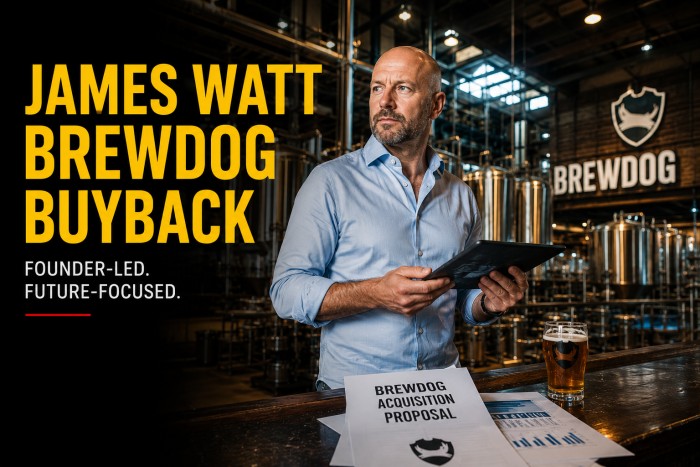
The James Watt BrewDog Buyback has emerged as one of the most talked-about business developments in the craft beer industry. Nearly two decades after co-founding BrewDog and helping transform it from a small Scottish brewery into a globally recognized brand, James Watt is attempting to regain ownership following the company’s financial collapse and acquisition by Tilray.
However, this story is about far more than a change in ownership. The James Watt BrewDog Buyback represents a broader conversation about founder leadership, business resilience, investor confidence, and whether an entrepreneur can successfully rebuild trust after a company experiences significant financial and operational setbacks.
For CEOs, founders, and investors, the situation offers valuable lessons on scaling a business, managing rapid growth, and protecting stakeholder relationships. It also raises an important question: Can the return of a founder become the catalyst for a successful corporate turnaround?
Why the James Watt BrewDog Buyback Matters
Founder-led buybacks are relatively uncommon, particularly when the business has already undergone financial restructuring and changed ownership. When they do occur, they often attract attention because they combine financial strategy with leadership vision.
The James Watt BrewDog Buyback is unique because it aims not only to recover ownership but also to reconnect with the community that helped fuel BrewDog’s rise. During its growth years, BrewDog built a loyal base of retail investors through its “Equity for Punks” crowdfunding model, allowing thousands of supporters to become shareholders.
That community-first approach became one of BrewDog’s defining strengths. Customers were no longer simply purchasing products—they were investing in the company’s long-term vision.
Following BrewDog’s financial collapse, many of those investors lost the value of their investments. By proposing that former participants could regain equivalent ownership if the acquisition succeeds, Watt has introduced a leadership narrative centered on rebuilding confidence rather than simply reclaiming control.
Whether the proposal ultimately succeeds or not, it highlights how trust can become one of the most valuable assets in any business transformation.
James Watt BrewDog Buyback and Founder-Led Leadership
History has shown that founders often maintain a unique connection with the companies they create. Their understanding of the brand, customer community, and original vision can become a strategic advantage during periods of uncertainty.
The James Watt BrewDog Buyback reflects this principle. Rather than viewing BrewDog solely as a financial asset, the proposal suggests an effort to reconnect the business with its entrepreneurial roots and rebuild the culture that originally differentiated it within the competitive craft beer market.
Founder-led returns have shaped the success stories of several global companies.
Steve Jobs returned to Apple during one of the company’s most challenging periods, helping transform it into one of the world’s most valuable technology businesses. Howard Schultz resumed leadership at Starbucks to strengthen operations and restore customer experience during periods of slowing performance. More recently, several technology founders have returned to guide their organizations through changing market conditions and strategic transitions.
While every business operates under different circumstances, these examples demonstrate that founders can provide continuity, long-term vision, and decisive leadership when organizations face disruption.
For BrewDog, the challenge is not simply restoring ownership—it is rebuilding confidence among employees, customers, investors, and business partners.
Business Lessons from the James Watt BrewDog Buyback
The BrewDog story provides valuable insights for organizations across industries.
Rapid expansion can create impressive growth, but it also increases operational complexity. As companies enter new markets, expand production, and scale internationally, leadership must ensure that financial discipline keeps pace with ambition.
Many businesses focus heavily on customer acquisition and revenue growth while underestimating the importance of sustainable cash flow, operational efficiency, and corporate governance.
The James Watt BrewDog Buyback reminds executives that long-term success depends on balancing entrepreneurial ambition with disciplined execution.
Strong brands alone cannot protect businesses from financial challenges. Sustainable organizations are built through effective leadership, prudent investment decisions, resilient operations, and transparent communication with stakeholders.
These principles apply far beyond the beverage industry. Whether operating in technology, healthcare, retail, manufacturing, or financial services, organizations face similar challenges when transitioning from rapid growth to long-term sustainability.
The Current Industry Situation
The global craft beer industry has evolved significantly over the past decade.
Consumers continue to seek premium products and authentic brand experiences, but breweries are also navigating rising production costs, supply chain pressures, changing consumer preferences, and increasing competition from both multinational beverage companies and independent producers.
At the same time, investors are placing greater emphasis on profitability, operational efficiency, and long-term financial resilience rather than growth at any cost.
Against this backdrop, the James Watt BrewDog Buyback reflects a broader shift occurring across multiple industries.
Businesses are increasingly recognizing that sustainable growth requires more than bold marketing and rapid expansion. It demands disciplined leadership, financial responsibility, and the ability to maintain stakeholder trust through periods of uncertainty.
As BrewDog enters another pivotal chapter, executives across industries will be watching closely—not simply to see whether ownership changes, but to understand what the outcome reveals about founder-led turnarounds in today’s business environment.