
European Central Bank Outlook 2026: What Businesses Should Know About Interest Rates and Inflation

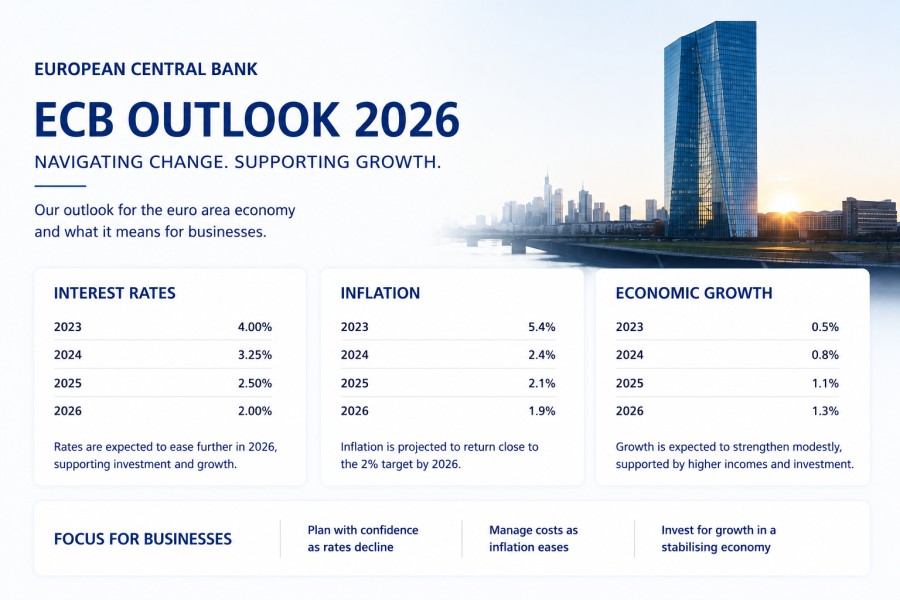
The European Central Bank Outlook 2026 has become one of the most closely watched topics for business leaders, investors, and policymakers across Europe. After raising interest rates in June to counter renewed inflationary pressures, the European Central Bank (ECB) is navigating a difficult balance between controlling prices and supporting economic growth.
Inflation has eased in several major eurozone economies, particularly as energy prices have moderated, but uncertainty remains high. Geopolitical tensions, global supply chain risks, and fluctuating energy markets continue to shape the ECB’s policy decisions, making monetary policy a critical factor for businesses planning investments, managing financing costs, and preparing for future market conditions.
For executives, this is not simply a discussion about interest rates—it is about understanding how monetary policy influences borrowing, consumer demand, corporate investment, and long-term competitiveness.
Why the European Central Bank Matters
The European Central Bank is responsible for maintaining price stability across the euro area. Its primary objective is to keep inflation close to its medium-term target while supporting financial stability throughout the region.
One of its most influential tools is the adjustment of key interest rates.
When inflation rises significantly above target, the ECB may increase interest rates to reduce demand, slow price growth, and anchor inflation expectations. Conversely, when economic activity weakens, lower interest rates can encourage borrowing, investment, and consumer spending.
Because of this role, every ECB policy decision affects far more than financial markets. Changes in interest rates influence:
- Business investment decisions
- Corporate borrowing costs
- Mortgage rates
- Consumer confidence
- Employment
- Exchange rates
- Capital markets
- International trade
For business leaders, understanding the European Central Bank Outlook 2026 is essential for making informed strategic decisions.
The ECB’s Latest Interest Rate Decision
In June 2026, the ECB raised its key interest rates by 25 basis points—the first increase in nearly three years—in response to rising inflation driven largely by higher energy costs and geopolitical uncertainty. Policymakers emphasized that the move was necessary to prevent temporary energy shocks from becoming broader and more persistent inflation across the eurozone economy.
However, the central bank has also made clear that future decisions will remain data-dependent.
Recent inflation figures from Germany, France, and Italy indicate that headline inflation cooled more than expected during June, largely because energy prices declined. This has reduced the urgency for another immediate rate increase, although ECB officials continue to stress that they remain prepared to act if inflationary pressures return.
Rather than committing to a fixed path, the ECB is maintaining flexibility as economic conditions evolve.
Inflation Is Improving—but Risks Remain
Recent data offers encouraging signs that inflation across the eurozone is beginning to moderate.
France’s inflation has moved close to the ECB’s target, Germany has reported lower headline inflation, and energy prices have fallen from recent highs. These developments have eased immediate concerns that inflation could accelerate further during the summer.
Nevertheless, policymakers remain cautious.
Core inflation—which excludes volatile food and energy prices—has proven more persistent than headline inflation. At the same time, geopolitical tensions and uncertainty surrounding global energy supplies continue to pose risks to future price stability.
This combination explains why the ECB continues to describe its approach as data-driven, evaluating each policy meeting based on the latest economic evidence rather than following a predetermined schedule.
Why Business Leaders Should Pay Attention
Many executives view central bank decisions as issues primarily for economists or financial institutions.
In reality, ECB policy directly shapes the business environment.
Higher interest rates increase borrowing costs for companies, influence capital investment decisions, affect consumer purchasing power, and can alter expansion strategies across industries.
Businesses that rely on financing for growth, infrastructure, acquisitions, or innovation often experience the effects of monetary policy well before they appear in broader economic indicators.
Even companies with limited debt are affected through changing customer demand, supplier financing costs, labour markets, and investor sentiment.
For this reason, the European Central Bank Outlook 2026 has become a strategic consideration for CEOs, CFOs, entrepreneurs, and investors across Europe.
A Delicate Balance Between Inflation and Growth
The ECB’s greatest challenge today is balancing two competing priorities.
On one side is the need to maintain price stability by preventing inflation from becoming entrenched across the economy.
On the other is the responsibility to avoid slowing economic growth unnecessarily through overly restrictive monetary policy.
Recent easing in inflation has given policymakers greater flexibility, but economic uncertainty remains elevated. Energy prices, geopolitical developments, and global trade conditions could all influence future inflation trends over the coming months.
As a result, businesses should expect monetary policy to remain cautious, flexible, and highly responsive to incoming economic data rather than predictable or automatic.
How Higher Interest Rates Affect Businesses
The European Central Bank Outlook 2026 is not only shaping financial markets—it is directly influencing business strategy across the eurozone. From multinational corporations to small and medium-sized enterprises (SMEs), higher interest rates are changing how organizations borrow, invest, and plan for future growth.
When financing becomes more expensive, companies typically become more selective with capital expenditure. Expansion projects, acquisitions, equipment upgrades, and new hiring initiatives often undergo greater scrutiny as businesses seek to preserve cash flow and maintain profitability.
Industries that rely heavily on borrowing—such as real estate, construction, manufacturing, and infrastructure—are particularly sensitive to changes in interest rates. Higher financing costs can delay investments, reduce project viability, and place additional pressure on operating margins.
However, businesses with strong balance sheets and disciplined financial management are often better positioned to navigate tighter monetary conditions than competitors carrying higher debt levels.
The Impact on Consumers and Spending
Monetary policy affects households just as much as businesses.
Higher interest rates generally increase the cost of mortgages, personal loans, and consumer credit, leaving many households with less disposable income. As borrowing becomes more expensive, consumer spending often slows, especially on discretionary purchases such as travel, luxury goods, electronics, and home improvements.
For retailers, hospitality businesses, and consumer brands, this shift can translate into weaker demand and changing purchasing behavior.
Consumers increasingly prioritize:
- Essential spending
- Value for money
- Discounts and promotions
- Long-term affordability
- Financial security
Businesses that understand these changing priorities are better equipped to adapt their pricing strategies, product offerings, and customer experiences.
Investors Are Closely Watching the ECB
Financial markets react quickly to signals from the European Central Bank.
Interest rate decisions influence:
- Stock market performance
- Bond yields
- Currency exchange rates
- Corporate valuations
- Investment sentiment
Even subtle changes in policy language can trigger significant market movements.
When investors believe interest rates may remain elevated for longer, equity markets often become more volatile as businesses face higher financing costs and slower earnings growth.
Conversely, expectations of future rate reductions can improve investor confidence by supporting economic activity and lowering borrowing expenses.
For institutional investors and corporate finance teams, monitoring central bank communication has become just as important as analyzing quarterly earnings.
Which Industries Could Benefit?
Although higher interest rates create challenges, they also present opportunities.
Financial institutions, including banks and certain insurance providers, often benefit from improved lending margins when rates increase.
Companies specializing in:
- Financial technology (FinTech)
- Treasury management
- Risk consulting
- Business intelligence
- Corporate restructuring
may also experience stronger demand as organizations seek greater financial efficiency and improved cash management.
Businesses offering cost-saving technologies, automation, artificial intelligence, and operational optimization solutions could see increased investment as companies focus on productivity rather than rapid expansion.
Periods of tighter monetary policy often accelerate innovation by encouraging organizations to operate more efficiently.
Leadership Strategies for Navigating Higher Interest Rates
The European Central Bank Outlook 2026 highlights the importance of proactive leadership during periods of economic uncertainty.
Rather than delaying decisions indefinitely, executives should focus on building resilience while preparing for multiple economic scenarios.
Strengthen Cash Flow Management
Maintaining healthy liquidity provides businesses with greater flexibility during periods of higher financing costs.
Organizations should regularly review working capital, supplier payment terms, inventory management, and operational expenses to improve financial resilience.
Prioritize High-Return Investments
When capital becomes more expensive, every investment decision carries greater importance.
Businesses should prioritize initiatives that deliver measurable improvements in productivity, efficiency, customer experience, or long-term profitability.
Projects with uncertain returns may require additional evaluation before proceeding.
Reduce Financial Risk
Companies with variable-rate debt should assess their exposure to future interest rate movements.
Where appropriate, refinancing, restructuring debt, or improving balance sheet strength may reduce long-term financial risk.
A disciplined capital structure provides greater stability during uncertain economic conditions.
Invest in Technology and Productivity
While borrowing costs have increased, digital transformation continues to deliver long-term competitive advantages.
Artificial intelligence, automation, cloud computing, and advanced analytics enable organizations to improve efficiency while controlling operating costs.
Businesses investing strategically in technology today are often better positioned to outperform competitors during future economic cycles.
What Executives Should Watch Next
Although recent inflation data has eased concerns across parts of the eurozone, uncertainty remains.
Business leaders should closely monitor several economic indicators over the coming months:
- Eurozone inflation trends
- Core inflation levels
- Economic growth forecasts
- Labour market conditions
- Consumer confidence
- Energy prices
- Global trade developments
- ECB policy communications
Together, these indicators will shape future monetary policy decisions and influence the broader business environment.
Organizations that remain informed and agile will be better prepared to respond to changing market conditions than those reacting only after policy decisions are announced.
Real-World Lessons from Previous Rate Cycles
History shows that periods of higher interest rates often reward businesses with disciplined financial management.
Companies that maintain strong balance sheets, invest selectively, and focus on operational excellence frequently emerge stronger once economic conditions stabilize.
Many of today’s leading global businesses expanded their market positions during previous periods of economic uncertainty by continuing to innovate while competitors reduced investment.
The lesson for executives is clear: uncertainty should encourage smarter decision-making—not strategic paralysis.
The European Central Bank Outlook 2026 reminds leaders that sustainable growth is built on resilience, adaptability, and disciplined execution rather than short-term market optimism.
Future Outlook: What Comes Next for the European Central Bank?
As inflation gradually moves closer to the European Central Bank’s medium-term target, financial markets are increasingly focused on one critical question: What comes next?
The answer is unlikely to be straightforward.
ECB policymakers have repeatedly emphasized that future decisions will remain data-dependent, meaning interest rates will be adjusted according to inflation, economic growth, labor market conditions, and broader financial stability rather than following a predetermined path.
If inflation continues to moderate while economic growth remains resilient, the ECB may choose to keep interest rates unchanged for an extended period before considering any future adjustments.
However, renewed geopolitical tensions, supply chain disruptions, or another surge in energy prices could quickly alter the inflation outlook and require further policy action.
For business leaders, flexibility—not prediction—should remain the foundation of strategic planning.
The Future of Inflation in Europe
Although headline inflation has slowed compared with previous years, several structural challenges continue to influence price stability across the eurozone.
Business leaders should continue monitoring:
- Energy market volatility
- Wage growth
- Global supply chain resilience
- Commodity prices
- Consumer demand
- International trade policies
- Geopolitical developments
These factors will largely determine whether inflation remains under control or reaccelerates during the second half of 2026.
The ECB’s objective is not simply reducing inflation—it is ensuring that price stability supports sustainable economic growth over the long term.
What Business Leaders Should Do Now
Rather than waiting for future monetary policy decisions, executives should strengthen their organizations today.
Focus on Financial Resilience
Maintaining healthy cash reserves and disciplined cost management provides organizations with greater flexibility during uncertain economic conditions.
Businesses with strong liquidity are generally better positioned to invest when opportunities arise.
Review Capital Investment Plans
Higher financing costs make capital allocation more important than ever.
Organizations should prioritize projects that improve:
- Productivity
- Operational efficiency
- Customer experience
- Digital capabilities
- Long-term profitability
Strategic investments with measurable business outcomes should take precedence over short-term expansion.
Continue Investing in Innovation
Periods of slower economic growth often separate innovative businesses from those that rely solely on favorable market conditions.
Artificial intelligence, automation, advanced analytics, cybersecurity, and digital transformation continue to create competitive advantages regardless of interest rate cycles.
Companies that invest wisely during uncertain periods frequently emerge stronger when economic conditions improve.
Monitor Monetary Policy Closely
Central bank decisions increasingly influence corporate strategy.
Finance teams should regularly assess how changes in interest rates affect:
- Borrowing costs
- Investment returns
- Customer demand
- Pricing strategies
- Currency exposure
- Capital planning
Treating monetary policy as a strategic business variable rather than simply a financial indicator enables better long-term decision-making.
Key Takeaways
The European Central Bank Outlook 2026 reflects a broader shift in the global economic landscape.
Inflation is gradually easing, but uncertainty remains.
Businesses can no longer assume prolonged periods of exceptionally low borrowing costs.
Instead, leaders should prepare for an environment where disciplined financial management, operational efficiency, and strategic agility become increasingly important competitive advantages.
Organizations that proactively strengthen resilience today will be better positioned to capitalize on tomorrow’s opportunities.
Conclusion
The European Central Bank Outlook 2026 is about much more than interest rates.
It represents one of the defining economic themes shaping investment decisions, corporate strategy, and business confidence across Europe.
For executives, entrepreneurs, and investors, the challenge is not predicting every future policy decision—it is building organizations capable of succeeding under a range of economic scenarios.
The most resilient businesses are those that adapt quickly, invest strategically, and maintain financial discipline even when market conditions become uncertain.
While inflation appears to be moderating and economic conditions are gradually stabilizing, the eurozone continues to face significant geopolitical and structural risks that could reshape monetary policy over the coming months.
Business leaders who remain informed, embrace innovation, and make decisions based on long-term fundamentals rather than short-term market sentiment will be better positioned to navigate whatever comes next.
As Europe enters a new phase of monetary policy, one principle remains constant:
The organizations that thrive are not those that react fastest to change—they are the ones that prepare for it before it arrives.